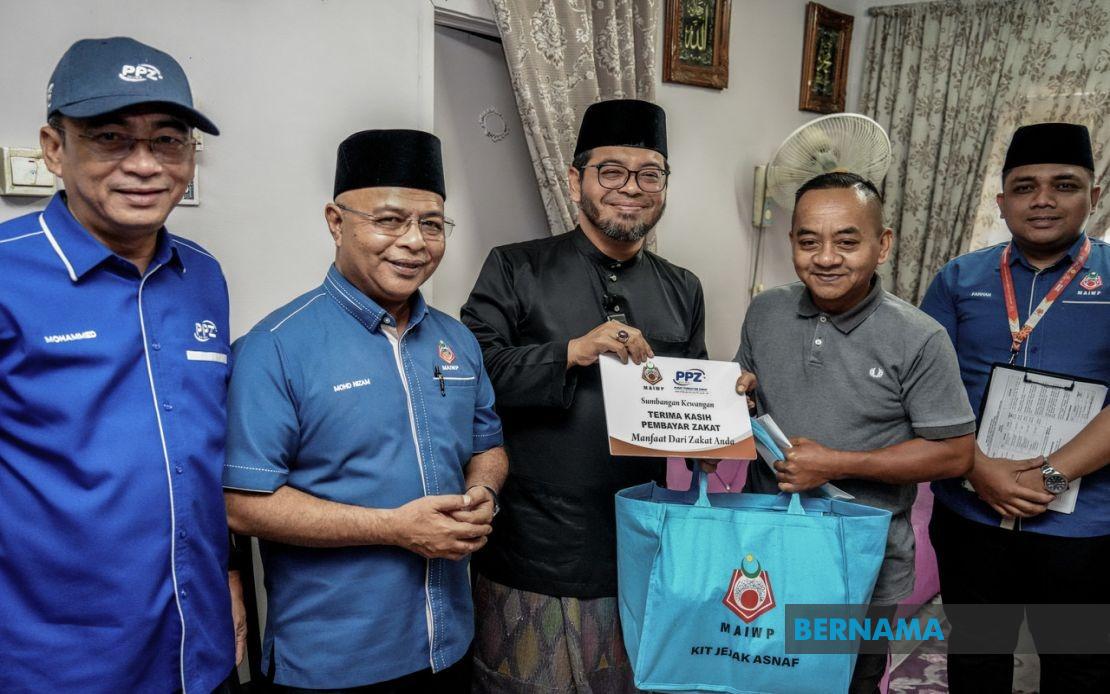
The Federal Territories Islamic Religious Council (MAIWP) has committed comprehensive financial support to a widow now solely responsible for five children ranging from six to 15 years old, following her husband's death earlier this month in Kuala Lumpur. The intervention comes as the family faces immediate hardship after losing their primary income earner, with MAIWP proposing a multi-faceted assistance scheme addressing accommodation costs, monthly living expenses, and educational needs.
Datak Dr Zulkifli Hasan, Minister in the Prime Minister's Department (Religious Affairs), emphasized the importance of direct field assessments in understanding beneficiaries' genuine circumstances. Through personal visits and ground-level engagement, MAIWP staff gain practical insight into household conditions and can tailor support packages that genuinely address recipients' most pressing concerns rather than applying generic solutions. This approach reflects a broader policy shift within Malaysia's welfare administration toward more responsive, needs-based assistance rather than standardized allocations.
The widow's family had previously accessed MAIWP's General Schooling Aid, a foundational programme designed to ease educational burdens for low-income households. With her husband's passing, however, the family's vulnerability intensified substantially. The new intervention significantly expands support to encompass rental assistance—a critical necessity given housing costs typically consume substantial portions of lower-income household budgets. Combined with bolstered schooling assistance and living expense allocations, the package aims to prevent the family's economic collapse during this transitional period.
Beyond this particular case, Zulkifli's office visit highlighted MAIWP's broader commitment to systematically supporting vulnerable families across the Federal Territories. A second family visited during the tour comprises a married couple managing eight school-going children on a single income from the father's employment as a Kuala Lumpur City Hall driver. Despite the household's size and modest income, this family receives targeted monthly medical assistance covering essential supplies like diapers and diabetic products, alongside wheelchair support and schooling aid—demonstrating how MAIWP calibrates assistance toward specific health and educational needs.
A third household receiving support exemplifies the challenges facing divorced and separated parents managing childcare responsibilities alone. This single mother, divorced since 2018, raises three school-attending children while navigating employment and household management without a partner's contribution. MAIWP provides her monthly living cost assistance, basic necessities provision, and schooling-related support, recognizing that single-parent households often face compounded financial strain from childcare expenses and reduced earning capacity when work commitments conflict with parental duties.
These cases reflect wider patterns within Malaysia's urban poor and lower-middle-income communities. Federal Territory residents facing sudden income loss through death, illness, or employment disruption often lack substantial savings or family safety nets, making formal assistance programmes crucial to preventing homelessness and educational disruption. The breadth of MAIWP's intervention—spanning medical needs, educational costs, housing, and basic living expenses—acknowledges that poverty and vulnerability are multidimensional challenges requiring comprehensive rather than partial responses.
As of August 12, 2026, MAIWP had distributed RM699.57 million cumulatively across its assistance initiatives, representing substantial ongoing commitment to Federal Territories residents. This funding represents both institutional capacity and sustained political prioritization of welfare provision within Malaysia's capital territory, where cost-of-living pressures and housing expenses significantly exceed national averages. The scale of expenditure underscores the genuine demand for assistance among Federal Territories households, many of whom contribute economically to the nation's capital yet struggle with basic living costs.
Zulkifli's framing of these interventions as part of broader community support measures reflects the government's positioning of welfare assistance as proactive social policy rather than reactive charity. The emphasis on understanding "actual circumstances" and ensuring assistance "met their needs" signals a departure from older bureaucratic models where aid qualification requirements sometimes prioritized administrative simplicity over genuine need assessment. For residents of Kuala Lumpur, Labuan, and Putrajaya, this approach potentially means more responsive, flexible support systems that adapt to individual household realities.
The systematic visitation programme itself carries significance beyond immediate aid distribution. By personally engaging with beneficiary families, senior government officials like Zulkifli gather real-world intelligence about welfare programme effectiveness, emerging vulnerabilities, and policy gaps that statistical reports alone might miss. These field encounters inform future policy refinement and resource allocation decisions, creating feedback loops between welfare recipients and high-level decision-makers that can improve programme design and targeting.
For Malaysian readers observing welfare administration debates, the MAIWP assistance cases illustrate how religious institutional structures continue playing substantive roles in poverty alleviation and social safety net provision. Beyond spiritual guidance, MAIWP operates as a significant welfare provider, complementing government programmes and reaching communities through religious networks and trust relationships. The widow's family case demonstrates how sudden, catastrophic income loss—though statistically less frequent than chronic poverty—remains a genuine vulnerability requiring responsive institutional capacity.
Looking forward, the combination of immediate relief for newly vulnerable families and ongoing support for chronically disadvantaged households suggests MAIWP's operational philosophy embraces both crisis response and structural poverty mitigation. As Malaysian urbanization continues and household vulnerabilities shift between economic cycles, the capacity of institutions like MAIWP to flexibly allocate resources while maintaining programme integrity becomes increasingly central to national social cohesion.

