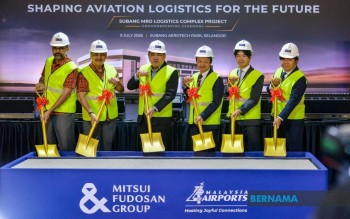
Malaysia Airports Holdings Bhd (MAHB) has forged a strategic partnership with Japan's Mitsui Fudosan Group to construct a RM80 million air cargo logistics complex at Subang Airport, signalling renewed momentum in developing the nation's aviation hub capabilities. The joint venture allocates MAHB a 30 per cent stake while Mitsui Fudosan retains 70 per cent ownership, with operations handled through MFMA Industrial Sdn Bhd, a specially formed entity combining the expertise of both partners.
Transport Minister Anthony Loke Siew Fook highlighted the deal as exemplifying MAHB's evolving strategy to unlock value from its substantial airport real estate holdings by partnering with globally experienced logistics operators. Speaking at the groundbreaking ceremony for the Subang maintenance, repair and overhaul (MRO) Logistics Complex Project, Loke noted that such collaborations allow the airport operator to concentrate on core aviation operations while leveraging external expertise to develop complementary commercial facilities.
Mitsui Fudosan's involvement brings considerable international pedigree to the initiative. The Tokyo-headquartered conglomerate has designed, built and managed numerous logistics complexes globally, including prominent facilities servicing Haneda Airport in Tokyo, one of Asia's busiest aviation gateways. This operational track record substantially reduces execution risks for the Malaysian project, as the developer brings proven methodologies for managing large-scale cargo and logistics operations integrated with active airport ecosystems.
The facility will be situated within Subang Aerotech Park, positioning it as a purpose-built industrial development specifically engineered to serve aviation and aerospace enterprises clustering around Subang Airport. This locational advantage is critical, as proximity to airport infrastructure, customs clearance facilities and air freight handling capabilities directly influences operational efficiency and cost competitiveness for logistics-dependent businesses. The complex thus represents more than a standalone commercial venture but rather a strategic node in Malaysia's broader aviation supply chain architecture.
Subang Airport's role as a secondary aviation hub presents particular opportunities for cargo-focused development. Unlike Kuala Lumpur International Airport (KLIA), which dominates passenger traffic and international long-haul operations, Subang has carved a niche in maintenance and repair services, charter operations and regional cargo movements. The new complex directly supports this positioning by creating integrated facilities where aircraft maintenance activities can coordinate with spare parts logistics, supporting services, and regional distribution functions. Such vertical integration enhances competitiveness against regional competitors, particularly as Southeast Asian economies increasingly fragment supply chains across multiple hubs.
The partnership structure itself reflects broader trends in Malaysian infrastructure development, where government-linked companies (in this case MAHB) increasingly adopt minority equity positions while ceding operational control to experienced private or foreign partners. This model allows MAHB to capture financial returns and maintain strategic oversight while transferring execution and management responsibilities to entities with specialised capabilities. For Mitsui Fudosan, the 70 per cent holding affords operational control and primary decision-making authority, aligning incentives for professional management.
From a regional perspective, this investment signals Malaysia's determination to compete for aviation-related investment amid intensifying competition from Thailand, Vietnam and Indonesia. Each nation is simultaneously upgrading airport infrastructure and ancillary facilities, recognising that cargo and logistics operations generate stable, employment-intensive revenue less vulnerable to cyclical passenger demand fluctuations. Malaysia's advantage lies in established infrastructure at Subang and KLIA, existing aerospace clusters and its position as a regional financial and trading centre, yet ongoing infrastructure improvements remain necessary to maintain competitive positioning.
The timing of this investment carries additional significance given Malaysia's broader economic diversification efforts. As the nation seeks to reduce dependence on traditional sectors, aviation-related industries offer attractive prospects given their capital intensity, technical skill requirements and integration into high-value global supply chains. The Subang complex will generate employment in logistics management, warehouse operations, customs brokerage and ancillary services, contributing to the skilled services economy the government seeks to develop.
Looking forward, the success of this MAHB-Mitsui Fudosan venture may establish a template for future airport infrastructure development across Malaysia. If the complex performs well operationally and financially, it could encourage similar partnerships at KLIA and other airport facilities, potentially unlocking billions in additional development. Moreover, positive outcomes may attract further Japanese investment in Malaysian logistics infrastructure, building on Japan's substantial existing presence in Malaysian manufacturing and automotive sectors.
The project also carries subtle geopolitical dimensions worth noting. Japanese investment in Malaysian aviation infrastructure reinforces Malaysia's diversified international partnerships, balancing the country's engagement with China, the United States and other major economic powers. Mitsui Fudosan's decision to establish significant operations at Subang demonstrates confidence in Malaysia's medium-term economic trajectory and regulatory stability, signals that may resonate positively in international investment circles beyond the logistics sector itself.

