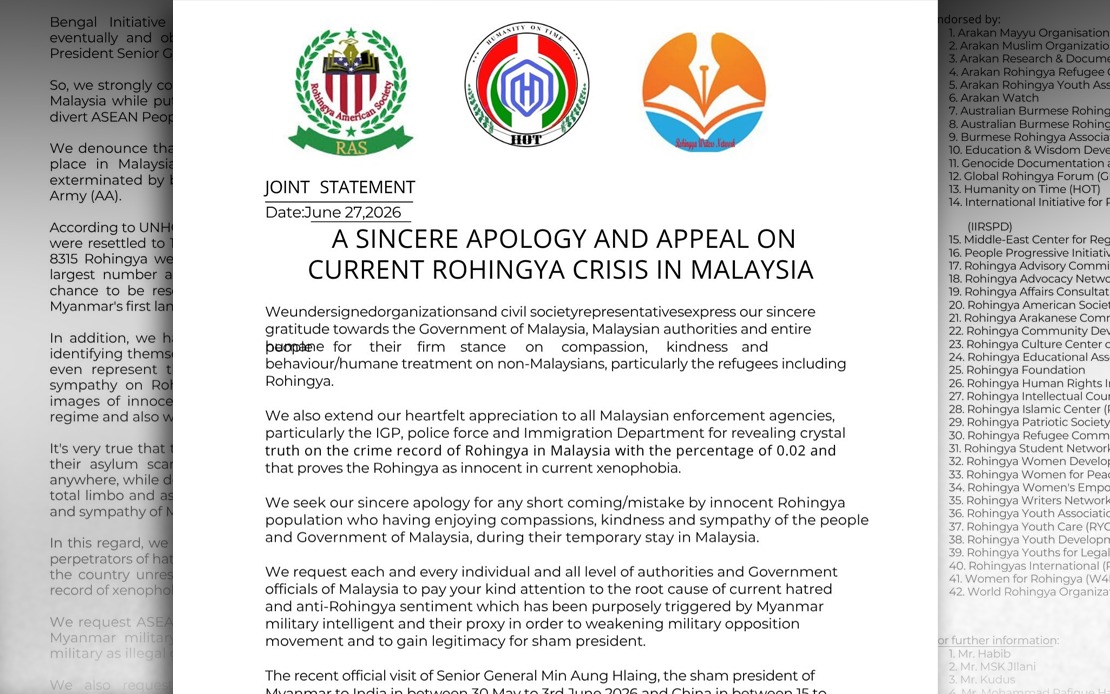
Malaysian Humanitarian Aid and Relief (MAHAR) has expressed satisfaction with an apology issued by 40 Rohingya non-governmental organisations, viewing the statement as evidence of accountability and a catalyst for more comprehensive humanitarian approaches in the country. The organisation's measured response reflects growing recognition among Malaysian civil society that addressing the Rohingya crisis requires multifaceted strategies extending well beyond traditional relief provision.
According to MAHAR, the scope of humanitarian assistance must evolve beyond distributing food and shelter to encompass structured programmes that equip refugees with essential knowledge about their obligations within Malaysian society. This perspective underscores a significant shift in how humanitarian organisations are conceptualising their role—moving from purely needs-based interventions toward capacity-building and cultural orientation initiatives that prepare displaced populations for coexistence within their host communities.
The humanitarian body has specifically urged the 40 NGOs to take on expanded responsibilities in building mutual understanding between refugee populations and Malaysian communities. By positioning themselves as bridges between groups, these organisations could facilitate dialogue around local laws, cultural norms, and societal expectations, thereby reducing friction and misconceptions. Such initiatives would address a persistent gap in integration programming that has often left newly arrived populations without structured guidance on navigating their new environment.
International advocacy represents another dimension where MAHAR believes Rohingya NGOs should intensify their engagement. Rather than limiting their work to immediate humanitarian response within Malaysia, these organisations are being encouraged to channel their energy toward ending systematic persecution in Myanmar. This dual-track approach—addressing symptoms while pursuing root-cause solutions—reflects sophisticated understanding that durable humanitarian solutions require simultaneous attention to refugee welfare and the underlying geopolitical drivers of displacement.
Jismi Johari, MAHAR's president, has articulated a nuanced position on community safety concerns that acknowledges legitimate public anxieties without resorting to collective blame. His framing recognises that Malaysian residents who have experienced incidents involving individuals from refugee communities have legitimate grounds for concern and that dismissing these concerns would undermine constructive dialogue. This measured acknowledgment contrasts sharply with more polarised responses that either dismiss safety worries entirely or use individual incidents to justify broad generalisations about refugee populations.
The MAHAR president's emphasis on contextualising misconduct within broader societal patterns carries particular significance in Malaysian discourse. By noting that problematic behaviour exists across all communities rather than being unique to refugee populations, Johari provides a reality check against scapegoating while simultaneously validating that specific incidents warrant attention and response. This calibrated approach offers a template for how civil society can address legitimate grievances without fuelling xenophobia or oversimplifying complex social dynamics.
Safety considerations for both refugee and host populations form the foundation of MAHAR's humanitarian philosophy. This dual-focus commitment acknowledges that sustainable coexistence depends on creating conditions where neither group feels threatened or marginalised. When refugee communities feel unsafe—through harassment or discrimination—and when host communities experience genuine security concerns, both dimensions of instability feed into broader social fragmentation. MAHAR's insistence on balanced attention to both dimensions reflects mature understanding of what genuine integration requires.
The invitation for NGOs to pursue empathy-based engagement across dividing lines addresses one of Malaysia's most pressing governance challenges. As the country hosts one of the world's largest Rohingya populations, often numbering in the hundreds of thousands, constructing frameworks for peaceful coexistence has become essential to maintaining social cohesion. Civil society organisations, positioned between official structures and grassroots communities, are uniquely situated to foster the interpersonal understanding that policies alone cannot create.
MAHAR's reaffirmation of commitment to justice-centred humanitarianism signals an important recalibration within the Malaysian civil society sector. Rather than viewing humanitarian work and public safety as competing priorities, the organisation frames them as complementary objectives achievable through deliberate, inclusive programming. This integration of justice, safety, and dignity represents a maturation of humanitarian discourse that moves beyond charity paradigms toward frameworks emphasising mutual respect and structural change.
The broader implications of MAHAR's position extend across Southeast Asia, where multiple countries grapple with refugee populations and integration challenges. Malaysia's approach—balancing genuine humanitarian commitment with acknowledgment of host-community concerns—offers a model for other nations wrestling with similar tensions. As regional displacement pressures intensify, frameworks that avoid false choices between refugee protection and local stability become increasingly valuable for policymakers across the Association of Southeast Asian Nations.

