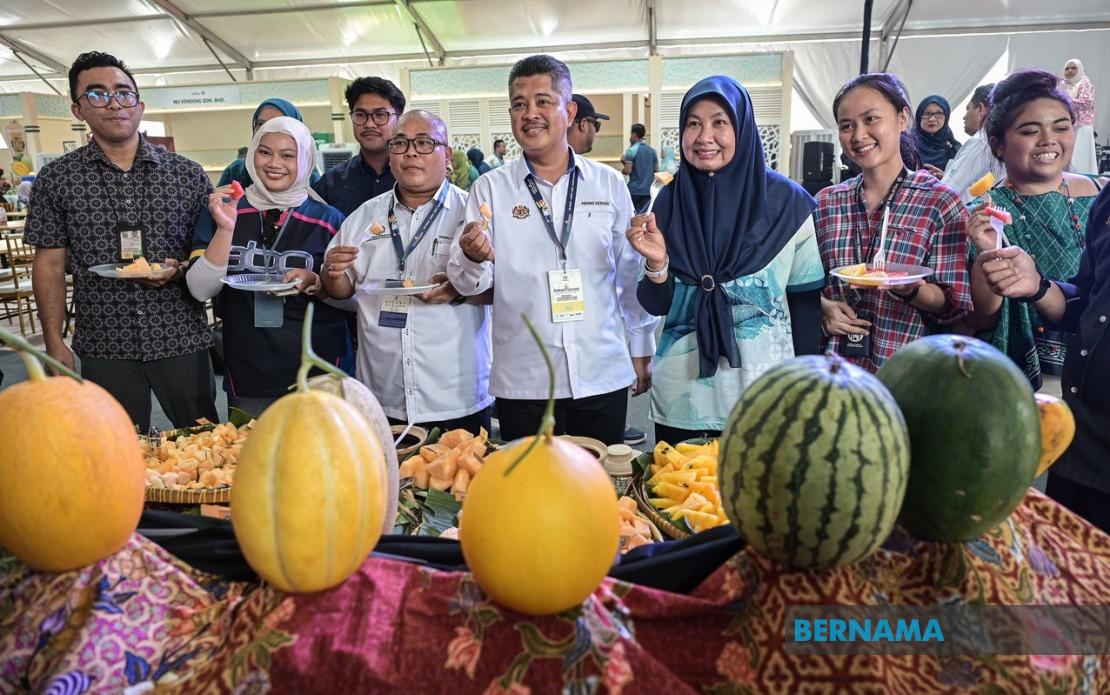
Malaysia's agricultural sector is poised to welcome a fresh innovation as the Malaysia Agriculture, Horticulture and Agrotourism Exhibition (MAHA) 2026 opens at the Malaysia Agricultural Expo Park Serdang (MAEPS) this week, marking the debut of a newly developed melon variety that has been designated as the flagship fruit for this edition of the biennial showcase.
The initiative represents a collaborative effort spanning three years between the Federal Agricultural Marketing Authority (FAMA) and participating local entrepreneurs, culminating in a product that organisers believe will reshape market dynamics for Malaysia's melon farming sector. Minister of Agriculture and Food Security Datuk Seri Mohamad Sabu will officiate the formal launch and unveil the fruit's official name during opening proceedings, underscoring the strategic importance of the innovation to Malaysia's agricultural development priorities.
FAMA chairman Abang Ahmad Kerdee Abang Masagus emphasised that positioning a distinctive fruit as the exhibition's symbol serves a crucial communicative function for visitors and stakeholders. He explained that the symbolic fruit provides visual identity and tangible representation of the nation's horticultural achievements, and without such an iconic product, the event's narrative impact diminishes considerably. The decision to anchor this year's MAHA around a newly commercialised melon variety therefore carries both practical and symbolic weight, signalling to the agricultural community and consumers that innovation remains central to Malaysia's farming agenda.
The new melon exhibits characteristics specifically calibrated for domestic consumption patterns. Most notably, it achieves a Brix measurement—the standard measure of sugar concentration in fruit—of level 18, representing a premium sweetness profile that distinguishes it from existing market offerings. The flesh texture delivers a crunchier bite than conventional varieties, addressing consumer preferences that have shifted toward textural variety and sensory satisfaction. These technical specifications were not arbitrary but emerged from systematic market research conducted by FAMA and its entrepreneurial partners, ensuring the final product would address genuine consumer demand rather than speculative assumptions.
The melon's physical dimensions have been engineered for contemporary household consumption patterns. Weighing approximately 1.3 kilogrammes, the miniaturised format aligns with demographic trends favouring smaller portions suitable for individual or couple-household servings. This sizing strategy acknowledges Malaysia's evolving family structures and lifestyle changes, where consumers increasingly prefer ready-to-eat convenience without excessive portions or waste. The anticipated retail price of around RM15 per unit positions the product as a premium-yet-accessible offering, distinguishing it from both budget commodities and luxury imports.
FAMA director-general Faisal Sulaiman reinforced that the variety's development responds directly to contemporary consumer behaviour data. Rather than imposing agricultural traditions onto market realities, FAMA and its collaborating entrepreneurs conducted empirical research identifying specific demand patterns among local shoppers. This consumer-centric approach represents a departure from supply-driven agricultural marketing, where producers historically determined what consumers would purchase. The ability to transport the melon conveniently, maintain freshness throughout the supply chain, and preserve high sweetness levels addresses practical household requirements that standardised larger melons often fail to satisfy.
The commercial implications extend throughout Malaysia's agricultural value chain. FAMA intends to supply over 150,000 units of melons—encompassing nearly 100 local and international varieties—during the ten-day exhibition running until August 10. This scale of supply demonstrates institutional commitment to supporting local farming operations and entrepreneurs across the melon sector. By creating a dedicated showcase and sales channel, FAMA facilitates direct market access that circumvents traditional distribution bottlenecks, allowing producers to capture premium pricing and build direct consumer relationships.
The strategic value of this initiative reaches beyond immediate sales figures. By establishing MAHA as a concentrated platform where hundreds of local and international agricultural entrepreneurs converge, Malaysia's authorities leverage the exhibition's convening power to strengthen entire value chains. Farmers witness emerging market trends firsthand, entrepreneurs access distribution networks, and consumers discover products they would not encounter through conventional retail channels. This ecosystem-building function explains why MAHA operates as a biennial event rather than an annual one—the concentrated intensity generates sustained competitive pressure and innovation throughout the subsequent two-year cycle.
For Southeast Asian agricultural contexts, Malaysia's approach offers instructive lessons in modernising horticulture while maintaining relevance to evolving consumer preferences. Rather than competing on production volumes with regional competitors, Malaysia is differentiating through targeted innovation addressing specific demographic preferences. The melon variety exemplifies this strategy: it is neither the largest nor cheapest option, but rather a precisely engineered product satisfying the particular needs of quality-conscious Malaysian households with disposable income.
The three-year development timeline reflects realistic expectations about agricultural innovation timescales. Unlike technology sectors where prototypes achieve market readiness in months, horticultural R&D requires multiple growing cycles to test performance across different seasonal conditions, soil types, and climatic variations. The patience exercised by FAMA and collaborating entrepreneurs in pursuing this extended development cycle suggests institutional commitment to reliability and market sustainability, not merely capitalising on marketing novelty.
Looking forward, the melon launch represents a template for additional innovation initiatives within Malaysia's agricultural sector. If the product achieves commercial success, it establishes proof-of-concept that structured R&D collaboration between government agencies and entrepreneurs can generate market-competitive products. This demonstration effect may encourage private sector investment in horticultural innovation, reducing dependency on government resources for future product development. By positioning MAHA as the institutional venue for launching and promoting such innovations, FAMA transforms the exhibition from a seasonal marketplace into a permanent engine of agricultural sector evolution.
The symbolic significance of inaugurating a new fruit variety at MAHA 2026 also communicates important signals to Malaysia's farming community about the government's long-term commitment to modernising agriculture. In an era when younger Malaysians increasingly pursue urban professional careers, initiatives demonstrating that farming can generate innovation, premium pricing, and market excitement help counter narratives portraying agriculture as a declining sector. The minister's personal involvement in the launch emphasises that horticultural advancement constitutes a national priority, not merely a sectoral concern confined to agricultural departments.

