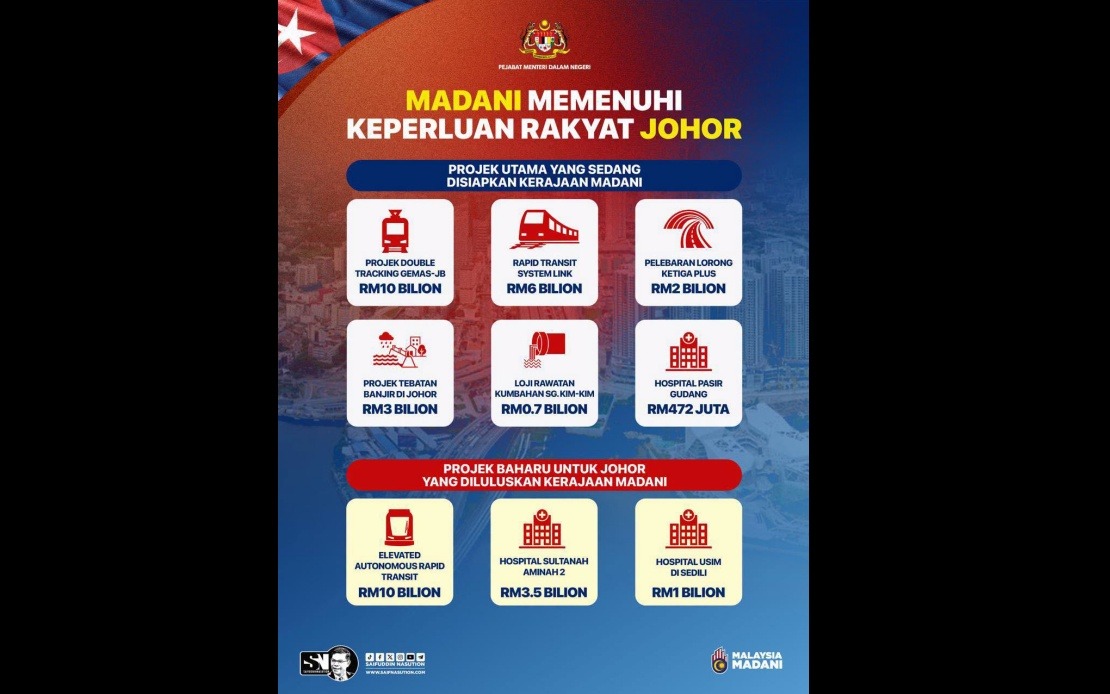
The Pakatan Harapan-led administration has reiterated its commitment to fostering equitable development across Malaysia's states, with Johor identified as a key focus region demonstrating the government's broader development philosophy. Speaking in Johor Bahru on June 29, Pakatan Harapan secretary-general Datuk Seri Saifuddin Nasution Ismail, who also holds the portfolio of Home Minister, underscored that the MADANI framework prioritises tangible improvements in citizens' everyday lives rather than emphasising headline investment figures alone.
The administration under Prime Minister Datuk Seri Anwar Ibrahim has structured its development approach around four interconnected pillars: infrastructure modernisation, enhanced public transportation networks, expanded healthcare access, and disaster mitigation. This multi-sector strategy reflects recognition that sustainable development requires simultaneous advances across economic, social, and environmental dimensions. For a state like Johor—strategically positioned as Malaysia's industrial and logistics hub—this comprehensive approach carries particular significance for the broader Southeast Asian region, given the state's role in regional trade and cross-border connectivity with Singapore.
Johor's development trajectory illustrates the government's practical application of MADANI principles. The Gemas-Johor Bahru Electrified Double Tracking Project represents a substantial commitment to rail infrastructure modernisation, addressing long-standing bottlenecks in the North-South Corridor and improving freight efficiency. Meanwhile, the Rapid Transit System Link serves complementary objectives by integrating Johor's urban and suburban areas, potentially alleviating congestion on the PLUS Highway—for which a third lane expansion is simultaneously underway. These projects collectively signal a coordinated approach to addressing transportation challenges that have constrained economic productivity and quality of life.
Beyond mobility infrastructure, the government has prioritised vulnerability reduction through the Johor flood mitigation project and environmental remediation via the Sungai Kim Kim Sewage Treatment Plant. These initiatives address recurring challenges that have historically disrupted economic activity and displaced communities. For a state prone to monsoon flooding, particularly in low-lying industrial zones, such preventive investment carries immediate material benefits and reduces long-term disaster recovery costs—a consideration increasingly relevant across Southeast Asia as climate variability intensifies.
Healthcare expansion constitutes the third major development vector. The Pasir Gudang Hospital complements two newer approvals—Sultanah Aminah Hospital 2 and USIM Hospital in Sedili—signalling a deliberate decentralisation of medical capacity beyond the Klang Valley. This expansion addresses rural-urban healthcare disparities and improves accessibility for Johor's dispersed population, particularly important given the state's significant industrial workforce and growing urbanisation.
The Elevated Autonomous Rapid Transit project represents a more experimental infrastructure initiative, suggesting the government's willingness to adopt emerging technologies in urban mobility solutions. Such projects signal confidence in Malaysia's capacity to leapfrog conventional transport models, positioning the nation as a potential testbed for autonomous transit systems within the ASEAN region—a dimension with implications beyond Johor's immediate geography.
Saifuddin Nasution's statement emphasises that development measurement should transcend financial metrics, instead evaluating success through employment generation, transportation efficiency, healthcare quality, and lived quality of life. This philosophical reframing reflects broader international shifts toward human development indices rather than GDP-centric assessment. For Malaysian stakeholders accustomed to infrastructure announcements focused on project costs and completion timelines, this articulation suggests a deliberate recalibration toward outcome-oriented governance communication.
The concentration of major projects in Johor reflects both the state's economic importance and political significance within the federal coalition. As the nation's second-largest contributor to GDP and home to critical port facilities, petrochemical industries, and high-tech manufacturing, Johor's development trajectory carries implications for national economic resilience. Strategic investment here generates multiplier effects across supply chains and regional trade networks that extend well beyond state boundaries.
Implementation represents the critical challenge ahead. Malaysia's historical development record demonstrates that project approval and actual service delivery frequently diverge, with completion timelines regularly extended and cost overruns common. The proliferation of announced initiatives—spanning transportation, healthcare, and environmental sectors—requires coordinated project management capacity, sustainable funding mechanisms, and accountable oversight structures. Johor's experience will likely establish benchmarks for evaluating MADANI's operational effectiveness.
The emphasis on inclusive development carries particular resonance given Malaysia's documented regional inequalities and urban-rural divides. Johor's mixed economic profile—combining urban centres, industrial zones, and agricultural hinterlands—provides a representative testing ground for inclusive growth models. Success here could validate replicable approaches for other states grappling with uneven development patterns.
From a Southeast Asian perspective, Malaysia's infrastructural modernisation efforts contribute to broader regional connectivity objectives under frameworks like the ASEAN Connectivity Master Plan and ASEAN+3 cooperation mechanisms. Johor's enhanced transportation networks, particularly the RTS Link and rail electrification, facilitate cross-border integration with Singapore and support the Singapore-Johor-Riau Growth Triangle agenda.
The government's development narrative also reflects response to criticisms regarding previous administrations' regional disparities in resource allocation. By explicitly highlighting multi-state commitment and naming specific projects across diverse sectors, the MADANI framework attempts to demonstrate equity in development distribution—a politically significant assertion during a government's consolidation phase.

