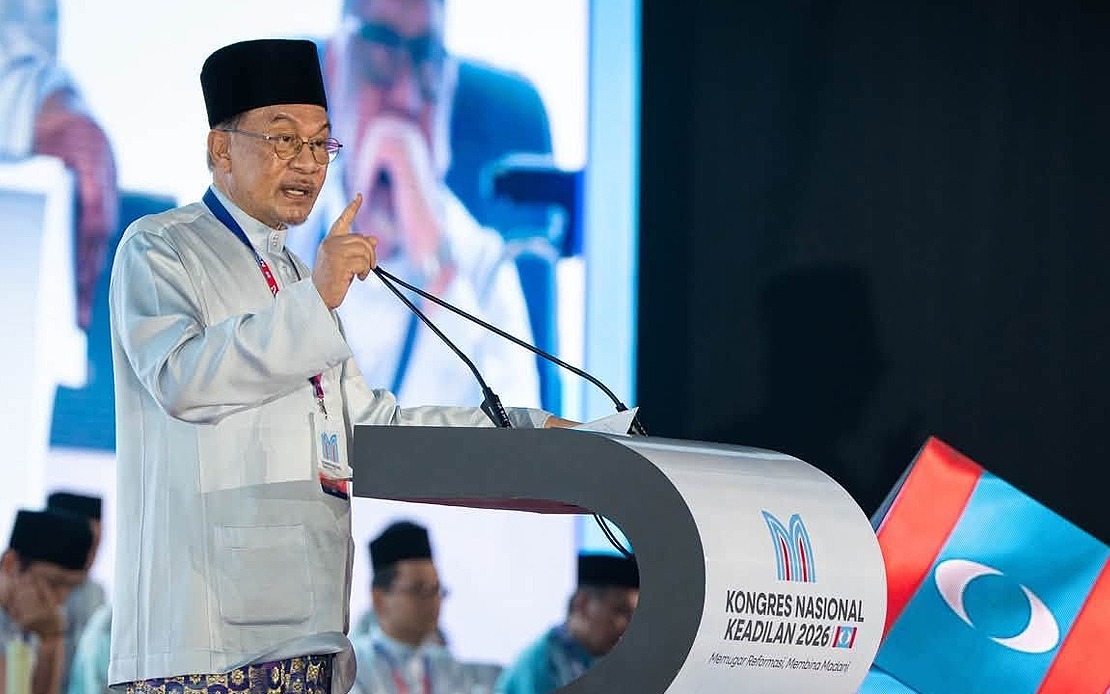
The MADANI Government faces a critical accountability challenge: converting an ambitious reform agenda into measurable improvements in the daily lives of ordinary Malaysians. This was the central message delivered by Prime Minister's Senior Political Advisor Tengku Datuk Seri Zafrul Tengku Abdul Aziz at the 2026 PKR National Congress in Melaka, where he stressed that policy achievements alone are insufficient without tangible spillover effects reaching all segments of society.
Speak of economic success without ensuring citizens experience its benefits remains a hollow victory, Tengku Zafrul warned through a Facebook post during the two-day gathering at the Melaka International Trade Centre (MITC), Ayer Keroh. He pointed to the nation's six percent economic growth—a figure that exceeded all analyst forecasts—as a prime example of this disconnect. While such macroeconomic performance represents genuine achievement, the critical test lies in whether ordinary households, small traders, and marginalised communities actually feel the improvements in their purchasing power, employment opportunities, and access to services.
The PKR Congress, organised under the banner "Reviving Reform, Building MADANI," provided an opportunity for party members to scrutinise the government's progress and chart the direction for upcoming initiatives. Tengku Zafrul noted that the debate sessions largely aligned with the broader policy framework and core messaging articulated by PKR President Datuk Seri Anwar Ibrahim in his opening address, suggesting a degree of cohesion within the ruling coalition on key priorities.
A significant communications gap has emerged between the MADANI Government's actual achievements and public awareness of those accomplishments. Tengku Zafrul explicitly acknowledged this deficit, arguing that improved communication channels are essential to bridge the understanding between government initiatives and citizen perception. When people remain unaware of reforms and benefits designed for their welfare, the responsibility for that information vacuum rests squarely with the government, not the public. This recognition reflects a maturation in political thinking—shifting from blame-gaming to acknowledging structural weaknesses in message delivery.
Among the substantive initiatives highlighted by Anwar Ibrahim were the abolition of the Universities and University Colleges Act (AUKU), a longstanding demand from student activists and civil society who viewed it as restricting academic freedom and youth participation in democratic processes. The government's commitment to rehabilitating the Federal Land Development Authority (FELDA), which has faced years of mismanagement accusations, signals intent to restore a crucial institution that impacts hundreds of thousands of rural settlers and their families. Additionally, the upcoming Budget will incorporate several economic measures designed to stimulate activity and improve household resilience.
These initiatives collectively demonstrate that PKR and the broader MADANI coalition recognise the reform journey remains incomplete. The abolition of AUKU addresses grievances accumulated over decades, while FELDA rehabilitation requires long-term institutional rebuilding. Economic initiatives in the Budget must be carefully calibrated to support micro-enterprises, agricultural productivity, and wage growth rather than merely aggregate GDP figures. For Malaysian readers, particularly those in rural areas and smaller urban centres far from Kuala Lumpur's commercial corridors, these measures carry direct implications for livelihood stability and opportunity creation.
Tengku Zafrul's implicit critique of PKR's communication capability warrants deeper examination. A political party controlling multiple ministerial portfolios and significant parliamentary influence should possess sophisticated mechanisms for publicising achievements and connecting policy outcomes to citizen experiences. The gap between accomplishment and awareness suggests either insufficient resource allocation to communications infrastructure or failure to tailor messaging for diverse audiences across Malaysia's economically and demographically varied landscape. Overcoming this requires targeted approaches addressing specific community concerns rather than generalised announcements from federal capitals.
PKR's institutional strength depends fundamentally on its capacity to listen to grassroots concerns while simultaneously strengthening its organisational machinery to deliver results. This dual challenge—remaining responsive to members and constituents while building effective implementation structures—has historically vexed Malaysian political parties. PKR must resist the temptation to view internal party discipline as an end in itself; rather, party solidarity should facilitate collective effort toward achieving measurable improvements in public service delivery, infrastructure development, and economic opportunity.
The confidence Tengku Zafrul expressed regarding winning continued public trust hinges on a single proposition: that the MADANI Government can sustain not merely announcements of reform but consistent evidence of institutional improvement and citizen benefit. For Malaysian voters comparing multiple political alternatives, this translates into observable differences in their lived experiences—better infrastructure, more responsive public services, reduced corruption, and genuine economic participation. Confidence is earned through repeated, visible delivery rather than rhetorical promises.

