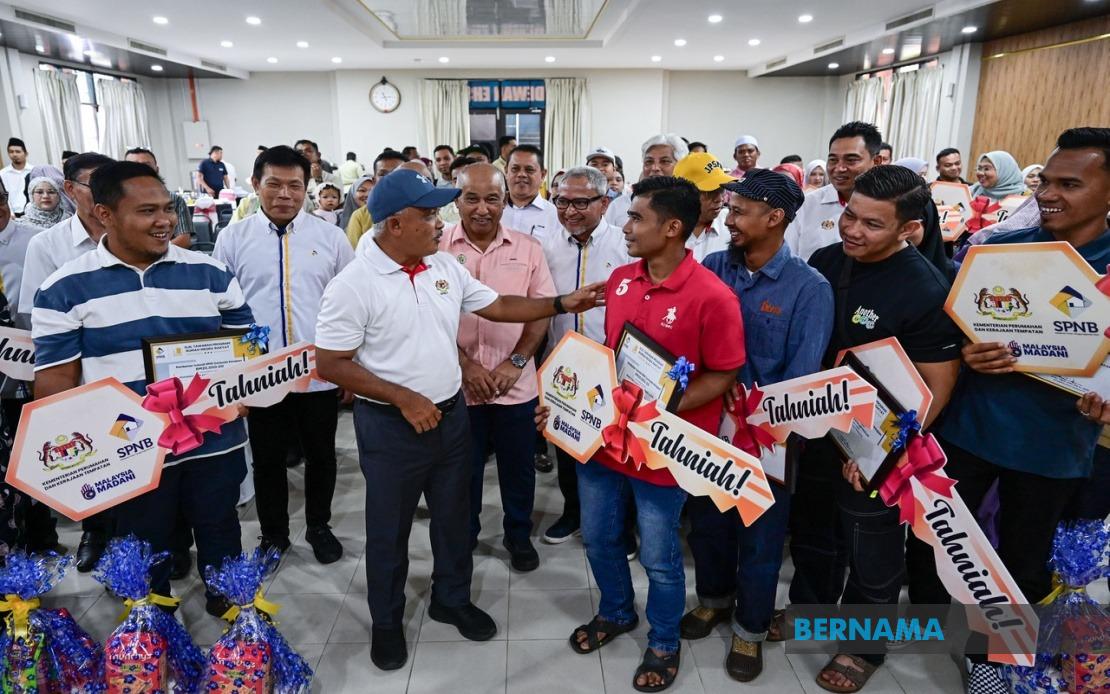
Fifty families in Terengganu took ownership of their new homes or received construction offers this week as part of the MADANI Government's drive to expand affordable housing across Malaysia. The assistance, distributed across the Kuala Terengganu and Kuala Nerus parliamentary constituencies, comprised thirty completed residences ready for immediate occupation alongside twenty formal offers for new construction. The presentation ceremony, held at Dewan Ehsan in Felda Wilayah Timur, underscored the Housing and Local Government Ministry's ongoing push to transform housing accessibility for lower-income Malaysians who possess land but lack adequate shelter.
The Rumah Mesra Rakyat (RMR) programme represents a targeted intervention by the current administration to bridge the gap between property ownership aspirations and financial reality for working-class households. Implemented through Syarikat Perumahan Negara Berhad (SPNB), a state-owned enterprise operating under the Housing and Local Government Ministry's purview, the initiative deliberately focuses on landowners facing barriers to constructing quality dwellings. This demographic—households with real estate assets but insufficient capital for building—represents a significant slice of Malaysia's housing-challenged population, particularly in rural and semi-urban areas where land ownership is more prevalent than liquid savings.
Housing and Local Government Ministry secretary-general Datuk Dr M. Noor Azman Taib articulated the programme's philosophy during the Terengganu distribution event, characterizing RMR as transcending mere shelter provision. According to him, the initiative functions as a mechanism for qualitative improvement in living standards through enabling genuine home ownership that balances safety, comfort, and affordability. This framing reflects a policy perspective that distinguishes between housing as basic infrastructure and home ownership as a pathway to family stability and economic security. The government recognizes that secure housing correlates with improved educational outcomes for children, better health indicators, and enhanced community cohesion—factors that multiply the developmental impact beyond simple construction metrics.
Budgetary allocations reveal the government's scaling ambitions for the programme. Under Budget 2026, planners anticipate constructing 6,545 RMR units nationally, representing a substantial expansion from current implementation rates. As of the announcement, approximately 3,900 units were actively progressing through various stages, with nearly 2,500 completed and transferred to beneficiaries and a further 1,420-plus under active construction. This pipeline suggests the government remains committed to accelerating delivery despite the inherent complexities of rural housing projects, which frequently encounter logistical challenges absent in urban developments.
Terengganu's performance within the national framework demonstrates regional variation in programme uptake and completion. The state hosts 680 RMR units across multiple constituencies, supported by a RM46.67 million allocation from housing development funds. By May of the previous year, just over one-third of the state's allocation had reached completion and handover, with another quarter in mid-construction phase. Within the Kuala Terengganu constituency specifically, thirty-four units were underway—slightly more than half finished and ready for occupation, whilst the remainder remained in building stages. Kuala Nerus similarly hosted thirty-two units in total, with a higher completion ratio of approximately seventy-eight percent, suggesting more advanced implementation in that area.
The programme's longitudinal track record provides context for current efforts. Introduced in 2002, RMR has facilitated home acquisition for more than eighty thousand families across Malaysia over two decades. This cumulative achievement underscores sustained political will across successive administrations to address housing insecurity among lower-income segments. The consistency of support across electoral cycles and policy transitions suggests RMR enjoys broad consensus regarding its utility and social value, a rare accomplishment in polarized political environments.
For Malaysian policymakers and regional observers, the RMR expansion holds lessons regarding inclusive economic development. The programme acknowledges that poverty and housing deprivation do not stem exclusively from landlessness; many lower-income households occupy property but lack financial access to construction. By targeting this specific constraint rather than pursuing conventional subsidized housing models, RMR represents a more nuanced poverty-alleviation approach. This targeting reduces deadweight loss—assistance flowing to those without genuine need—while maximizing impact among households where capital, not entrepreneurial capacity, represents the binding constraint on welfare improvement.
Terengganu's geographic and economic context amplifies RMR's relevance in the state. As a relatively less-developed region compared to Klang Valley or Penang centers, Terengganu hosts significant populations in rural and semi-urban settlements where land ownership remains relatively accessible but construction financing remains constrictive. The programme's expansion in Terengganu therefore addresses demonstrable need rather than aspirational targets. Moreover, housing security in such areas generates secondary benefits—reduced rural-urban migration pressure, strengthened local community institutions, and enhanced human capital retention as families gain incentives to remain in home communities.
Implementation through SPNB rather than private developers reflects a deliberate policy choice prioritizing affordability and social objectives over profit maximization. While private housing corporations respond to market signals and investor returns, state-owned enterprises can subsidize below-market construction costs and extend flexible repayment terms. This institutional choice becomes particularly important in low-density areas where private developers find insufficient commercial viability, yet public need remains acute. The SPNB model enables service provision in constituencies that market forces alone would not justify, albeit at taxpayer expense.
The programme's expansion trajectory also reflects macroeconomic considerations. Rising construction costs, land price inflation, and tightening lending standards have progressively restricted lower-income households' capacity to acquire or build homes through conventional commercial channels. Government intervention through RMR counterbalances these market forces, ensuring that housing remains within reach for working Malaysians despite structural cost pressures. This counter-cyclical dimension becomes increasingly valuable as Malaysian economy matures and real estate transitions from affordable asset class to investment vehicle for wealthier segments.
Forward momentum in Terengganu and nationwide RMR expansion carries implications for housing affordability across Southeast Asia. Malaysia's experience demonstrates that targeted, state-enterprise delivery mechanisms can facilitate homeownership among lower-income populations more effectively than either pure market provision or universal housing subsidies. Neighboring countries facing similar affordability crises—Thailand, Vietnam, Indonesia—may find the RMR model instructive, particularly the emphasis on addressing specific financing constraints rather than attempting comprehensive housing market overhauls.
The Terengganu distribution ceremony, though ceremonial, marked tangible progress in reducing housing deprivation among specific families and communities. Each completed home represents not merely construction achievement but establishment of housing security, enabling recipients to redirect resources from shelter insecurity toward education, health, and productive investment. Scaling this impact from fifty Terengganu beneficiaries toward the thousands envisioned under Budget 2026 targets remains administratively complex and resource-intensive, yet the MADANI Government's commitment to acceleration suggests genuine prioritization of housing equity within broader development agendas.

