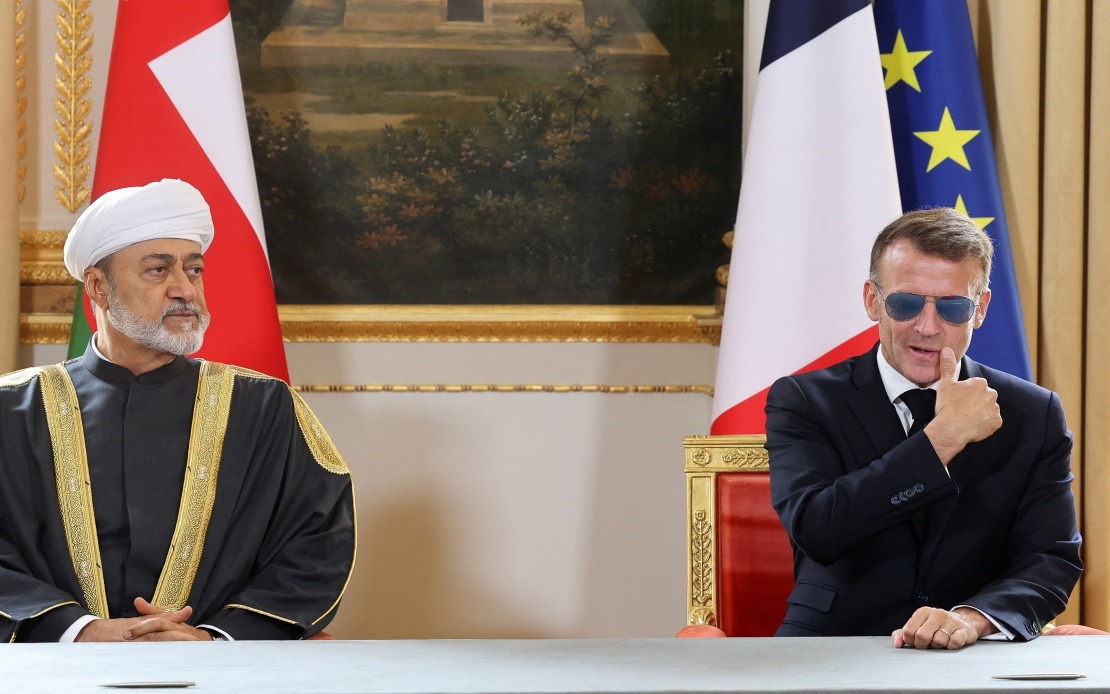
French President Emmanuel Macron has once again donned the aviator-style sunglasses that catapulted him into unexpected fashion notoriety, wearing them during diplomatic meetings with the Sultan of Oman on Monday. The eyewear appeared as Macron greeted Sultan Haitham bin Tariq outside the Élysée Palace in Paris, and remained on throughout their subsequent bilateral discussions. According to French media sources with knowledge of the president's medical situation, Macron turned to the sunglasses due to an eye condition that continues to require eye protection.
The resurgence of Macron's infamous eyewear marks a continued chapter in what has become an unlikely saga of presidential fashion dominating international headlines. Earlier this year, when Macron wore the same aviators at the World Economic Forum in Davos in January, the spectacles triggered a cascade of global commentary ranging from humorous commentary to outright mockery. United States President Donald Trump was among those who seized on the moment to poke fun at the French leader's appearance, while domestic French audiences drew comparisons between Macron and Hollywood actor Tom Cruise, invoking imagery from action films that likely appealed to social media audiences seeking comedic fodder.
The underlying reason for the eyewear—a minor eye inflammation diagnosed earlier in the year—had initially prompted French officials to explain that Macron required ocular protection for approximately two weeks. Yet months later, the president evidently continues to face ongoing optical challenges that necessitate the continued use of sunglasses during official state business. The persistence of this condition underscores that what initially appeared to be a temporary medical inconvenience has evolved into a more lingering health matter requiring sustained management.
The unexpected visibility of Macron's sunglasses at high-level international forums has demonstrated the peculiar intersection of politics, health, and modern celebrity culture in an age of instant global communications. What might have been treated as a routine medical accommodation in previous eras has instead become fodder for international commentary, creating a narrative layer that accompanies the French president's diplomatic engagements. The mere appearance of these spectacles now carries sufficient cultural weight to warrant media reporting and public discussion across multiple continents.
From a commercial perspective, the phenomenon has proven remarkably advantageous for French luxury eyewear manufacturer Henry Jullien. Following Macron's high-profile appearances in the sunglasses, the company reported an unexpected surge in customer inquiries directed specifically toward the model that adorned the French leader's face. Rather than view the association as incidental, Henry Jullien has strategically leveraged the connection, continuing to promote the eyewear line through promotional materials that prominently feature photographs of Macron wearing the aviators. This represents a textbook example of unplanned celebrity endorsement delivering measurable commercial benefits to a luxury goods producer.
The incident also highlights the broader phenomenon of unscripted moments during official state visits increasingly shaping public perception and generating international media narratives. In an era where every gesture, appearance, and sartorial choice is documented and instantly disseminated across digital platforms, leaders must navigate not only the substance of their diplomatic missions but also the inevitable commentary surrounding their presentation. For Macron, what began as a straightforward medical response has morphed into a recurring talking point that potentially overshadows substantive discussion of Franco-Omani bilateral relations.
The meeting between Macron and Sultan Haitham bin Tariq itself represents significant diplomatic engagement between France and Oman, nations with longstanding commercial and strategic interests in the Arabian Peninsula and broader Middle East region. Yet the visibility of the sunglasses threatens to dominate coverage of the encounter, exemplifying how modern media ecosystems frequently prioritize novelty and visual elements over substantive policy discussion. This dynamic presents particular challenges for leaders attempting to project gravitas and command during formal state interactions while managing medical conditions affecting their appearance.
The continued presence of the aviators also raises practical questions about the nature and duration of Macron's underlying eye condition. The initial assessment of minor inflammation requiring roughly two weeks of ocular protection has apparently understated the true timeline of recovery and symptom management. Whether this reflects a more serious underlying condition than initially disclosed, a delayed healing process, or recurring episodes of inflammation remains unclear from official statements. The medical opacity surrounding the situation creates space for continued speculation about the French president's health.
Looking forward, the sunglasses may well become a permanent fixture of Macron's public profile during this particular period of his presidency. The eyewear has achieved sufficient cultural resonance that their absence would likely prompt media commentary and public observation. Rather than representing a minor health accommodation, the aviators have evolved into a distinctive visual marker associated with this phase of his administration, an unintended consequence of combining medical necessity with the relentless scrutiny of global media attention. For Macron, managing both the diplomatic agenda and the narrative surrounding his appearance has become an inextricable aspect of contemporary presidential governance.

