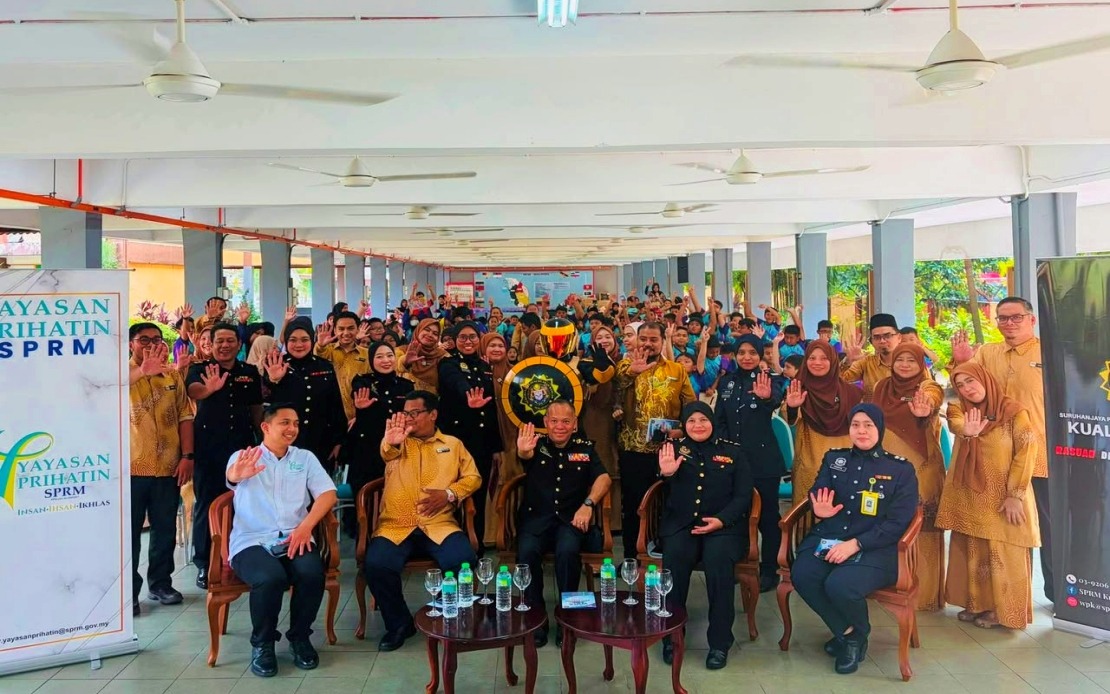
The Malaysian Anti-Corruption Commission's Kuala Lumpur branch has intensified its push to embed anti-corruption values at the primary school level, launching the Wira Antirasuah (WAR) programme at Sekolah Kebangsaan Jalan Pasar 1 here. The initiative represents a deliberate pivot towards preventive education, recognising that cultivating ethical behaviour in children offers the most effective long-term safeguard against institutional and societal corruption.
Moducting the programme, MACC's Kuala Lumpur director Mohamad Zakkuan Talib articulated a philosophical position central to the commission's educational strategy: that integrity represents not merely a collection of grand gestures but rather a consistent pattern of principled behaviour embedded in daily decision-making. He framed the inculcation of honest conduct during formative years as a sustained investment in developing a generation equipped with both moral clarity and the fortitude to resist wrongdoing in all its manifestations.
The conceptual framework underpinning this approach reflects international best practices in anti-corruption work. Mohamad Zakkuan's remarks emphasised that authentic integrity manifests through seemingly mundane actions—resisting the temptation to cheat in examinations, declining to appropriate another's property, refusing to plagiarise, maintaining commitments, and honouring the confidence placed by others. This granular understanding of ethical conduct stands in contrast to narratives portraying integrity as episodic heroism, instead positioning it as the cumulative product of countless small choices made consistently across time.
The WAR programme itself incorporated multiple experiential learning dimensions designed to sustain engagement across different pupil demographics and learning styles. Interactive activities featured prominently, including an informational session conducted by the commission's Community Education Branch (PenMas), which provided pupils with structured knowledge about corruption's mechanisms and consequences. The involvement of Kapten MACC, the commission's animated mascot, served to render abstract ethical principles more accessible and memorable for younger audiences, leveraging character-based learning methodologies increasingly recognised within educational psychology.
Beyond awareness-raising, the MACC formalised its commitment to SKJP1 through the establishment of an Anti-Corruption Corner—a dedicated school space functioning as an information hub on integrity for both staff and pupils. Such a permanent fixture signals institutional seriousness and provides ongoing touchpoints for reinforcing anti-corruption messaging rather than treating the initiative as a one-off event. The corner's presence within the school environment sustains topical salience and offers resources for integrated learning across the curriculum.
Critically, the programme addressed material dimensions of pupil welfare alongside its moral-educational components. Yayasan Prihatin SPRM donated a smart television to the school, enhancing pedagogical infrastructure, while targeted financial assistance reached 29 pupils from economically disadvantaged backgrounds. This holistic approach recognises that abstract values-education rings hollow for children grappling with genuine material deprivation, and that demonstrable institutional care enhances the credibility of messages about ethical citizenship.
The commemoration of Malaysia's National Month provided the occasion for amplifying the programme's messaging, with special education pupils participating in the planting of hibiscus flowers as part of the broader Keep Malaysia Clean campaign. This symbolic gesture integrated environmental stewardship with anti-corruption advocacy, suggesting broader connections between institutional integrity and communal well-being.
For Malaysian policymakers and educators, the MACC's school-based initiative carries significant implications. Corruption persists partly because institutional cultures normalise or tacitly tolerate dishonest conduct, processes often initiated during educational years through unexamined peer norms and insufficiently scrutinised role models. Early intervention through structured, age-appropriate programming addresses this vulnerability before problematic patterns ossify. The programme's emphasis on consistency and small actions proves particularly valuable in contexts where spectacular corruption scandals receive extensive media coverage while the quotidian normalisation of minor ethical lapses proceeds largely unremarked.
The expansion of such initiatives across Malaysia's public education system would constitute meaningful investment in building institutional culture change from foundational levels. While school-based anti-corruption education cannot independently resolve systemic governance challenges, it creates baseline expectations around ethical conduct and equips future civil servants, professionals, and citizens with frameworks for recognising and resisting corrupt pressures. For Southeast Asia more broadly, where institutional corruption remains a significant development constraint, emulating Malaysia's approach to values education in schools represents a potentially efficient allocation of anti-corruption resources, directing effort toward constituencies least shaped by entrenched incentive structures.
The MACC's Kuala Lumpur office has signalled through this programme its understanding that corruption reduction requires multi-generational commitment and that preventing the internalisation of corrupt norms among young people offers superior returns to enforcement-focused approaches targeting established wrongdoers. Whether scaled appropriately across the school system, such initiatives could meaningfully reshape institutional cultures and citizen expectations of public office.

