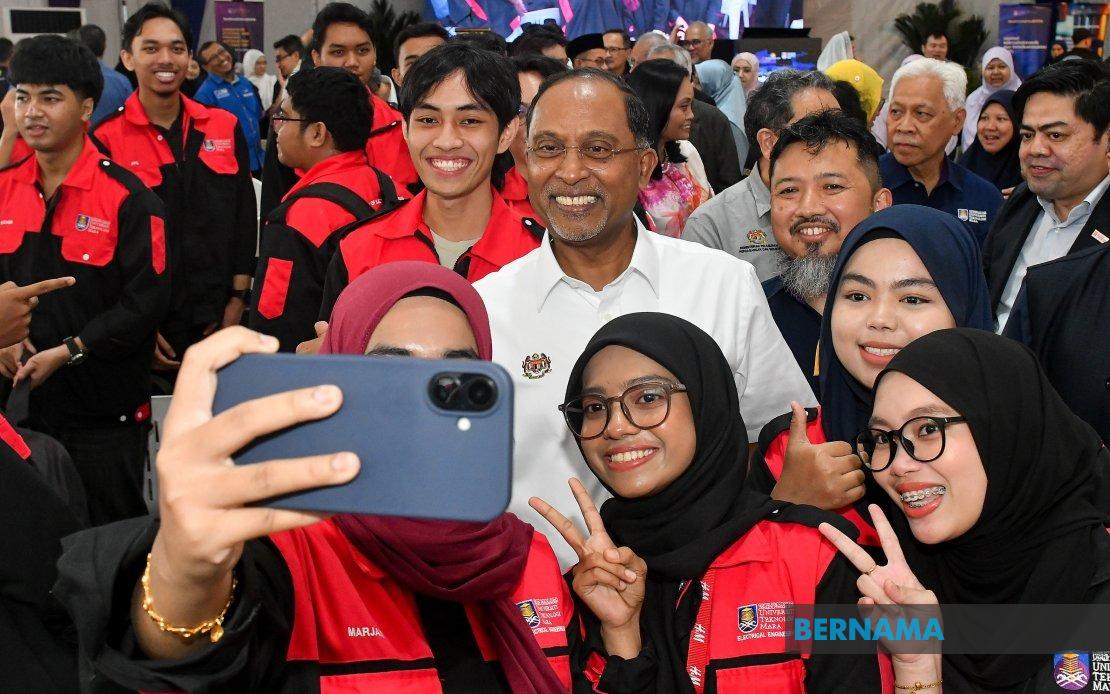
The opening of the Light Rail Transit 3 Shah Alam Line has begun reshaping how students at Universiti Teknologi MARA reach their campus, delivering immediate relief from the congestion that has long plagued commuters navigating the sprawling Klang Valley region. Higher Education Minister Datuk Seri Dr Zambry Abd Kadir emphasised the transformative potential of the new transport corridor during a visit to UiTM Shah Alam on June 30, noting how the dedicated UiTM Shah Alam Station addresses one of the institution's most pressing logistical challenges. The enthusiasm among student passengers has already become visible, with many experiencing firsthand how the rail connection streamlines their daily journeys while simultaneously reducing the transportation expenses they previously incurred through traditional modes.
The broader significance of the LRT3 Shah Alam Line extends well beyond individual student convenience. Operating across a comprehensive network of 20 stations—stretching from Bandar Utama through Stadium Shah Alam to Johan Setia—the line fundamentally reimagines regional connectivity across Selangor's western corridor. The infrastructure creates seamless interchange possibilities for commuters navigating between Shah Alam's industrial and educational precincts and the wider Klang Valley economic zone. This geographic coverage proves particularly crucial as the Shah Alam area continues its rapid urbanisation trajectory, where transportation infrastructure has consistently lagged behind population growth and commercial development. By establishing direct rail access to the campus precinct, UiTM no longer remains isolated from the broader metropolitan transport ecosystem that characterises the Klang Valley's mature urban areas.
The temporary free-fare policy announced by Prime Minister Datuk Seri Anwar Ibrahim, extending complimentary travel from June 29 through July 31, represents a strategic effort to accelerate user adoption and demonstrate the tangible value proposition of the new service. For students operating within typically constrained budgets, this promotional window effectively eliminates one significant operational cost during the critical months when many new commuting patterns are established. The subsidy period allows sufficient time for commuters to integrate rail travel into their routine mobility patterns, potentially creating sustained usage behaviour that persists even after fare collection commences. The underlying calculus suggests that establishing initial ridership momentum through price removal builds constituency support for the service and reduces future operational vulnerabilities arising from insufficient passenger volumes.
While the LRT3 expansion addresses immediate transportation challenges, Minister Zambry simultaneously articulated an ambitious parallel agenda centred on Malaysia's semiconductor sector development. The launch of the Semiconductor@UiTM initiative, occurring during the same visit and accompanied by a RM20 million government allocation, signals the ministry's strategic determination to position UiTM as a cornerstone institution within Malaysia's broader effort to establish semiconductor sector dominance. This dual focus—combining physical infrastructure investment with human capital development—reflects sophisticated understanding that regional competitiveness depends upon both material preconditions and workforce capabilities. The infrastructure enabling efficient student movement now parallels infrastructure enabling knowledge transfer and technical skill acquisition within one of the country's most economically consequential industries.
The semiconductor initiative substantially exceeds typical academic programming by embedding industry alignment throughout its architecture. Rather than confining engineering education within traditional classroom parameters, the programme emphasises cross-sector learning partnerships that directly expose UiTM students to operating semiconductor manufacturing environments and contemporary technological deployments. This integration of practical industry exposure represents explicit acknowledgment that global semiconductor supply chains value hands-on familiarity with production realities and real-world problem-solving experience far more than theoretical knowledge divorced from operational context. By facilitating substantive engagement between UiTM's Electrical and Electronics Engineering cohorts and multinational semiconductor corporations operating within Malaysia, the initiative creates multiple pathways through which academic excellence translates into immediate employment readiness.
Malaysia's semiconductor sector currently commands approximately 13 per cent of global market share while generating over RM300 billion in annual economic returns—a performance placing the country among the world's most consequential semiconductor producers despite lacking substantial domestic chip design capabilities. This outsized significance renders semiconductor workforce development a matter of immediate national economic interest, as competitive labour cost advantages that historically attracted manufacturing investment face continuous pressure from automation and relocation to lower-cost jurisdictions. Developing high-skill technical talent represents Malaysia's primary mechanism for retaining semiconductor sector investment and capturing greater value along the industry supply chain. By positioning UiTM as a centre producing globally competitive E&E graduates capable of managing sophisticated manufacturing operations and contributing to advanced product development, the Semiconductor@UiTM initiative directly addresses this strategic vulnerability.
The programme's alignment with Malaysia's National Semiconductor Strategy demonstrates institutional coherence between academic planning and broader government industrial policy. Rather than permitting universities to develop semiconductor capabilities independently of sectoral planning processes, the approach ensures that UiTM's substantial investments generate capacity aligned with actual industry recruitment requirements and technology advancement trajectories. This strategic coherence reduces the risk that expensive academic infrastructure and curriculum development efforts produce graduates whose training obsolesces rapidly as global semiconductor technology evolves. The deliberate connection between government strategy documents and campus-level programme design represents effective industrial policy implementation operating through higher education institutions as executing agencies.
Minister Zambry explicitly conceptualised the Semiconductor@UiTM initiative as establishing a benchmark template that other Malaysian universities should emulate in their respective disciplinary spheres. This aspirational framing suggests that the success or failure of UiTM's semiconductor initiative carries consequences extending far beyond the specific institution and programme, influencing whether similar strategic partnerships between government, universities, and industry can proliferate across Malaysian higher education more broadly. Successful implementation would validate a model whereby substantial government resource allocation directly channels through universities toward industry-aligned talent development. Conversely, implementation challenges or insufficient graduate employment outcomes would demonstrate the limitations of this approach and necessitate alternative strategies for workforce development within critical technology sectors.
The convergence of transportation infrastructure expansion and semiconductor skill development initiatives at UiTM Shah Alam exemplifies how contemporary regional economic competitiveness depends upon multifaceted investment spanning physical mobility, human capital formation, and strategic industry engagement. For Malaysian observers concerned with the country's long-term economic positioning amid intensifying global technological competition, these developments warrant careful attention as indicators of whether systematic policy coordination can effectively address the integrated infrastructure and capability requirements that emerging economies must satisfy. The coming months will provide initial evidence regarding whether the LRT3 genuinely reshapes UiTM commuting patterns and whether the Semiconductor@UiTM initiative successfully bridges the historically problematic gap between academic engineering education and industry-ready workforce capabilities. Success across both dimensions would demonstrate that strategic government investment, when properly designed and executed, can meaningfully advance Malaysian economic objectives within sectors crucial to sustained prosperity.

