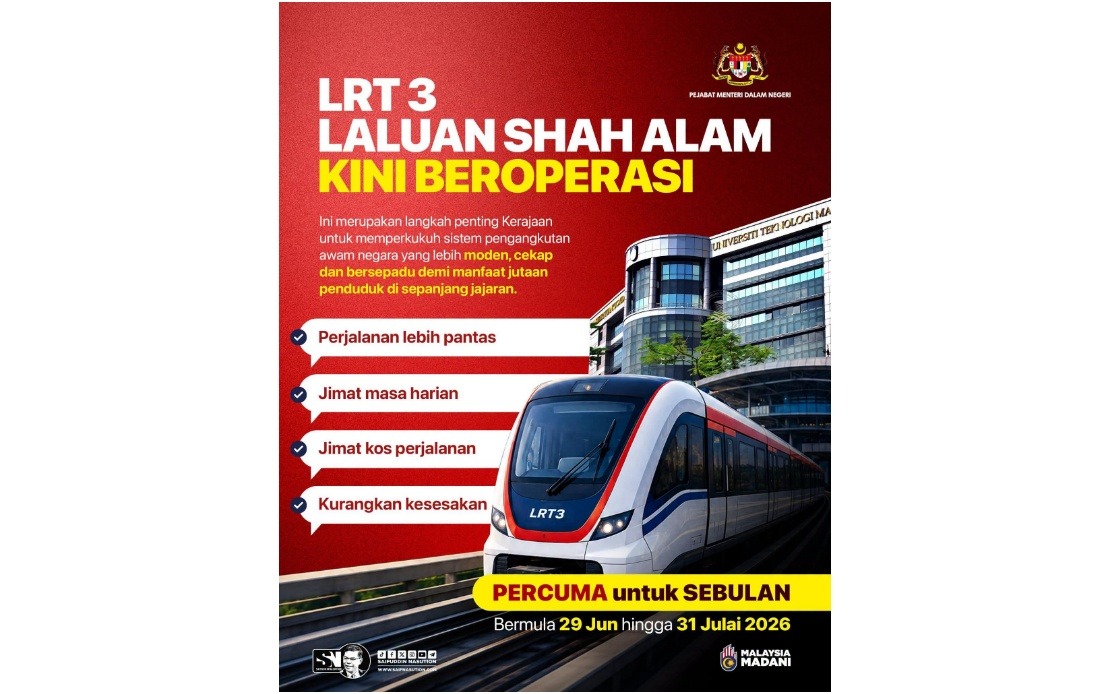
Malaysia's new Shah Alam Line LRT3 represents a significant milestone in the MADANI Government's broader strategy to transform the country's public transport landscape, according to Home Minister Datuk Seri Saifuddin Nasution Ismail. Launched officially by Prime Minister Datuk Seri Anwar Ibrahim on Sunday, the rail line addresses a critical transportation need along one of Southeast Asia's busiest commuter corridors, positioning the project as a cornerstone investment in national infrastructure that directly impacts millions of daily commuters across the Klang Valley.
The new line's strategic importance extends beyond simple connectivity solutions. By establishing an alternative transport route through Shah Alam, Klang, Subang and surrounding municipalities, the project acknowledges a fundamental challenge facing Malaysian urbanisation: the unsustainable reliance on private vehicles that has contributed to chronic traffic congestion, extended commute times, and elevated transportation costs for working families. Saifuddin framed the LRT3 initiative as directly addressing these interconnected problems, creating what he described as a more integrated public transport ecosystem designed around user convenience and accessibility rather than automobile dependency.
The government's decision to offer complimentary travel on the new line through July 31 represents a deliberate policy choice to encourage behavioural change among commuters. This promotional period extends beyond the rail line itself to encompass Prasarana Malaysia Bhd's feeder bus network serving the corridor, effectively creating a comprehensive zero-cost transit experience for trial users. The move reflects understanding that infrastructure alone cannot drive modal shifts; commuters must experience tangible benefits including reduced costs, faster journeys, and improved reliability before permanently abandoning private vehicles.
For residents and workers across the affected municipalities, the financial implications are substantial. Regular LRT3 users commuting daily face significant annual savings once the promotional period ends, while the reduction in vehicle-related expenses extends beyond fuel to encompass tolls, parking, maintenance, and vehicle depreciation. Saifuddin specifically highlighted families managing school-run logistics and workers traversing the congested Shah Alam-Klang-Subang triangle, suggesting the initiative directly alleviates pressure on household budgets while simultaneously freeing time previously consumed by traffic navigation.
The LRT3 project's environmental implications align with Malaysia's broader sustainability commitments. By displacing private vehicle journeys with electric rail transit, the system reduces transportation-sector carbon emissions while improving urban air quality across the Klang Valley—a region historically challenged by air pollution during rush hours. This environmental benefit, though less prominently articulated by officials than economic arguments, represents significant long-term public health gains for affected communities.
Saifuddin's emphasis on the line as a "strategic investment" in national quality of life reflects the MADANI Government's positioning of public transport modernisation as a core governance priority. This framing distinguishes transport policy from conventional infrastructure spending by explicitly connecting it to improved living standards and citizen wellbeing. The appointment of high-level officials including the Prime Minister to inaugurate the service underscores institutional commitment to treating public transport not as a secondary service but as central to national development objectives.
The free-travel incentive carries particular significance for behavioural economics research in the Malaysian context. By removing financial barriers during the trial period, the government creates optimal conditions for commuters to evaluate whether LRT3 usage genuinely improves their daily routines. This data—whether commuters return to private vehicles after promotional benefits expire or establish permanent transit habits—will provide crucial evidence for evaluating project success and informing future transport investments in other Malaysian regions.
For the Klang Valley specifically, the LRT3 potentially reshapes property values, commercial location preferences, and demographic distribution. Areas with improved transit connectivity typically experience accelerated development and attracting both residential and commercial investment. The feeder bus network linking LRT3 stations to surrounding neighbourhoods expands the catchment area, potentially catalysing economic activity in previously underserved communities and supporting small businesses dependent on convenient customer access.
The project also positions Malaysia within regional public transport competition, particularly against Singapore's highly integrated MRT system and Bangkok's expanding BTS network. By modernising rail infrastructure serving major urban corridors, Malaysia demonstrates commitment to transit-oriented development standards increasingly expected in major Southeast Asian metropolitan regions. This competitive dimension, while unstated in official messaging, reflects awareness that international investment and talent attraction depend partly on modern infrastructure quality perceived by professionals evaluating relocation decisions.
Saifuddin's public encouragement for commuters to "leave your car behind" during the promotional period represents explicit messaging against automobile dependency—a notable rhetorical shift from earlier decades when private vehicle ownership signified progress and prosperity. This language reflects evolved understanding of congestion economics and quality-of-life relationships, suggesting the MADANI Government views transport choice diversity as fundamental to modern urban development rather than aspirational luxury.
The sustainability of the free-travel initiative beyond July 31 remains unstated, though typical promotional periods suggest eventual fare implementation. However, the government's commitment to maintaining competitive pricing compared to private vehicle alternatives will determine whether LRT3 achieves permanent modal shift or remains a trial-period novelty. Saifuddin's religious invocation—"insya-Allah, you'll want to ride it again"—subtly frames transport choice as value alignment beyond mere economics, suggesting the government envisions public transit adoption as reflecting both rational financial calculation and shared civic responsibility.
Looking forward, the LRT3 serves as template for evaluating transport modernisation prospects across other Malaysian corridors facing similar congestion challenges. The project's operational performance, ridership uptake during and after the promotional period, and impact on Klang Valley traffic patterns will provide critical benchmarks informing decisions about future LRT extensions, monorail expansion, or commuter rail projects serving other major metropolitan regions throughout Peninsula Malaysia.

