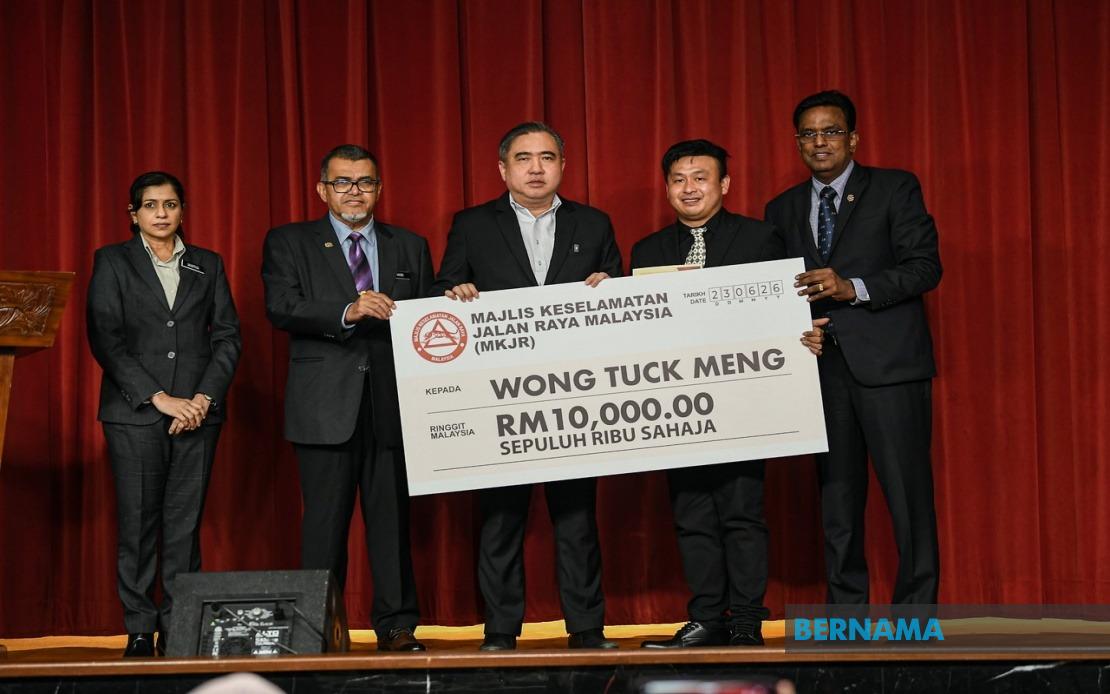
Wong Tak Ming, a lorry driver whose split-second decision-making averted a potential disaster on a Perak highway, was formally honoured today by Transport Minister Anthony Loke at a special ceremony held within Parliament House in Kuala Lumpur. The recognition came in the form of a Special Certificate of Appreciation and a cash award of RM10,000, both funded through the Malaysian Road Safety Council (MKJR), marking a government-wide acknowledgement of his extraordinary bravery during an incident that unfolded near the Menora Tunnel last week.
The incident itself occurred on June 15 when an express coach departing from Kedah toward Kuala Lumpur encountered a mechanical failure on a steep downhill segment adjacent to the Menora Tunnel. As the bus lost traction and careened toward a loss-of-control situation, Wong found himself positioned directly in its trajectory. Rather than attempting to flee or minimize his own vehicle's exposure, he made the critical decision to position his lorry strategically in relation to the runaway bus, using his heavier vehicle as a stabilizing force to reduce the speed and momentum of the stricken transport.
The Transport Minister described Wong's actions as those of an individual who embodied heroism despite facing considerable personal danger. Loke's comments underscored the gravity of what might have transpired without intervention, noting that the prevention of what could have evolved into a fatal collision represented the preservation of not just individual lives but the collective safety of the travelling public. His remarks reflected the broader significance of individual citizens taking responsibility for the wellbeing of strangers in moments of acute crisis.
Wong's methodology during the emergency demonstrated both composure and strategic thinking. After the initial contact between the two vehicles, he steered his lorry closer to the guardrail, effectively boxing in the bus and guiding both vehicles toward a controlled stop. This manoeuvre required precise spatial awareness and nerves that did not falter under extreme pressure. The coordination necessary to prevent either vehicle from breaching the barrier or jackknifing suggested a driver with exceptional vehicle control and crisis management instincts.
In reflecting on his response, Wong emphasised that his primary motivation stemmed from fundamental human instinct rather than any sense of heroism. He explained that his immediate thought process focused solely on preventing fatalities and creating sufficient warning time for other road users further ahead to detect and avoid the unfolding emergency. His ability to sound his horn while simultaneously managing vehicle positioning demonstrated the multitasking capacity required in genuine emergency situations. Wong's modesty about his actions contrasts sharply with the objective reality that his decisions directly determined whether this incident resulted in zero fatalities or a potential multi-casualty catastrophe.
Parliament itself recognized the significance of Wong's intervention, with Deputy Speaker Datuk Dr Ramli Mohd Nor conveying the formal gratitude of the Dewan Rakyat following Transport Minister Loke's tabling of the Road Transport (Amendment) Bill 2025 for its second reading. This parliamentary recognition elevated the incident beyond routine road safety discourse into the realm of national appreciation, signalling that the government regards citizen participation in preventing accidents as worthy of formal institutional acknowledgement.
The circulation of incident footage across social media platforms significantly amplified public awareness of Wong's actions, transforming a localized highway emergency into a nationwide conversation about road safety and individual responsibility. The viral nature of the video demonstrated Malaysian society's appetite for celebrating positive human behaviour, with widespread online commentary praising Wong's judgment and composure. This public engagement arguably created the momentum that led to government recognition, illustrating how digital platforms can elevate deserving individuals from anonymity to national prominence.
The award carries implications for Malaysia's broader road safety agenda, particularly regarding the behavioural dimensions of accident prevention. While infrastructure improvements, vehicle technology, and regulatory frameworks constitute important components of road safety strategies, Wong's example highlights the irreplaceable value of attentive, responsive drivers who prioritize the welfare of other road users. His case study demonstrates that accidents classified as inevitable by some analytical frameworks can in fact be mitigated or prevented entirely through individual intervention and situational awareness.
For Malaysian motorists and commercial vehicle operators, Wong's recognition serves as a reminder that the highways connecting our nation's regions remain shared spaces where individual decisions carry life-altering consequences for complete strangers. The Perak incident illustrates that technical failures, while potentially catastrophic, need not inevitably result in loss of life when other drivers maintain sufficient alertness and readiness to respond. This message carries particular resonance for Malaysia's trucking industry, where lorry drivers occupy a unique position to either compound or contain road emergencies given their vehicle's mass and capabilities.
The RM10,000 award, while symbolic, also reflects government acknowledgement that exemplary road safety behaviour merits tangible recognition beyond public appreciation. This financial component may establish precedent for identifying and rewarding other instances of citizen intervention that prevent traffic tragedies. Wong's case thus transcends individual recognition to potentially establish frameworks through which Malaysia's road safety culture can be incrementally strengthened through celebration and incentivization of responsible driving behaviour.
The Road Transport (Amendment) Bill 2025, which coincidentally received parliamentary consideration on the same day as Wong's recognition, may eventually incorporate mechanisms for enhanced accident prevention protocols or driver recognition programs informed by incidents such as this. The legislative timing suggests potential connections between Wong's example and evolving government thinking about how the road transport framework can better accommodate and encourage the kind of civilian intervention that has demonstrably saved lives.
Wong's elevation from anonymous lorry driver to nationally recognized hero encapsulates a distinctly Malaysian narrative about community safety and individual responsibility. His actions required no specialized training, expensive equipment, or institutional authorization—merely presence of mind, vehicle control capability, and a decision to act rather than remain passive. These elements remain accessible to any Malaysian motorist confronted with an emergency on our roads, making Wong's example a blueprint for potential life-saving intervention available to all drivers regardless of profession or background.