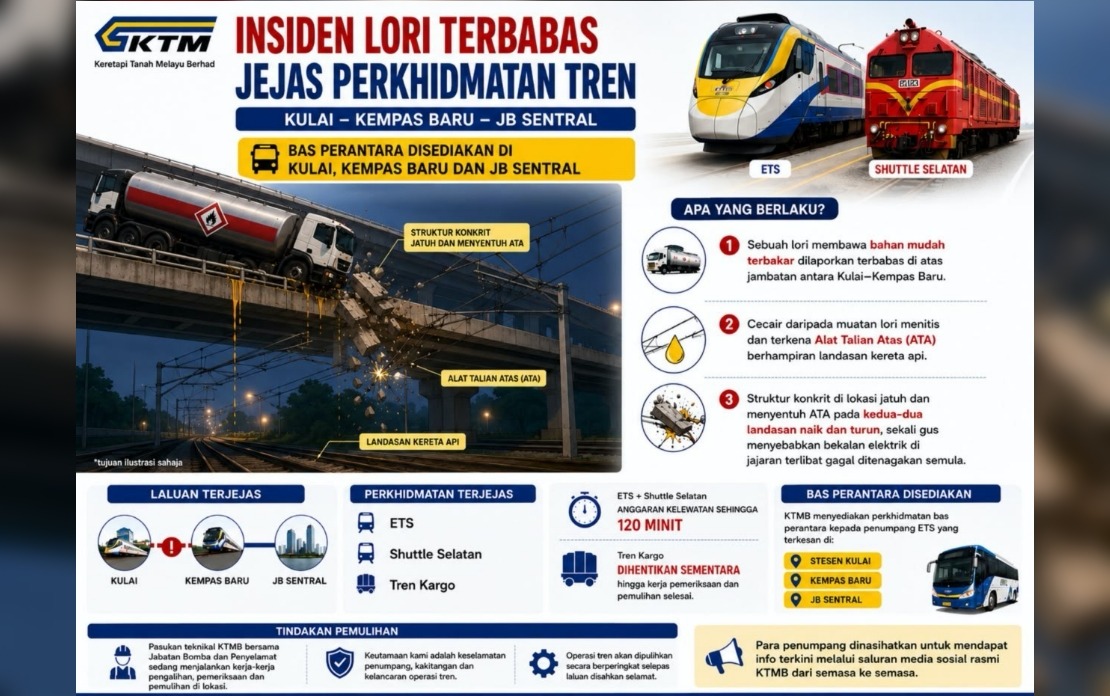
Train commuters on the Kulai–Kempas corridor faced significant service disruptions on August 5 when a lorry transporting flammable liquid skidded onto the railway reserve, severing the electrical supply to both the Shuttle Selatan and ETS operations. The incident occurred in the Johor Bahru area and immediately halted traffic on one of the region's busiest commuter routes, stranding thousands of passengers and triggering an emergency response from railway operators and cleanup crews.
Keretapi Tanah Melayu Berhad (KTMB), the national operator, confirmed through official channels that the power disruption was caused by the vehicle's proximity to the tracks. The accident necessitated immediate stabilisation efforts to prevent further damage to infrastructure while technicians worked simultaneously on restoring electrical connectivity. The dual shutdown of both Shuttle Selatan—the premium express service—and the conventional ETS represented a comprehensive collapse of rail services in the corridor, compounding the impact on daily commuters and commercial traffic.
The scale of the disruption became apparent within minutes of the incident. ETS service 9449 fell behind schedule by 32 minutes, while service 9533 faced significantly longer delays of 55 minutes as of late evening. These figures were provided on a provisional basis, with KTMB cautioning that recovery times remained contingent on how quickly repairs could proceed and whether secondary complications emerged. The uncertainty underscored the cascading nature of transport disruptions, where a single infrastructure failure ripples through an entire network.
Railway management moved swiftly to mitigate passenger inconvenience by deploying shuttle buses at three strategic points along the affected segment. Kulai, Kempas Baru, and JB Sentral stations became distribution hubs where stranded commuters could board replacement services. This contingency arrangement, while not seamless, prevented a complete transportation collapse and allowed thousands of workers, students, and traders to continue their journeys, albeit with extended travel times and modified routes.
Passengers holding Shuttle Selatan tickets faced the additional burden of locating alternative transportation options, as replacement bus services were not being automatically provided for this premium tier. KTMB advised these passengers to explore other modes of transport independently, whether through ride-sharing platforms, conventional buses, or private arrangements. This distinction in service provision between the two service tiers highlights the operational complexity of integrated rail networks and the cascading consequences when primary infrastructure fails.
Compensation measures were announced to ease the financial impact on affected passengers. KTMB indicated that fare adjustments would be extended to those impacted by the disruptions, though specifics regarding calculation methodology and claim procedures were not immediately detailed. This commitment to fare reimbursement represents standard practice in such circumstances and aims to restore confidence in railway service reliability, even as the underlying infrastructure vulnerability remains exposed.
The incident exposed critical dependencies in Malaysia's transportation infrastructure. The Kulai–Kempas route serves as a vital economic corridor linking Johor's industrial zones with residential areas and the state capital. Disruption to this segment affects not only individual commuters but also supply chain operations, business continuity, and regional economic productivity. The presence of hazardous goods vehicles operating in proximity to electrified rail corridors presents ongoing risk that warrants examination of traffic management protocols and safety buffers.
For Malaysian transportation authorities and planners, the accident underscores the urgency of infrastructure redundancy and improved coordination between road and rail safety frameworks. The vulnerability of electrical systems to external interference, whether through direct contact or electromagnetic effects, remains a concern across modernising transport networks in Southeast Asia. As rail expansion continues throughout Malaysia and the region, lessons from such incidents must inform design standards and operational procedures.
KTMB's public communications during the incident demonstrated institutional transparency, with real-time updates posted to social media and clear guidance provided to passengers. Station staff were mobilised to assist stranded commuters, and the organisation's apology acknowledged the severity of inconvenience imposed on the travelling public. This responsive approach, while not preventing the disruption itself, at least contained secondary damage to KTMB's operational reputation and passenger trust.
For commuters dependent on this route, the August 5 disruption served as a reminder of the fragility underlying modern mass transit systems. Although recovery proceeded relatively swiftly and substitute services partially compensated for the outage, the incident highlighted the importance of infrastructure maintenance, hazardous goods management near sensitive facilities, and contingency planning. As Malaysia continues developing its rail network, such incidents provide valuable data for refining safety protocols and ensuring that economic growth in transportation is matched by corresponding advances in system resilience.

