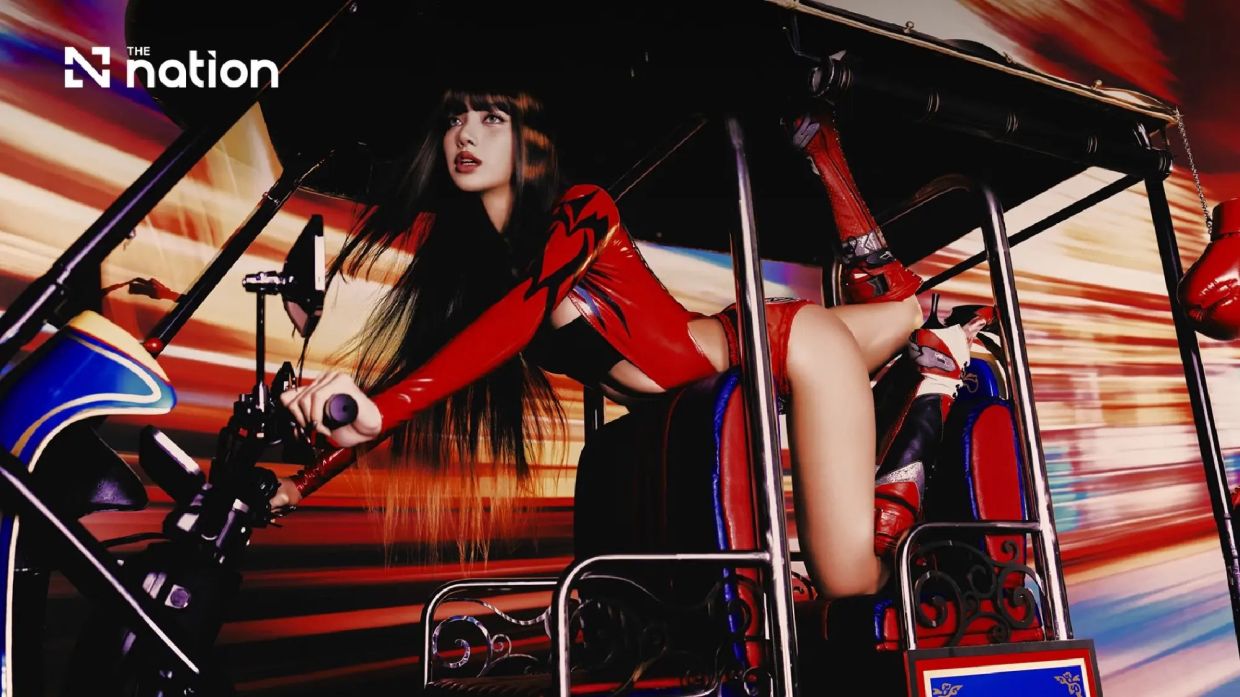
BLACKPINK singer Lalisa Manobal has crafted her latest solo venture around distinctly Thai symbols, positioning Muay Thai and the country's signature three-wheeled taxis at the visual heart of her upcoming single "SaWaDiKa". The campaign, which unfolded through teaser imagery released ahead of the track's September 3 debut, represents a deliberate statement about cultural identity from an artist who has consistently used her global platform to represent Thailand internationally.
The campaign imagery reveals Lisa in contemporary reinterpretations of traditional combat-sport styling rather than literal replications of conventional Muay Thai ring wear. One photograph captures her in boxing shorts bearing her name in embroidered lettering, anchoring the design in the sport's practical aesthetic while elevating it through high-fashion execution. A second image positions her astride a distinctively painted blue-and-red tuk-tuk, draped in a leather bodysuit and lace-up boots that reference both boxing footwear and broader Muay Thai visual language. The creative treatment uses streaked lighting effects to convey motion and velocity, transforming the humble transport vehicle into a dynamic element of the modern visual narrative.
The title itself carries layered significance for Malaysia and the broader Southeast Asian region. "SaWaDiKa" stylises "sawasdee ka", the polite Thai greeting universally recognised across the region and used in daily interaction throughout Thailand. By elevating a simple everyday phrase into the name of a globally distributed music release, Lisa has centred the Thai language within her creative vision, making linguistic and cultural authenticity inseparable from the commercial project. Thapanee Kiatphaibool, governor of the Tourism Authority of Thailand, publicly welcomed the initiative, noting that the promotion of the greeting resonates with international perceptions of Thai warmth and hospitality.
This artistic choice reflects Lisa's existing formal role as an "Amazing Thailand Ambassador", a designation she accepted in 2025 following her appointment by the TAT to represent the nation's character and cultural identity to international audiences. The integration of that ambassadorial responsibility into her creative output demonstrates how celebrity soft power functions as an extension of formal diplomatic and tourism strategy. For Malaysia, observing how Thailand has mobilised one of its most internationally visible artists to promote cultural symbols offers insights into nation-branding approaches that regional competitors might emulate or learn from.
The campaign's global rollout began before the single's official announcement, with enigmatic outdoor displays featuring Thai and English versions of the greeting appearing across major metropolitan centres including Bangkok, New York, Los Angeles and Mexico City. This coordinated international deployment created anticipatory momentum among fanbase communities while simultaneously broadcasting Thai language and cultural references to mainstream audiences in key entertainment markets. The strategy demonstrates a sophisticated understanding of how social media speculation and pre-release marketing can amplify reach beyond traditional music industry channels.
The broader pattern reveals Lisa's deliberate construction of a visual and thematic narrative around Thai cultural elements. Her 2021 solo debut "LALISA", which drew its title directly from her given name, prominently featured traditional Thai dress and dance-inspired imagery, with the music video presenting her in elaborate gold costume and headdress set against architectural references to Buri Ram province, her birthplace. Lisa subsequently explained that she had specifically requested Thai cultural inclusion within that project, establishing artistic agency over how her heritage appeared in her work. The follow-up single "Rockstar" in 2024 brought that cultural connection into contemporary urban space, utilising Yaowarat Road in Bangkok's Chinatown and other city locations as visual backdrops within a futuristic pop aesthetic.
"SaWaDiKa" extends this trajectory by synthesising multiple layers of Thai identity—the martial art universally recognised as distinctively Thai, the transport form that international visitors immediately identify with Thailand, and the language itself. This convergence moves beyond superficial cultural reference and into genuine thematic coherence. The campaign positions these elements not as exoticised additions to a Western pop framework but as central, integrated components of the artistic vision itself. For Malaysian audiences and broader Southeast Asian observers, this approach contrasts with how regional artists sometimes deploy cultural elements as secondary additions rather than foundational design principles.
The single arrives as the lead track from Lisa's forthcoming six-track extended play titled "PRESS PLAY", scheduled for release on October 23. The project's framing emphasises return and progression, presenting it as a return to Lisa's artistic origins while celebrating her journey from Thailand to international prominence. This positioning resonates with how transnational Asian artists increasingly articulate their trajectories—not as departures from cultural origin points but as expansions that maintain connection to those origins while accessing global platforms. The remaining five tracks on the EP have not yet been publicly identified, leaving space for additional revelations as the project's release approaches.
"SaWaDiKa" will debut at 5pm Pacific Time and 8pm Eastern Time on September 3, which translates to 7am on September 4 in Thailand, ensuring the release reaches domestic audiences during morning hours when music consumption patterns typically accelerate. This scheduling precision demonstrates attention to regional listening habits and the importance of coordinating release timing across multiple time zones for maximum initial impact. The release strategy reflects evolving approaches to global music distribution where simultaneous availability across markets has become standard practice for major international artists.
For the Malaysian music industry and Southeast Asian cultural observers, Lisa's campaign illustrates how artists with international reach can leverage global platforms to promote regional cultural symbols without requiring explicit government or institutional backing. The organic integration of Thai cultural elements into commercially significant music releases generates international visibility and engagement with Southeast Asian identity markers in ways that traditional tourism or cultural diplomacy sometimes cannot achieve. As the region increasingly competes for international attention and cultural influence, understanding how individual artists contribute to broader soft-power narratives becomes increasingly relevant to considerations of regional cultural standing and economic impact through creative industries.

