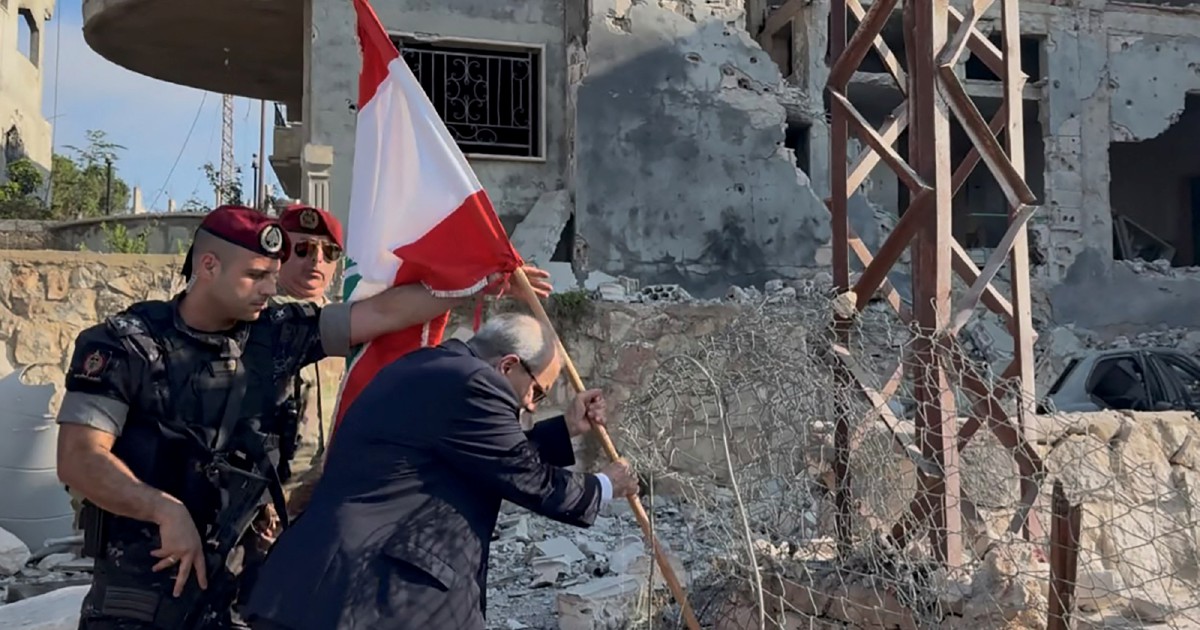
Lebanese Prime Minister Nawaf Salam has declared that his government is committed to securing a complete Israeli withdrawal from all occupied Lebanese territory, marking a forceful reassertion of Beirut's negotiating position as the country seeks to consolidate recent ceasefire gains. The statement, made during a visit to Zawtar al-Gharbiyah on Wednesday, comes at a critical juncture as Lebanon's military apparatus expands its footprint in southern border regions following months of intensive conflict that devastated civilian infrastructure and displaced hundreds of thousands of people.
Salam's emphasis on "complete" withdrawal underscores the distinction between temporary ceasefires and the comprehensive territorial resolution that Lebanese officials view as essential for genuine stability in the region. The linguistic precision in his phrasing signals that partial measures or indefinite occupation remain unacceptable to Beirut, despite the immediate military advantages any ceasefire might provide. This rhetorical stance serves multiple audiences simultaneously—reassuring the Lebanese public that their government has not abandoned territorial integrity while simultaneously signalling to international mediators, particularly the United States and France, that Lebanon's demands have not diminished even as active hostilities have been suspended.
The timing of Salam's remarks during a tour of Zawtar al-Gharbiyah carries significant symbolic weight. This village represents the kind of Lebanese territory that has endured repeated cycles of occupation and conflict spanning decades. By positioning himself on the ground in a location where the Lebanese army has recently moved forces, Salam attempts to demonstrate tangible progress toward reasserting state authority in border areas—a fundamental objective that has eluded Lebanon for years given the dominant presence of Hezbollah and its affiliated militias in the same regions.
The deployment of Lebanese army units to these southern communities reflects an internationally-backed strategy to gradually establish Lebanese state control over areas that have effectively operated beyond government jurisdiction. International observers, particularly those monitoring any ceasefire arrangement, have emphasized that credible Lebanese military presence is essential to preventing the rapid remilitarization that has historically followed previous conflicts. The army's expanding presence thus becomes evidence, in Salam's narrative, that his government is actively fulfilling its responsibilities and working toward the territorial consolidation upon which any final withdrawal agreement must be based.
Israeli forces have occupied portions of southern Lebanon intermittently since 1978, with the nature and extent of this occupation shifting substantially over four decades of regional turbulence. The most recent phase of intensive conflict has reinforced in Lebanese consciousness the unresolved question of territorial sovereignty. Salam's invocation of complete withdrawal implicitly references United Nations Security Council Resolution 1701, which established principles for Lebanon's territorial integrity and the withdrawal of foreign forces following the 2006 conflict. The fact that these principles remain unfulfilled nearly two decades later illustrates the persistent challenges facing Lebanese negotiators.
For Malaysian and broader Southeast Asian observers, Lebanon's situation offers sobering lessons about the durability of disputed territorial arrangements. The repeated failure to secure permanent resolution of border questions creates perpetual instability that radiates outward, affecting regional security dynamics, refugee flows, and the ability of states to invest in development. Lebanon's experience suggests that without iron-clad international guarantees and verification mechanisms, declarations of withdrawal—even when formally agreed—may prove temporary or reversible.
The Lebanese government faces the delicate task of simultaneously managing domestic expectations, demonstrating strength to international partners, and engaging in pragmatic negotiations with parties that possess superior military capabilities. Salam's public statements must therefore be read as both genuine policy objectives and necessary political messaging to constituencies that have endured extraordinary suffering. The precision with which he frames Beirut's goals—complete rather than phased withdrawal—reflects awareness that partial measures will satisfy neither the Lebanese public nor the factional powers within Lebanese politics that wield significant influence over any eventual agreement.
The international dimension cannot be overlooked. The United States, which has mediated previous Israeli-Lebanese arrangements, remains invested in achieving outcomes that prevent future escalations while acknowledging Israeli security concerns regarding its northern border. France, historically influential in Lebanese affairs, has similarly engaged with various parties. Both powers will be attentive to whether Lebanese demands for complete withdrawal are being presented as negotiating positions that might accommodate compromise, or as absolute requirements that may prove unachievable through diplomatic means alone.
Salam's visit to areas of recent military redeployment also serves to demonstrate to skeptical Lebanese citizens that their government has not surrendered to external pressures despite the asymmetrical power balance. This domestic legitimacy, fragile though it may be, depends on maintaining the rhetorical stance that Lebanon's sovereignty and territorial integrity are non-negotiable. The challenge lies in translating this rhetoric into tangible results—a task that has defeated Lebanese governments repeatedly throughout the nation's modern history.

