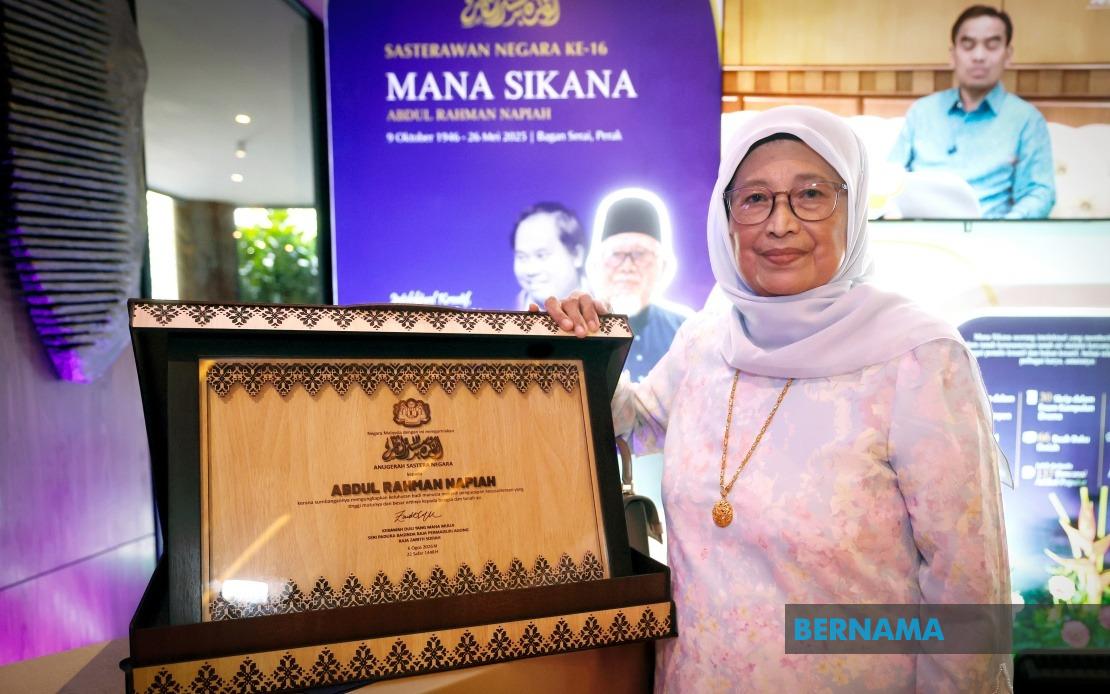
Malaysia's literary community has finally bestowed its highest honour upon the late Dr Abdul Rahman Napiah, better known by his celebrated pen name Mana Sikana, nearly five months after his death. The conferment of the 16th National Laureate title—presented by Her Majesty Raja Zarith Sofia, Queen of Malaysia—came during a ceremony in Kuala Lumpur that served as both celebration and poignant reminder of a life dedicated to advancing the nation's cultural landscape. Mana Sikana's widow, Salmah Ali, 82, received the award on his behalf, delivering emotional remarks about a recognition her husband had long anticipated but would not live to fully savour.
Salmah's acceptance speech revealed the depth of her late husband's professional ambitions and his awareness, in his final days, that such recognition might finally arrive. According to her account, Mana Sikana had been informed of the possibility of receiving this distinction before his death in May at age 80 from heart complications. The timing underscores a bittersweet reality familiar to many in Malaysia's intellectual circles: the nation's highest cultural honours often arrive late in an artist's life, sometimes too late. She recalled that on the very day he died, he was actively engaged in his professional duties, presenting a working paper at Dewan Bahasa dan Pustaka—the national language and literature authority—before experiencing the health crisis that would ultimately prove fatal.
Mana Sikana's career trajectory exemplifies the multifaceted nature of literary contribution that the National Laureate award recognizes. Beginning as a schoolteacher in Bagan Serai, Perak, where he was born on October 9, 1946, he evolved into a versatile creative force whose influence extended far beyond the written page. His early decades involved producing television and radio dramas, a medium through which literature reaches mass audiences and shapes cultural consciousness. During his time in Johor Bahru, he collaborated extensively with Singaporean broadcasters, creating works that aired across the region, before returning focus to Malaysian television productions. This multimedia engagement reflected an understanding that literature's impact depends partly on its accessibility and contemporary relevance.
His later career demonstrated the complementary relationship between creative practice and academic rigour. Pursuing further studies at Universiti Kebangsaan Malaysia, he rose to the rank of professor, thereby institutionalizing his knowledge within Malaysia's higher education system. His academic influence extended internationally through visiting lectureships at Indonesian universities, positioning him as a regional intellectual whose work shaped literary discourse across Southeast Asia. Throughout his tenure at various institutions—including UKM, Nanyang Technological University in Singapore, and Universiti Pendidikan Sultan Idris—he maintained the dual responsibility of scholar and creator, a balance that many literary figures struggle to achieve.
Education Minister Fadhlina Sidek's remarks at the ceremony framed Mana Sikana's selection as recognition of his comprehensive contributions to national literature through creative writing, literary theory, criticism, and academic discourse. This characterization acknowledges that literary development depends not merely on producing individual works but on constructing the intellectual infrastructure—theories, critical frameworks, and pedagogical approaches—through which communities understand and value literature. By serving as both practitioner and theorist, Mana Sikana contributed to raising literary consciousness across multiple generations of Malaysian readers and writers.
The family dimension of his legacy also warrants attention. Salmah noted that Mana Sikana shared his literary knowledge and passion with his four children and twelve grandchildren throughout his life, suggesting that his influence functioned within the domestic sphere as well as the public and academic realms. Such intergenerational transmission of intellectual values, though difficult to quantify in official assessments, often proves decisive in sustaining cultural traditions and encouraging new voices to engage with literature seriously.
For Malaysian readers and the broader Southeast Asian literary community, Mana Sikana's belated recognition raises questions about the mechanisms through which national culture is valued and commemorated. The National Laureate award, by honouring a figure whose contributions spanned nearly seventy years across teaching, creative work, drama production, and international academic exchange, affirms that literary significance encompasses more than publishing acclaimed novels or poetry collections. It acknowledges the cumulative impact of sustained engagement with language, form, and meaning.
The significance of this honour for Malaysia extends to questions of cultural continuity. In an era when younger writers and academics look to establish their own voices and relevance within rapidly changing media landscapes, Mana Sikana's career demonstrates how deep roots in language and tradition can coexist with innovation in presentation and form. His evolution from schoolteacher to internationally engaged scholar mirrors possibilities available to other Malaysian intellectuals willing to sustain long-term commitment to their discipline.
Salmah's emotional acceptance of the award also highlighted the personal cost of artistic dedication. She described her husband's lifetime accumulation of literary awards beginning in his school days, yet emphasized that the National Laureate designation held particular significance, perhaps because it represented recognition at the highest official level. That he learned of its likelihood before dying, yet did not live to receive it personally, embodies a poignancy familiar to many families of creative figures whose work extends far beyond their individual lifespans.
As Malaysia continues to recognize and celebrate its cultural contributors, Mana Sikana's posthumous honour prompts reflection on whether such recognitions arrive adequately during recipients' lifetimes. The decision to confer this title nevertheless ensures that his comprehensive body of work—spanning creative writing, academic scholarship, drama production, and pedagogical influence—receives formal acknowledgement within national literary history. For future generations of Malaysian writers and scholars, his example demonstrates the possibility of sustaining intellectual engagement across multiple forms and contexts over a lifetime's commitment to advancing the nation's literary consciousness and Southeast Asia's broader cultural development.

