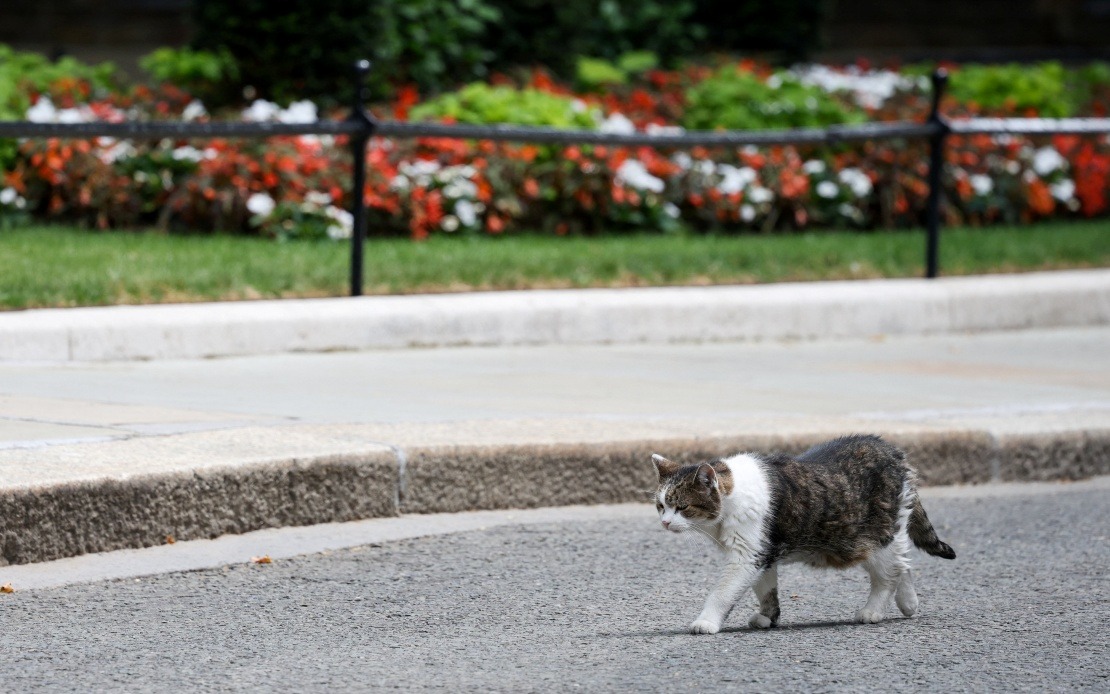
Larry, the resident feline of 10 Downing Street, has achieved a peculiar distinction in British politics: surviving the tenure of six different prime ministers while maintaining his post as the residence's most famous occupant. On 21 July, as the newly installed Prime Minister Andy Burnham convened his inaugural Cabinet meeting within the hallowed walls of the official residence, Larry was observed roaming the grounds outside—a scene that encapsulates the cat's remarkable staying power amid the constant churn of political leadership at the top of the British government.
The appointment of Andy Burnham marked another transition in the revolving door of Number 10, yet Larry's presence remained constant. While government ministers gathered indoors to discuss matters of state policy and executive decisions, the tabby cat went about his business in the gardens, seemingly indifferent to the political upheaval occurring just metres away. This tableau underscores the peculiar permanence of Larry's role—a position that has transcended the temporary nature of ministerial office and the political fortunes that determine who occupies the Prime Minister's chair.
Larry's longevity at 10 Downing Street represents a unique institutional memory within British politics. Unlike elected officials, civil servants, or appointed ministers, whose tenures depend on electoral cycles, party politics, and political fortune, the cat operates on a different timeline entirely. His presence spans administrations of vastly different political complexions and policy directions. The six prime ministers he has outlasted represent significant shifts in British political direction, yet Larry has maintained his position through each transition, adapting to new residents and new governing philosophies with the pragmatic indifference characteristic of felines.
For Malaysian and Southeast Asian observers, Larry's story offers an interesting contrast to the intensity of political transitions in the region. While British prime ministerial changes, particularly recent ones, have occurred with relative institutional stability and constitutional propriety, they nonetheless represent significant disruptions to the machinery of government. Larry's uninterrupted tenure illustrates how institutional symbols and continuity can persist even amid substantial political change. In developing democracies and established ones alike, such symbols of continuity serve important psychological and institutional functions, providing reassurance that governmental institutions transcend individual leaders.
The role of 10 Downing Street's cat dates back decades, with Larry representing the latest in a tradition of official residence cats tasked with pest control and, increasingly, with serving as a public-facing symbol of the Prime Minister's household. His social media presence has transformed what was once a purely functional role into a form of soft power, generating international goodwill and humanising the otherwise austere institution of the Prime Minister's office. In an era of intense political polarisation and public cynicism toward elected officials, Larry represents something apolitical and universally appealing.
Burnham's ascendancy to the premiership marks a significant moment in recent British political history, yet the presence of Larry outside his official residence during the first Cabinet meeting serves as a gentle reminder that governance involves both grand political narratives and the mundane continuities of institutional life. While political commentators analysed Burnham's first decisions and policy direction, Larry carried on with feline affairs, indifferent to these developments. This detachment from political consequence is precisely what gives the cat his cultural resonance.
The feline's longevity also reflects the institutional stability of the British civil service and the permanence of physical spaces like 10 Downing Street itself. While prime ministers come and go—sometimes serving full terms, sometimes departing after months of political turbulence—the residence, its staff, and its resident cat persist. Larry has absorbed considerable institutional knowledge simply through being present across multiple administrations. He has witnessed the private moments of six different sets of political leaders, seen the rise and fall of various policy initiatives, and observed the personal toll that the highest office in British politics exacts on those who hold it.
For British readers and international observers, Larry represents a comforting continuity amid perpetual political flux. In the United Kingdom, where constitutional conventions and institutional traditions carry considerable weight, the presence of such continuity matters significantly. Larry embodies the principle that some elements of governance transcend temporary political leadership and serve as anchors to institutional identity and historical continuity. His presence at 10 Downing Street predates many current political figures and will likely extend beyond them.
The symbolic weight of Larry's tenure extends to questions about what we value in governance and political leadership. While politicians are evaluated on their records, their policies, and their performance in office, Larry is evaluated solely on his capacity to be present. This simplicity contrasts sharply with the complexity and scrutiny applied to elected officials. There is something almost philosophical about a creature serving six different masters with the same equanimity, suggesting that some roles transcend the personalities and ideologies of those who temporarily hold power above them.
As Burnham settles into his role as Prime Minister and confronts the substantial policy challenges facing Britain, Larry will continue his daily routines within and around 10 Downing Street. The cat's indifference to political transitions serves as a gentle corrective to the intense focus on individual leaders and their immediate impact. Governance, Larry's presence reminds us, involves institutions, traditions, and continuities that persist regardless of who occupies the top office. For Malaysian readers observing British politics, Larry's story illustrates how even the most hierarchical and centralised political systems contain elements of permanence and continuity that transcend individual leadership changes.

