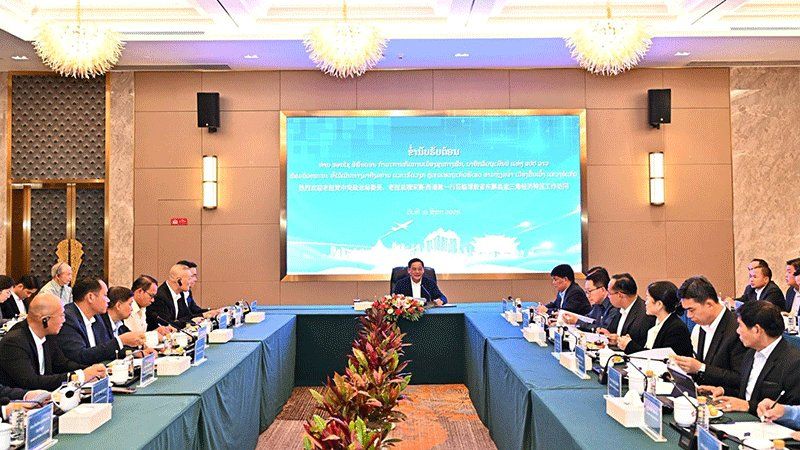
Prime Minister Sonexay Siphandone has intensified calls for stricter management and more environmentally conscious development at the Golden Triangle Special Economic Zone, signalling growing concerns about the trajectory of one of Laos's most ambitious economic projects. During a working visit to the 10,000-hectare zone in Tonpheung district, Bokeo province, on Tuesday (August 18), the premier outlined a range of reforms aimed at tightening oversight and ensuring that investment translates into genuine economic benefits. The zone, straddling the borders where Laos, Myanmar and Thailand converge near China, represents a cornerstone of Laos's regional integration strategy and has attracted cumulative investments reaching approximately US$10 billion since its establishment in 2007.
The premier's intervention comes at a critical juncture for the zone's development trajectory. With more than 19 years of operation, the Golden Triangle SEZ has evolved into a substantial economic hub housing over 10,000 registered workers and attracting tens of thousands of investors, business operators, residents and tourists. Yet beneath these headline figures lies a troubling reality: only 60 per cent of the business activities specified in contractual agreements have materialised, exposing significant gaps between initial commitments and actual performance. This shortfall prompted Sonexay to demand a comprehensive overhaul of management practices and more rigorous accountability measures from developers and operators.
The zone's physical footprint comprises 3,000 hectares designated for commercial development and 7,000 hectares preserved as forested areas, reflecting an attempt to balance economic expansion with environmental stewardship. However, the premier's emphasis on sustainability suggests that current development patterns may be eroding this balance. Companies operating across manufacturing, real estate, hospitality, finance, tourism and services sectors have established significant operations, yet the incomplete realisation of contractual obligations indicates that promised projects remain unfulfilled or have stalled. Sonexay's directive specifically targeted the need for improved investment environments and more efficient service delivery mechanisms, particularly through strengthening the zone's one-stop-service system to reduce administrative friction.
A cornerstone of the premier's reform agenda involves channelling financial transactions through Laos's banking infrastructure. By mandating that all commercial dealings—encompassing trade, investment, wage payments and service contracts—flow through the formal banking system, authorities aim to enhance financial transparency and create reliable records of economic activity. This measure addresses longstanding concerns about informal transactions and capital leakage that plague special economic zones across Southeast Asia. Sonexay also instructed officials to enforce the Law on Enterprises with greater vigilance, signalling that regulatory compliance will no longer remain aspirational but rather be actively monitored and enforced.
Border management and labour mobility represent additional dimensions of the premier's reform framework. Given the zone's strategic location at the tripoint border, controlling entry and exit has proven challenging, with workers regularly crossing from Myanmar, Thailand and increasingly from China. Sonexay called for enhanced mechanisms to regulate cross-border worker movements while simultaneously encouraging greater regional cooperation through expanded airline connectivity and streamlined bilateral arrangements. This approach recognises that the zone's competitiveness depends partly on reliable access to skilled labour from neighbouring economies, yet unfettered migration creates security and administrative complications.
The premier identified tourism, manufacturing, processing, transport, education and public health as priority sectors warranting accelerated investment and development. This sectoral targeting suggests a shift toward higher-value activities and services that can generate sustained employment and technical spillovers. Manufacturing and processing operations, coupled with transport infrastructure improvements, could position the zone as a regional hub for goods movement and value-added production. Meanwhile, education and healthcare investment responds to longstanding gaps in services availability across Bokeo province and reflects recognition that zones thrive when they offer comprehensive living environments rather than mere commercial spaces.
Sonexay's directive to enhance the zone's Management and Administration Committee reflects institutional weakness in governance structures. With more than 400 government officials already stationed at the zone, the issue is not staffing but rather coordination, decision-making authority and alignment of institutional incentives. The premier's insistence on improving concession agreements in accordance with relevant legislation suggests that existing contractual arrangements may contain ambiguities or outdated provisions that shield operators from accountability. Modernising these frameworks could clarify obligations, establish clearer performance benchmarks and create enforceable mechanisms for remedying breaches.
For Malaysia and other Southeast Asian economies, developments at the Golden Triangle SEZ carry broader implications. Laos's experience demonstrates that merely designating territory as a special economic zone and attracting foreign capital proves insufficient without robust regulatory frameworks and genuine institutional capacity. As Malaysia pursues its own regional integration ambitions and considers deepening economic ties with Laos through initiatives like ACMECS and CLMV mechanisms, the need for transparent governance and predictable regulatory environments becomes increasingly apparent. Malaysian investors and businesses operating in or considering entry into Laotian zones would benefit from the reforms now being championed by the premier.
The strategic location of the Golden Triangle SEZ—adjacent to the Mekong River and positioned as a gateway to consumer and labour markets across mainland Southeast Asia—ensures its continued importance despite current management challenges. However, realising its potential requires moving beyond promotional rhetoric to substantive institutional reform. Sonexay's August visit and subsequent directives suggest that Lao leadership recognises this imperative. Whether implementation will match the ambition of these pronouncements remains to be seen, but the premier's intervention signals that underperformance at the zone will no longer be tolerated as inevitable. Success in transforming the Golden Triangle SEZ into a genuinely productive and sustainable economic space would not only benefit Laos but would also strengthen investor confidence across the Mekong subregion.

