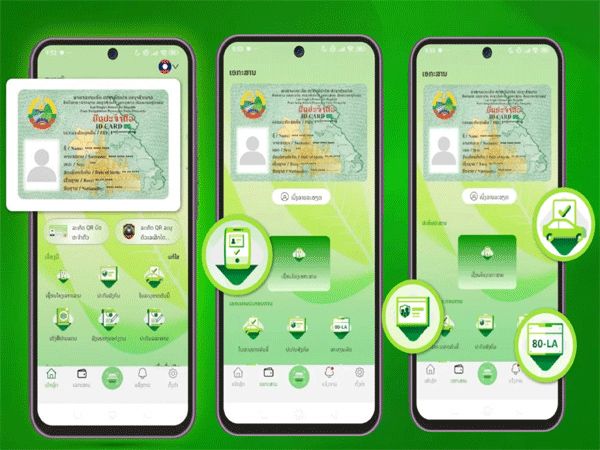
Laos has taken a major stride towards digital governance by formally retiring its traditional identity documentation system in favour of a unified mobile application. The Ministry of Public Security has begun rolling out the LAeID application nationwide, eliminating the long-standing white and green identity cards that have served as primary identification documents for Laotian citizens. Complementing this shift, paper household registration books—essential administrative records that citizens have carried for generations—are being phased out in favour of digital storage within the new platform. From July 18 onwards, these conventional documents can no longer be used for official transactions, signalling an irreversible transition toward a paperless administrative landscape.
The transition represents a deliberate policy choice to streamline government operations and citizen interactions with state institutions. The Office of the Ministry of Public Security has issued formal notice to all governmental bodies, public agencies, and organisations throughout the country, ensuring coordinated implementation of the LAeID system. Citizens are actively encouraged to register for digital identity credentials and establish electronic identification accounts through the application, which functions as a centralised hub for personal documentation. The phased approach acknowledges practical realities: rather than forcing simultaneous migration of all citizen services, Laos is beginning with core identity verification before progressively integrating additional administrative systems.
For ordinary Laotians, the practical benefits of this digitalisation are substantial and immediately tangible. Citizens will no longer need to accumulate multiple paper documents or navigate between different government offices to prove their identity or access various services. Instead of presenting physical papers across numerous transactions, individuals can verify their credentials through a single smartphone application, significantly reducing administrative friction. This convenience factor extends beyond mere personal benefit—it represents a fundamental restructuring of how citizens and government interact, lowering barriers to accessing essential services and reducing time spent navigating bureaucratic processes.
The underlying rationale driving this transformation extends to systemic efficiency and cost reduction across both individual and institutional levels. The Ministry projects that the LAeID system will substantially diminish paperwork requirements, decrease operational expenses for government agencies, and enhance the speed and reliability of public service delivery. By consolidating citizen data within a unified digital framework, authorities expect to streamline internal government operations while simultaneously improving data governance and administrative coherence. The transition also addresses longstanding inefficiencies inherent in paper-based systems, such as documentation loss, data inconsistency across agencies, and time-consuming manual verification processes.
The LAeID application is architecturally designed to function as a comprehensive digital wallet containing critical personal credentials. Although the system currently operates in a foundational phase with only the digital identity function active, the long-term vision encompasses integration of substantially broader documentation. Future iterations will incorporate birth certificates, marriage certificates, health insurance credentials, social security records, vehicle registration documents, driving licences, and passport information—essentially transforming the application into a single authoritative source for official identification across multiple domains. This phased development strategy allows the government to establish stable core functionality before expanding into more complex integrations with disparate government databases.
The implementation architecture reflects practical understanding of digital system deployment challenges. Citizens must first register for a digital identity card through district or provincial public security offices located nationwide, establishing the foundational credential required for all subsequent digital interactions. Once registered, individuals can activate their electronic identification account within the LAeID application using their citizen identity number as a username, with password authentication handled through SMS verification or manual creation during registration. The Ministry of Public Security maintains administrative control over the entire system, ensuring consistent standards and security protocols across the network.
Laos's embrace of digital identification technology positions the nation within a broader regional trend toward modernised governance infrastructure. Several Southeast Asian countries have pursued comparable initiatives, recognising that digital identity systems provide essential infrastructure for expanded e-government services and improved administrative efficiency. The LAeID system reflects Laos's commitment to this trajectory, explicitly framing the initiative as integral to the country's overarching digital transformation agenda aimed at modernising public administration and expanding citizens' access to digital public services. This positioning suggests government recognition that technological advancement represents a necessary pathway toward institutional effectiveness and competitive governance capacity.
The progressive linking of government databases with the LAeID platform promises to fundamentally alter citizens' engagement with state institutions. As additional systems become integrated into the platform, individuals will increasingly conduct official transactions online without requiring physical office visits or document presentation. This capability carries particular significance for rural populations and citizens residing in remote areas, where geographic distance from administrative centres historically created substantial barriers to accessing government services. Digital accessibility could substantially democratise service delivery, particularly benefiting marginalised populations whose ability to conduct transactions has been constrained by practical limitations inherent in paper-based, office-centric systems.
The transition also generates implications for data security, privacy governance, and digital literacy across the population. Consolidating comprehensive citizen information within a centralised digital system creates both opportunities and risks regarding personal data protection. The government must establish robust cybersecurity frameworks, encryption protocols, and data access controls to prevent unauthorised breaches or misuse of sensitive personal information. Simultaneously, successful adoption requires substantial digital literacy initiatives, particularly among older populations and citizens with limited technological familiarity. Government agencies will need to provide accessible support mechanisms and alternative verification procedures during the transition period to ensure that vulnerability to technological barriers does not create de facto exclusion from essential services.
The LAeID system's establishment marks a significant inflection point in Laotian public administration, signifying governmental commitment to technological modernisation despite the inherent complexities of system-wide transitions. The phased implementation approach demonstrates pragmatic recognition that digital transformation requires time, careful coordination, and attention to technical and human factors affecting system adoption. As additional government databases become integrated and citizens become increasingly comfortable utilising the platform, the LAeID application is likely to become indispensable infrastructure for accessing Laotian public services, fundamentally reshaping administrative interactions for an entire generation of citizens and establishing technological foundations for more sophisticated digital governance initiatives.
Regional observers view Laos's digital identity initiative within the context of broader Southeast Asian development trajectories. The LAeID system reflects convergent recognition across the region that digital infrastructure investment enhances governmental capacity, reduces administrative costs, and improves citizen service experiences. Successful implementation could position Laos as a model for other nations pursuing comparable digital transformation agendas, while failure or suboptimal execution might reveal instructive lessons regarding challenges inherent in large-scale technology deployment across diverse populations with varying technological access and capabilities. The initiative therefore carries significance extending beyond Laotian borders, offering insights relevant to regional governance modernisation discussions.

