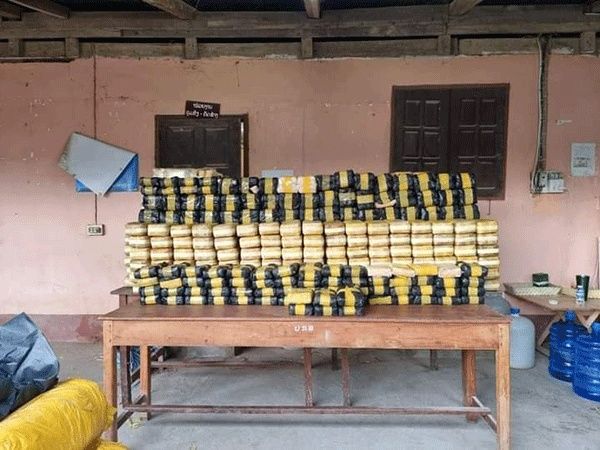
Authorities in Xaysomboun Province, located in central Laos, have signalled an urgent need for intensified action against drug trafficking following troubling crime statistics that reveal narcotics offences now dominate the provincial security landscape. During the opening six months of this year, drug-related cases accounted for 24 of the 54 criminal matters handled by the Xaysomboun Provincial Public Security Force—a stark figure representing nearly 44 percent of all recorded criminal activity in the region. The concentration of drug offences underscores how thoroughly narcotics trafficking has penetrated the province's criminal environment, eclipsing other categories of lawbreaking and establishing itself as the foremost public security challenge facing local authorities.
The processing of these cases has proceeded unevenly, highlighting potential resource constraints within the provincial security apparatus. Of the 24 drug-related investigations, only two had reached conclusion and referral to prosecutorial authorities by mid-year, while the remaining 22 cases remained suspended in various stages of investigation. This distribution suggests that the volume of narcotics offences is straining the province's investigative capacity, leaving cases to accumulate in the system for extended periods. When examining the broader crime picture, the provincial force managed to settle just six matters overall, formally conclude four cases for prosecution, and achieve resolution on 15 additional cases, leaving 29 investigations ongoing—a pattern indicating systemic processing delays across the criminal justice response.
The alarm sounded by provincial law enforcement leadership underscores Laos's deepening struggle with transnational drug networks. Police Brigadier General Ouday Insouvanh, commanding the Xaysomboun Provincial Public Security Force, presented these figures during a visit by Police Lieutenant General Vanthong Kongmany, the nation's Minister of Public Security, on August 7. The high-level engagement signals Vientiane's recognition that provincial drug problems merit direct ministerial attention and intervention. General Ouday's emphasis on maintaining political stability and social order during the six-month period, alongside ongoing intelligence collection and security monitoring, frames drug enforcement as integral to broader state consolidation objectives rather than a discrete law enforcement challenge.
The national government has consistently prioritised drug suppression as a central pillar of state security policy. Prime Minister Sonexay Siphandone reported to the National Assembly during an extraordinary session last month that Laotian authorities processed 1,786 drug-related cases nationwide during the first six months of 2024, resulting in the arrest of 4,025 suspects—including 93 foreign nationals. The seizure of substantial quantities of narcotics, ancillary drug manufacturing and distribution equipment, and vehicles employed in trafficking operations demonstrates the scale of enforcement operations across the country. The designation of drug suppression as a national agenda five years prior reflects longstanding governmental commitment, yet the continued prevalence of narcotics offences suggests that enforcement strategies have yet to achieve breakthrough results against entrenched trafficking organisations operating across Southeast Asia's complex cross-border environment.
Minister Vanthong's directives extend police responsibilities well beyond traditional drug enforcement into emerging security domains that reflect evolving criminal methodologies. He instructed the Xaysomboun Provincial Public Security Command to strengthen monitoring of social media platforms and develop capacity to combat cybercrime, aligning local operations with ministry-wide cybersecurity priorities. This expansion acknowledges that contemporary criminal enterprises leverage digital infrastructure for coordination, money laundering, and trafficking operations, requiring police forces to develop technical capabilities and digital literacy among personnel. The integration of cyber-focused responsibilities alongside conventional crime suppression—encompassing smuggling, human trafficking, theft, burglary, illegal mining, and gambling operations—reflects the complexity of modern policing in a developing nation seeking to prevent criminal networks from exploiting technological gaps.
Road safety emerged as an equally pressing concern during ministerial consultations, revealing the multifaceted nature of provincial security challenges extending beyond deliberate criminality. The Xaysomboun Provincial Public Security Force recorded 60 traffic accidents during the six-month period, resulting in four fatalities, 80 injuries, and damage to 109 vehicles valued at losses exceeding 2.56 billion kip. These figures translate into profound human costs—bereaved families, permanent disabilities, and substantial economic burdens placed on communities and households already constrained by limited financial resources. The casualty toll illustrates how inadequate road infrastructure, insufficient vehicle maintenance, lax enforcement of traffic regulations, and driver behaviour deficiencies create compound risks to public welfare, demand comparable governmental prioritisation alongside narcotics enforcement, and require sustained investment in both highway safety infrastructure and driver compliance mechanisms.
Tourism and foreign national management represent another dimension of provincial security operations that receives ministerial oversight. During the first six months of 2024, the Xaysomboun Provincial Public Security Command inspected 1,698 tourists residing temporarily in the province, of whom 396 were foreign nationals. This monitoring function reflects Laotian state apparatus concerns regarding border security, prevention of undocumented migration, counterterrorism precautions, and national sovereignty maintenance in frontier regions. The systematic inspection regime demonstrates how tourism development and security imperatives intersect in provincial governance, requiring police forces to balance commercial interests with surveillance obligations—a tension particularly acute in provinces hosting international travellers who may originate from nations with strained diplomatic relations toward Laos or regional partners.
Minister Vanthong's address to provincial security leadership articulated expectations extending beyond operational crime suppression toward institutional transformation and personnel development. He emphasised strengthening political and ideological education among officers and personnel, directing compliance with Communist Party directives, state legislation, and public security force disciplinary protocols. This emphasis reflects enduring mechanisms of political control within Laotian security apparatus, ensuring that law enforcement personnel operate within ideological parameters established by state and party hierarchies. The ministerial instruction that officers acknowledge institutional weaknesses rather than passively awaiting superior directives, accept direct responsibility for operational outcomes, and adapt methodologies to shifting criminal environments suggests recognition that centralised command structures may inhibit adaptive responses necessary for effective contemporary policing.
The ministerial address also highlighted immigration management and foreign national oversight as requiring professionalised, expertise-based approaches rather than ad hoc procedural administration. Minister Vanthong directed that immigration operations maintain professional standards, clearly delineate institutional responsibilities, and assign personnel according to demonstrated competence levels—recommendations implying that current immigration administration may suffer from inadequate specialisation or capacity constraints. Additionally, he required that investigations, detention protocols, and rehabilitation procedures consistently adhere to legal frameworks, a directive that perhaps obliquely addresses concerns regarding extrajudicial detention practices or prosecutorial shortcuts that may characterise enforcement operations in developing Southeast Asian security systems lacking robust independent oversight mechanisms.
The evolving security landscape in Xaysomboun Province reflects broader transnational challenges confronting Laos and the wider Southeast Asian region. As narcotics trafficking organisations continuously refine transportation routes, concealment techniques, and distribution networks to circumvent enforcement efforts, provincial and national authorities must correspondingly innovate investigative methodologies, international cooperation arrangements, and institutional capacity. The concentration of drug offences in Xaysomboun, a province bordering Thailand and positioned within broader Southeast Asian trafficking corridors, indicates that local enforcement faces structural disadvantages against transnational criminal enterprises commanding financial resources, operational sophistication, and cross-border mobility advantages. Sustainable progress against narcotics trafficking will require sustained ministerial commitment, substantial institutional investment, international cooperation frameworks with neighbouring states, and extended timeframes for results—none of which can be achieved through enforcement initiatives alone without complementary demand reduction, prevention, and treatment interventions addressing root causes of drug consumption and production.

