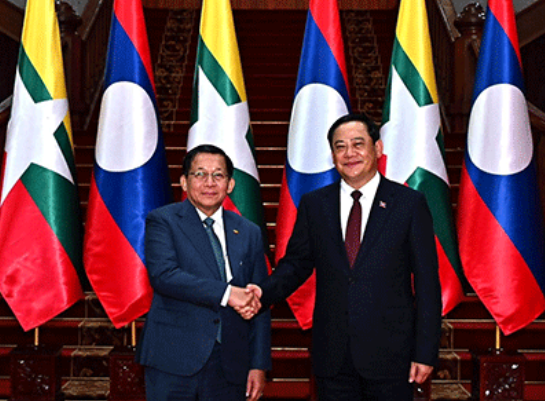
Myanmar President Min Aung Hlaing has concluded a three-day state visit to Laos that reinforced the bonds between two of mainland Southeast Asia's closest neighbours. Arriving in Vientiane on July 3 at the invitation of President Thongloun Sisoulith, the Myanmar leader and his delegation participated in a ceremonial programme designed to underscore the 70th anniversary of formal diplomatic relations between Laos and Myanmar. The visit carried significant symbolic weight in regional terms, marking Myanmar's first official foreign engagement at the presidential level since the formation of its current government.
The centrepiece of the visit was a comprehensive series of bilateral meetings that revealed the breadth of cooperation these two nations are pursuing. President Thongloun welcomed his counterpart with a full ceremonial reception at the Presidential Palace, setting the tone for substantive discussions about the future direction of relations. During their official talks, the two presidents reviewed existing areas of collaboration and identified new domains for partnership, while also addressing regional developments and their mutual strategic interests. The tone throughout suggested not merely the maintenance of existing ties but an active drive to expand engagement across multiple policy spheres.
What makes the Laos-Myanmar relationship particularly significant for the wider region is the way it bridges different approaches within Southeast Asia. Myanmar's involvement in various multilateral frameworks—from the Association of Southeast Asian Nations to the broader Mekong-Lancang Cooperation initiative—gives these bilateral ties implications that extend well beyond the two countries themselves. Both leaders underscored their commitment to enhanced coordination in these regional and international forums, recognising that their bilateral partnership serves as a foundation for coordinated action on issues of common concern. This positioning is especially relevant as Laos increasingly moves to assert itself as a connector between Southeast Asia and China.
The practical dimension of the relationship came into sharp focus through specific sectoral agreements signed during the visit. The two countries formalised new arrangements on tourism cooperation, establishing collaborative mechanisms between Myanmar's Ministry of Hotels, Tourism and Culture and Laos' Ministry of Culture and Tourism. Simultaneously, Vientiane and Naypyidaw were designated as sister cities, a move designed to foster cultural and institutional exchanges at the municipal level. These formal agreements, while sometimes dismissed as ceremonial in nature, represent the practical infrastructure through which bilateral relationships function operationally.
Defence and security cooperation emerged as a priority area for both sides, reflecting geographical realities and shared concerns about border management. The two nations pledged to strengthen coordination on border security matters and information sharing, essential considerations given that Laos and Myanmar share a land frontier and face common challenges related to transnational crime and irregular movement. Their agreement to deepen collaboration through the Laos-Myanmar Joint Committee on Bilateral Cooperation establishes an institutional mechanism for translating these commitments into concrete action. Such frameworks are particularly important in mainland Southeast Asia, where porous borders and weak institutional capacity can complicate bilateral management.
The parliamentary dimension of the engagement added another layer to the bilateral relationship. When President Min Aung Hlaing met with Xaysomphone Phomvihane, President of Laos' National Assembly, the two officials pledged to strengthen cooperation between their respective legislatures. This is a noteworthy development in a region where parliamentary institutions sometimes play secondary roles in foreign policy formulation. By explicitly engaging the legislative branch, both countries signal an intention to embed bilateral agreements within their respective domestic political structures, potentially ensuring greater durability and implementation than if such understandings remained confined to executive bodies. Xaysomphone indicated that the National Assembly would play an active monitoring role in tracking the implementation of bilateral agreements, suggesting accountability mechanisms that may enhance follow-through.
Trade and investment cooperation featured prominently in discussions, though the visit communiqués provided limited specificity about concrete commercial targets or timelines. Both leaders committed to enhancing collaboration in this domain, alongside energy, transportation and labour mobility arrangements. For Myanmar, deepening economic ties with Laos potentially offers an alternative avenue for maintaining regional integration at a moment when international relations remain complicated by political sensitivities. For Laos, strengthened economic cooperation with Myanmar could diversify its engagement patterns and reduce excessive dependency on any single economic partner. The emphasis on labour cooperation is particularly relevant for Laos, which hosts significant numbers of Myanmar migrants in its workforce.
The humanitarian and public health dimensions of the relationship were symbolically emphasised through the handover of snake antivenom serum from Myanmar to Laos' Ministry of Health. While seemingly modest in scope, such exchanges reflect both practical development cooperation and the everyday realities of public health challenges in mainland Southeast Asia. Cross-border health issues, including disease transmission and the management of endemic conditions, are areas where bilateral cooperation can yield tangible benefits for ordinary citizens in both nations.
President Thongloun's public appreciation for Myanmar's recent electoral process and formation of its new government carried diplomatic significance. By explicitly congratulating Myanmar on these domestic political developments and expressing confidence in its future trajectory under President Min Aung Hlaing's leadership, the Lao President positioned his country as a supportive neighbour willing to engage positively with Myanmar's political evolution. In a region where Myanmar's international standing has been contested following recent political transitions, such affirmations of confidence from fellow Southeast Asian leaders carry weight in legitimising the current government within regional circles.
The symbolic components of the visit—including the laying of wreaths at the Unknown Soldier Monument and attendance at traditional Baci ceremonies and state banquets—reflect the cultural dimensions through which Laos and Myanmar express their connection. These ceremonial elements serve important functions in Southeast Asian diplomacy, creating atmospheres of personal warmth and mutual respect that can facilitate agreement on more substantive matters. The planned extension of the visit to Luang Prabang, where the Myanmar delegation would tour temples and cultural heritage sites, further reinforced this emphasis on civilisational and cultural affinity as foundations for modern political cooperation.
For Malaysian observers and the wider Southeast Asian community, the Laos-Myanmar engagement offers lessons about how smaller nations within ASEAN maintain bilateral relationships that serve broader regional interests. The emphasis on institutional mechanisms, parliamentary engagement, and sectoral cooperation demonstrates approaches to bilateral management that transcend simple rhetoric about friendship. As Myanmar continues navigating complex regional and international dynamics, its cultivation of strong ties with neighbours like Laos reflects a strategy of deepening Southeast Asian anchoring at a time when geopolitical pressures from major powers intensify. The 70-year history underpinning this relationship provides stability and trust upon which both nations are building contemporary cooperation frameworks designed to address 21st-century challenges.

