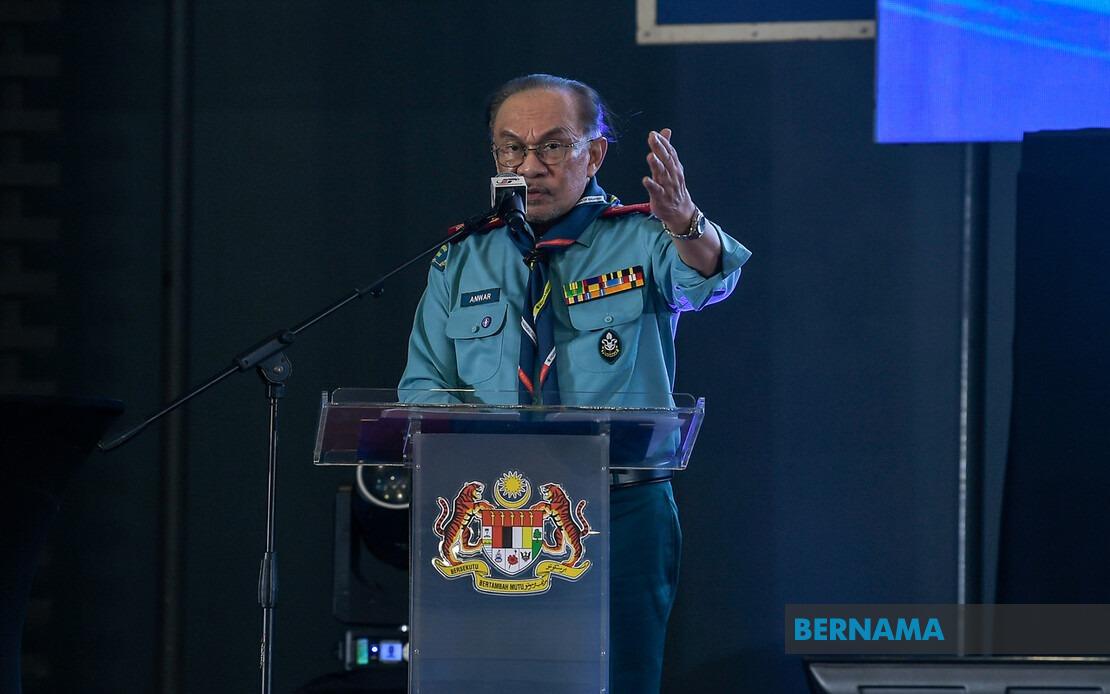
Prime Minister Datuk Seri Anwar Ibrahim has sought to ease tensions surrounding Malaysia's language policy by framing the promotion of Malay as complementary to, rather than competitive with, proficiency in other languages. Speaking at the Ambang Merdeka Sahabat MADANI 2026 highlight programme at Universiti Teknologi MARA (UiTM) Permatang Pauh on August 29, Anwar articulated a vision of linguistic pluralism that acknowledges both the constitutional role of Malay and the practical necessity of multilingual competence in an increasingly interconnected world.
The Prime Minister's remarks emerge amid recurring debates about Malaysia's language priorities, a sensitive issue that intersects with questions of national identity, cultural preservation, and educational strategy. By positioning multilingualism as an economic imperative rather than a cultural threat, Anwar attempted to reframe what has often been presented as a binary choice between protecting Malay and embracing global languages. His comments at the UiTM event suggest the government views language competency not as a finite resource to be divided among competing tongues, but as an expanding capability that serves Malaysia's diverse population and economic interests.
Critically, Anwar emphasised that every Malaysian citizen, regardless of ethnic background, should achieve proficiency in the national language. This framing reinforces the constitutional position of Malay while avoiding the polarising rhetoric that has characterised some previous policy discussions. The Prime Minister's insistence on this foundational principle signals that the government will not abandon efforts to ensure Malay remains central to national cohesion and institutional function, even as it welcomes multilingual development. For Malaysian students and professionals, this means the expectation of Malay fluency remains non-negotiable across educational and public service contexts.
Simultaneously, Anwar acknowledged English's transformed role in the global economy and information ecosystem. Rather than viewing English as a colonial legacy to be minimised, he characterised it as a practical tool that complements rather than supplants Malay. This pragmatic stance recognises that English proficiency remains essential for Malaysian workers competing in regional and international markets, from technology sectors to international business. By explicitly endorsing English's integration into Malaysian education and professional development, Anwar signalled openness to policies that strengthen English instruction without framing such efforts as culturally threatening.
The Prime Minister's recognition of Mandarin's growing economic significance carries particular weight for Malaysia, a nation with substantial Chinese-speaking populations and deep commercial ties to China and Taiwan. Anwar's encouragement for Malaysians to master Mandarin, contingent on maintaining strong Malay abilities, reflects the region's economic realities. As China's influence in Southeast Asia expands through trade, investment, and technological partnerships, linguistic capability in Mandarin increasingly translates into competitive advantage for Malaysian businesses and professionals. This position acknowledges demographic and economic facts while maintaining the primacy of Malay in national institutions.
Tamil proficiency received explicit validation in Anwar's remarks, a notable inclusion that signals respect for Malaysia's Indian-origin communities and their cultural-linguistic heritage. By naming Tamil alongside English and Mandarin as a language worthy of strengthened proficiency, Anwar reinforced the principle of inclusive multiculturalism that the MADANI framework purports to advance. This rhetorical commitment to Tamil, historically marginalised in national language policy discussions, carries symbolic importance for Tamil-speaking Malaysians seeking recognition and resources for mother-tongue education and cultural preservation.
The Prime Minister's invocation of a non-zero-sum approach to language learning directly challenges the assumption that investment in one language necessarily diminishes others. This framing has significant policy implications for Malaysia's education system, where curriculum decisions about language allocation have long been contentious. By rejecting zero-sum logic, Anwar created conceptual space for educational models that integrate multiple languages more effectively, though the practical implementation of such models remains complex given curriculum time constraints and resource limitations. The intellectual framework he presented, however, could guide future education policy away from winner-take-all competitions between linguistic communities.
Anwar's insistence that linguistic development serves economic opportunity and national competitiveness rather than cultural capitulation represents a deliberate depoliticisation of language questions. By framing multilingualism as a practical investment in individual and national futures, the Prime Minister sought to shift discussion away from identity politics and toward pragmatic capability-building. This rhetorical strategy acknowledges that Malaysian families increasingly view language learning as essential to their children's social mobility and professional prospects, a motivation that transcends ethnic or ideological boundaries. For Malaysian parents concerned about their children's competitive positioning in the job market, this message validates investments in multiple languages as rational economic decisions.
Yet beneath this consensual framing of linguistic complementarity lie persistent tensions in Malaysian society regarding language, culture, and belonging. The very fact that a Prime Minister felt compelled to publicly clarify that Malay advocacy does not require diminishing other languages suggests that such anxieties remain widespread across communities. These concerns often reflect deeper fears about cultural preservation, economic opportunity distribution, and the pace of social change. Anwar's reassurances, while intellectually coherent, may not fully address underlying concerns among communities worried about relative status or resources. The challenge for policymakers lies in translating these rhetorical commitments to linguistic pluralism into concrete educational investments and institutional arrangements that genuinely serve all communities.
Anwar also pivoted toward themes of national unity and social cohesion, warning against efforts to sow inter-ethnic discord through inflammatory language around cultural questions. His emphasis on shared responsibility for maintaining harmony reflects recognition that language debates can easily become proxies for deeper identity conflicts. By urging Malaysians to embrace principles of mutual support and inclusive development, Anwar sought to anchor language policy discussions within a broader framework of national solidarity. This appeal to common citizenship and collective interest, while frequently reiterated by Malaysian leaders, remains perpetually fragile in a society where different communities maintain distinct concerns about cultural survival and institutional fairness.
The significance of Anwar's remarks extends beyond immediate language policy to encompass broader questions about Malaysia's self-conception as a multilingual, multicultural nation navigating regional and global integration. His vision of complementary linguistic competencies reflects aspirations to position Malaysia as an economically dynamic, culturally confident society capable of engaging multiple civilisational traditions simultaneously. Whether such aspirations can translate into educational systems and employment practices that genuinely reward multilingual competence, rather than merely celebrating it rhetorically, will determine whether language policy in Malaysia can truly transcend the zero-sum conflicts that have historically marked these debates.

