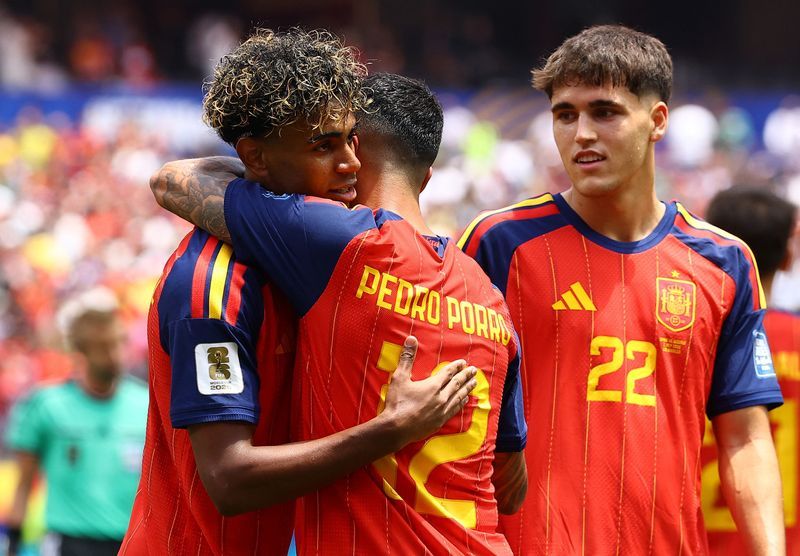
Spain's convincing 3-0 triumph over Austria represents far more than a routine knockout progression—it signals the restoration of a team that briefly lost its way when forced to operate without one of football's most intriguing young talents. At just 18 years old, Lamine Yamal has become the unexpected pivot around which Luis de la Fuente's defending European champions are reorganising their approach, blending the possession-based principles that defined their Euro 2024 success with a new dimension of individual dynamism that opponents struggle to contain.
The injury-troubled early stages of the tournament had cast shadows over Spain's prospects. Yamal arrived in North America nursing a persistent hamstring problem, forcing de la Fuente to bench the Barcelona Academy graduate for Spain's opening match against Cape Verde. That goalless draw exposed uncomfortable truths about a squad attempting to impose their trademark control football without the catalyst who had energised their continental campaign. The performance lacked the incisiveness and rhythm associated with a team fresh from winning every group match at the European Championship, suggesting that the collective machinery alone required additional spark to function at championship intensity.
Since stepping onto the pitch with greater regularity as his fitness improved, Spain have undergone a visible transformation. The foundational midfield architecture that underpins their philosophy remains intact—Rodri and Pedri still orchestrate proceedings with measured precision—but Yamal's growing influence has created an entirely new attacking vector that opposing defences cannot adequately address. His presence on the right flank forces opponents into tactical dilemmas: commit additional defenders to contain him and risk exposing central areas, or maintain defensive shape and grant him dangerous possession in advanced positions. Either choice carries consequences.
Yamal's technical sophistication extends beyond the ability to beat defenders in direct confrontations. What truly distinguishes the teenager is his capacity to make structured, systems-based football appear instinctive and spontaneous. Where Spain's approach typically emphasises geometric precision and positional discipline, Yamal introduces an element of unpredictability that confounds pre-set defensive organisation. His willingness to drift inside from the wing, combined with the positioning of Alex Baena on the opposite flank, creates numerical overloads in central areas that activate Rodri and Pedri more effectively than their original tactical setup could achieve.
The introduction of Baena alongside Yamal's increasing sharpness has proven transformative. Against Cape Verde, with Gavi and Ferran Torres occupying the wide berths in a more conventional formation, Spain appeared blunt and struggled to generate the penetrative movements that characterise elite attacking football. Baena's constant circulation of play and willingness to stretch the pitch horizontally has restored Spain's attacking balance, offering a secondary route of progression that complements Yamal's work on the opposite side. This dual threat forced Austria into perpetual adjustment, unable to consolidate defensive stability while tracking two distinct attacking channels.
Yamal's performance merited player-of-the-match recognition despite the absence of goals or assists—a detail that reveals something fundamental about Spain's evolved approach. While conventional tournament contenders rely heavily on prolific finishing from their primary attacking threats, Spain demonstrated they could accumulate comfortable victory margins through subtler processes: magnetic attraction of opposing defenders, disruption of defensive shape, and creation of conditions allowing secondary attackers to function more productively. This represents sophistication rather than limitation, suggesting a team confident in multiple pathways to victory rather than dependent upon individual brilliance alone.
The defensive dimension of Spain's performance deserves equivalent emphasis. Austria failed to register a single shot on target—a feat unmatched in World Cup knockout football since Germany's 2014 final victory over Argentina. This statistic encapsulates Spain's comprehensive dominance, indicating a team that controlled not merely possession percentages but the quality and location of offensive opportunities granted to opponents. Combined with their unbeaten run spanning 34 matches and the absence of conceded goals since their 2022 group-stage defeat to Japan, Spain have constructed a formidable defensive foundation that complements their attacking improvements.
The full-back positioning of Marc Cucurella and Pedro Porro proved similarly influential, providing width while maintaining defensive responsibility—a balance that allowed Spain to stretch Austria without exposure at the back. Rodri's gradual elevation in influence throughout the match, particularly during the second period, demonstrated how Spain's midfield can fluctuate dynamism and control according to match conditions. This adaptability, combined with Mikel Oyarzabal's repeated decisiveness in attacking situations, indicates a squad developing the tactical intelligence required for deep tournament runs.
Despite these encouraging developments, incomplete aspects remain. Spain require more sustained periods of midfield control to fully neutralise opposition threats, and the spacing between their defensive lines occasionally permits dangerous counter-attacking opportunities. Yet the trajectory is unmistakably positive, with each performance suggesting increasing mechanical cohesion and confidence in their collective identity. The early concerns that emerged from the Cape Verde stalemate have been systematically addressed through tactical adjustment and Yamal's physical recovery.
For regional observers, Spain's journey offers instructive lessons about tournament football's unpredictability and the transformative effect of individual brilliance properly integrated into team structure. Yamal's emergence represents not a departure from Spanish football principles but their sophisticated evolution—proof that systematic excellence and individual flair need not exist in tension. As Spain progress deeper into the tournament, the degree to which Yamal maintains his upward fitness trajectory and de la Fuente continues refining the balance between possession control and dynamic attacking will substantially determine their ultimate trajectory.

