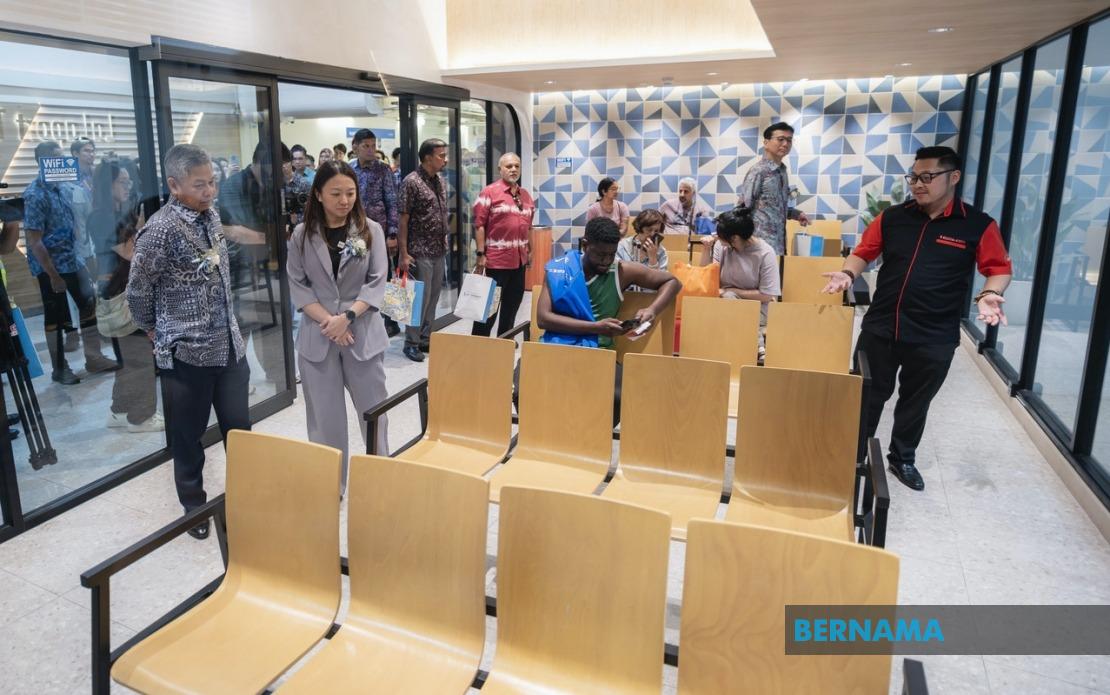
The LaLaport Transportation Hub, a state-of-the-art integrated transit facility housed within the East Atrium's LG1 level beside the Hang Tuah LRT and Monorail interchange, has officially launched as part of efforts to modernise Kuala Lumpur's congested urban transport network. According to Hannah Yeoh, Minister in the Prime Minister's Department (Federal Territories), the facility is projected to accommodate up to 10,000 passengers daily while functioning as a critical interchange point connecting rail services, express buses, e-hailing platforms, conventional taxis, and ride-sharing options through a climate-controlled pedestrian corridor.
The hub represents a strategic response to Kuala Lumpur's intense mobility demands. The city experiences roughly 1.2 million daily entries and exits, generating approximately 5.5 million journeys throughout the metropolitan area. These figures underscore the urgency of augmenting transport infrastructure and optimising the efficiency of existing networks. By consolidating multiple transport modes under a single roof with proper wayfinding and passenger amenities, the LaLaport facility addresses a longstanding gap in the city's transit ecosystem, where travellers previously faced fragmented connections between different operators and service types.
Physically, the hub spans a fully enclosed space equipped with 11 dedicated bus parking bays, temperature-controlled waiting lounges, staffed booking counters, automated ticketing kiosks, and a real-time Passenger Information Display System that broadcasts current bus schedules and arrivals. These design features reflect international best practices in transport terminal management, emphasising passenger comfort and accessibility. The facility also incorporates multiple ground-level connections to the adjacent Hang Tuah interchange, eliminating the need for passengers to navigate between separate buildings or uncertain pedestrian routes—a common pain point in Southeast Asian transport hubs.
Operator Asia Success Resource Sdn Bhd, headed by chief executive officer Aaron Chuah, expects the terminal to process approximately 150 bus trips daily. Significantly, the hub will offer round-the-clock express coach service between Kuala Lumpur and Singapore, positioning itself as a key gateway for cross-border travellers in one of Southeast Asia's busiest international travel corridors. This connection directly addresses regional mobility patterns, as many Malaysian and Singaporean residents, business professionals, and tourists regularly traverse this route. By centralising departure and arrival points, the hub reduces operational complexity for carriers and improves the passenger experience for regional commuters.
Thirty bus operators have signed on to use the LaLaport facility as their primary city-centre transit base, with particular emphasis on intercity and cross-border services. Beyond conventional coaches, the hub interfaces with the Boleh-Boleh Ride on-demand shuttle van service, which directs passengers to major destinations throughout the city core. The facility additionally offers dedicated shuttle connections to Kuala Lumpur International Airport's Terminals 1 and 2, addressing a critical travel need for thousands of daily flyers and reducing reliance on private vehicles or single-purpose transport services to the airport.
From a governance perspective, the launch signals evolving regulatory frameworks governing transport terminals in Malaysia's federal capital. Dewan Bandaraya Kuala Lumpur (DBKL) has shifted from annual to three-year operating licences for transport terminals, a structural change designed to furnish operators with greater operational certainty and security. This longer licensing cycle encourages capital investment in facility improvements and service expansion, as operators can justify expenditures across a multi-year timeline rather than facing annual uncertainty. The regulatory adjustment reflects pragmatic policy-making aimed at stabilising the urban transport sector.
Concurrently, DBKL is undertaking a broader public safety enhancement programme, deploying approximately 10,000 operational closed-circuit television cameras across the city. This investment in surveillance infrastructure aims to heighten security and accessibility across Kuala Lumpur's public spaces, with the LaLaport hub functioning as a flagship example of integrated safety and passenger-friendly design. Such measures are particularly relevant in Malaysia's major transport nodes, where volumes of transiting passengers and complex layouts can create security vulnerabilities if poorly managed.
The launch carried international dimensions reflecting Malaysia's bilateral relationships. Japanese Ambassador to Malaysia Noriyuki Shikata attended the opening ceremony, characterising the hub as evidence of deepening Malaysia-Japan cooperation in sustainable urban development. Shikata referenced Prime Minister Datuk Seri Anwar Ibrahim's recent Japan visit as confirmation of both nations' commitment to expanded partnership, spanning energy security and other strategic domains. Notably, Malaysia and Japan will mark their 75th diplomatic anniversary next year, and transport and infrastructure collaboration represent tangible expressions of this enduring relationship.
For Malaysian readers and Southeast Asian observers, the LaLaport hub embodies broader trends reshaping urban mobility across the region. As metropolitan areas from Bangkok to Jakarta grapple with congestion and fragmented transit systems, integrated terminals offering seamless mode transfers and passenger information systems have become increasingly central to urban planning strategies. The facility demonstrates that modernising transport infrastructure need not require massive new rail or highway construction; instead, optimising existing nodes through thoughtful design and operator coordination can yield significant efficiency gains. The hub's success in reaching its 10,000-passenger target will likely encourage similar projects in other Malaysian cities and provide a model for Southeast Asian peers developing their own transit ecosystems.

