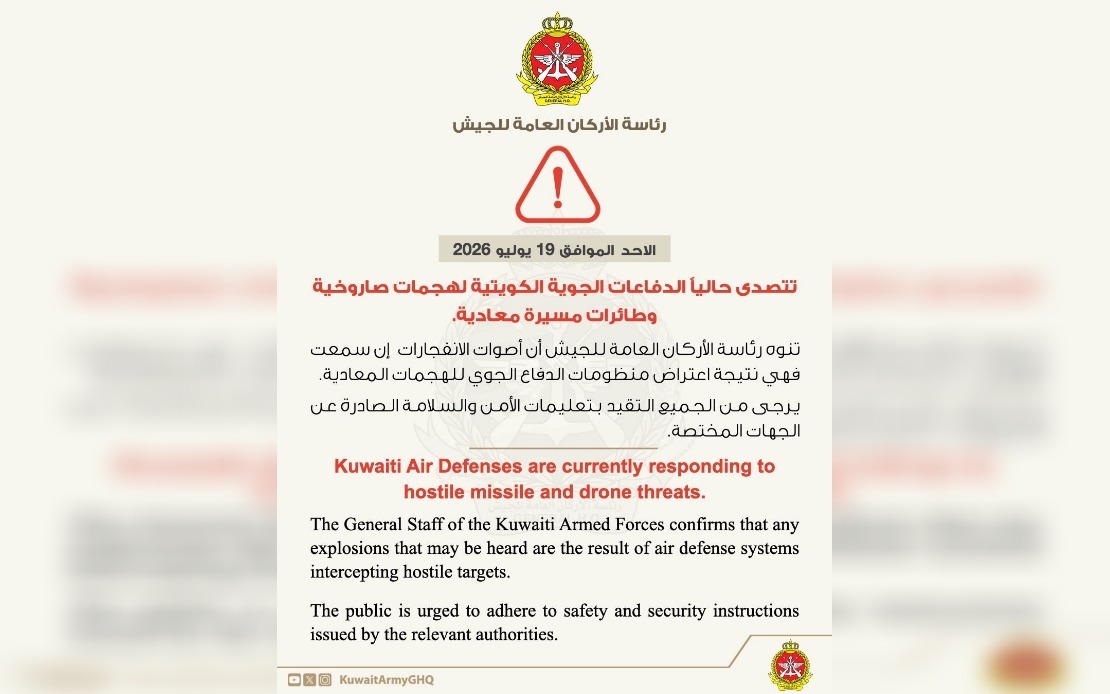
Kuwait has activated its air defence systems to counter what its military describes as a coordinated barrage of hostile missiles and unmanned aerial vehicles, signalling a dangerous escalation in the volatile Persian Gulf region. The Kuwaiti armed forces announced on Sunday that explosions being reported across the country stem from active interception operations, while authorities urged residents to remain vigilant and comply with security protocols. This defensive posture reflects the mounting strain on one of the world's most strategically significant oil producers as broader geopolitical tensions between Washington and Tehran show no signs of abating.
The current crisis represents the latest chapter in an intensifying cycle of military confrontation spanning nearly a week. The United States has conducted multiple successive strikes targeting Iranian military installations within Iranian territory, prompting swift retaliation from Tehran. Iran's response has involved precision missile and drone attacks directed at American military facilities and allied positions across the region, with Kuwait emerging as a particularly vulnerable location hosting significant American military assets and personnel. This tit-for-tat dynamic has created an environment of sustained military activity and heightened alert status across the Gulf.
Kuwait's strategic importance in this conflict cannot be overstated for Asian observers. The emirate hosts substantial American military infrastructure and thousands of US personnel, making it an inevitable flashpoint in any US-Iran confrontation. Beyond its role as a military hub, Kuwait serves as a critical node in global energy supply chains, and any disruption to its stability directly impacts oil prices and energy security across Asia, including Malaysia's own strategic reserves and shipping routes. The current situation demonstrates how regional Middle Eastern conflicts possess immediate consequences for distant economies dependent on Gulf hydrocarbons.
The underlying tension between Washington and Tehran persists despite diplomatic efforts aimed at de-escalation. In June, Pakistan brokered a memorandum of understanding designed to establish a framework for ending hostilities and pursuing sustained peace negotiations. That agreement has proven ineffective in restraining military actions, suggesting deeper structural tensions that transcend formal diplomatic channels. The collapse of this diplomatic initiative indicates that both parties harbour unresolved grievances and strategic objectives incompatible with genuine reconciliation, leaving the region vulnerable to further escalation cycles.
The proliferation of drone and missile capabilities throughout the Middle East compounds the risks facing civilian populations in contested areas. Iran's demonstrated ability to conduct coordinated, multi-vector attacks using unmanned systems and ballistic missiles represents a significant evolution in regional military technology. These capabilities enable asymmetric challenges to conventional military superiority and create defensive challenges for nations like Kuwait attempting to protect critical infrastructure and population centres. The reliance on air defence interception as a primary protective mechanism underscores the inadequacy of conventional diplomatic and security arrangements in preventing actual armed conflict.
For Malaysian policymakers and strategic observers, this crisis illuminates vulnerabilities in the current regional security architecture. Southeast Asia's economic dependence on Gulf stability and Middle Eastern energy resources means that Persian Gulf instability ultimately threatens Southeast Asian prosperity. Malaysia's shipping routes, investments in regional energy infrastructure, and commercial relationships with both American and Iranian entities create multiple channels through which this conflict might generate secondary effects throughout Asia. The conflict also raises questions about whether ASEAN's non-interference doctrine adequately protects regional interests when external crises threaten fundamental economic interests.
The broader implications for global energy markets deserve careful attention from economic managers across Southeast Asia. Kuwait ranks among the world's largest petroleum exporters, and any sustained military operations threatening production facilities or export infrastructure could trigger significant price volatility. Asian economies, particularly those with limited strategic petroleum reserves or alternative energy sources, face potential economic disruption from supply interruptions or sudden price spikes. Malaysia, as both an energy producer and consumer within Southeast Asia's integrated energy market, faces exposure to these shocks through multiple channels.
The military dimensions of current operations also raise humanitarian concerns that transcend regional boundaries. Air defence operations, while necessary for protecting civilian populations, create additional hazards through unexploded ordnance and potential accidental impacts on civilian infrastructure. Kuwait's appeal to residents to follow security instructions reflects recognition that civilian populations bear substantial risks from both the initial hostile fire and the defensive responses it generates. International humanitarian principles increasingly emphasize civilian protection obligations even during legitimate military operations, placing obligations on all parties to minimize non-combatant harm.
Communication channels between Washington and Tehran remain crucial for preventing further escalation into direct military confrontation. Both powers possess extensive arsenals capable of inflicting severe damage, suggesting mutual incentives for limiting conflict scope and intensity. However, the demonstrated ineffectiveness of Pakistan's brokered agreement suggests that traditional diplomatic approaches may require supplementation through multilateral mechanisms or third-party mediators with greater leverage over both parties. The international community, including Southeast Asian nations with interests in regional stability, should consider whether existing diplomatic initiatives sufficiently address underlying grievances driving the cycle of retaliation.
Looking ahead, the sustainability of Kuwait's defensive posture remains uncertain. Prolonged air defence operations consume substantial resources while degrading both equipment and personnel capability through sustained operations. If hostile action continues at current levels, Kuwait may eventually exhaust defensive capacity or suffer breaches allowing impacts on critical infrastructure. This scenario would represent a qualitative escalation with cascading consequences for regional stability, global energy markets, and ultimately Southeast Asian economic interests dependent on uninterrupted Gulf operations.
The unfolding crisis in Kuwait serves as a sobering reminder that distant regional conflicts possess immediate consequences for global economic systems and security arrangements. Southeast Asian nations, while geographically distant from the Persian Gulf, remain intimately connected to regional stability through energy interdependence, maritime commerce, and broader strategic relationships. Monitoring developments in Kuwait and the broader US-Iran confrontation should constitute a priority for Malaysian strategic analysts and policymakers concerned with protecting national economic interests and regional stability during this period of heightened Middle Eastern tension.

