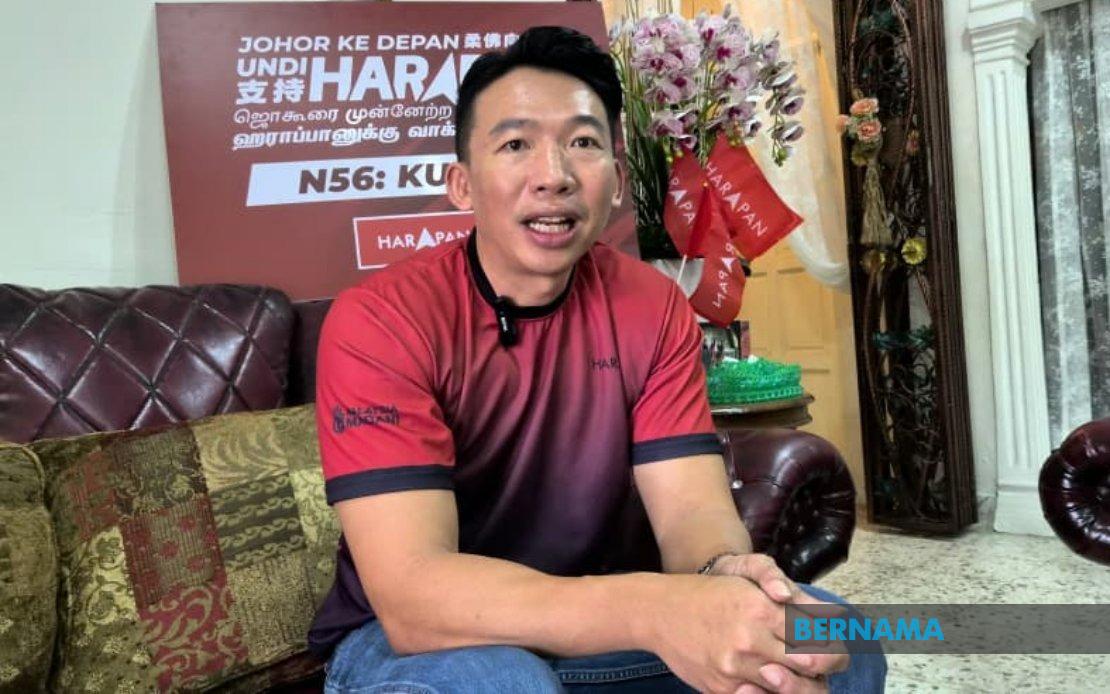
As Johor's state election campaign accelerates towards its climax, most political parties have widened their messaging to encompass national concerns and broader ideological battles. Yet Pakatan Harapan's standard-bearer for the Kukup seat has charted a contrarian course, deliberately narrowing his platform to concentrate exclusively on hyper-local grievances and tangible infrastructure shortfalls that residents encounter repeatedly. Cheah Chee Hong argues that this deliberate recalibration reflects what voters genuinely want to hear—practical remedies for problems they experience daily rather than abstract political discourse that already saturates digital platforms.
Cheah's strategic decision to divorce his campaign from the national conversation stems from a straightforward observation about information saturation. In an era when social media constantly bombards citizens with political commentary and ideological positioning, he contends that constituents have already absorbed their fill of national-level debate through their screens. His remedy is refreshingly direct: voters deserve representations committed to solving immediate, concrete challenges within their locality. This positioning may appear to abandon valuable messaging territory, yet it signals recognition that electoral success in constituency-level contests often depends on perceived responsiveness to neighbours' tangible needs rather than alignment with national party talking points.
During more than seven days of intensive door-to-door engagement across Kukup, Cheah identified three persistent problems that residents consistently raised. Waste collection remains chronically inadequate across the constituency, with residents expressing frustration over irregular and incomplete rubbish clearance. Internet connectivity constitutes a second major complaint, with coverage remaining sparse and unreliable in many residential areas, thereby hampering both business productivity and educational access. Third, electricity supply instability has emerged as an economically damaging nuisance—power fluctuations have destroyed household appliances and created particular hardship for residents operating home-based enterprises. These three issues, Cheah determined, must form the foundation of any credible development agenda.
Cheah's preliminary campaign platform positions these basic service failures as prerequisite obstacles that must be overcome before Kukup can realistically aspire to higher-order economic development. This sequencing reflects a pragmatic understanding of constituent hierarchies—villagers struggling with irregular garbage collection and erratic power supplies are unlikely to embrace tourism promotion rhetoric, however ambitious. Only after basic municipal services reach acceptable standards can the constituency genuinely position itself as an attractive destination for leisure visitors and business investors. By frontloading infrastructure fundamentals, Cheah suggests he intends to build voter confidence through demonstrated competence in service delivery rather than grand visionary pronouncements.
Beyond addressing immediate problems, Cheah has articulated a secondary development platform centred on infrastructure modernisation and tourism positioning. His proposals encompass road rehabilitation, systematic street lighting expansion, expanded parking facilities, and improved amenities oriented toward attracting leisure visitors. These initiatives, while more ambitious than garbage collection scheduling, remain grounded in achievable municipal governance rather than abstract reform. Concurrently, he envisions strengthened partnership with the Ministry of Tourism, Arts and Culture to leverage Kukup's promotional potential and translate the constituency's geographic assets into economic opportunities.
Kukup's locational advantages form a compelling foundation for this development narrative. Proximity to Johor Bahru positions the constituency within commuting range of the state's commercial centre. The forthcoming Johor Bahru-Singapore Rapid Transit System promises enhanced regional connectivity and mobility, potentially channelling investment capital and tourist traffic toward outer constituencies like Kukup. Most significantly, Kukup's inclusion within the Johor-Singapore Special Economic Zone creates a regulatory and fiscal framework explicitly designed to catalyse cross-border economic activity. Cheah's campaign implicitly leverages these structural advantages, arguing that electing a representative focused on basic service delivery will unlock existing potential rather than requiring costly new infrastructure investment.
Economic opportunity generation through business facilitation represents Cheah's tertiary campaign objective. He has proposed establishing a substantial night market facility within the constituency, conceptualising this both as direct income generation for local residents and as a tourism attraction with potential to diversify Kukup's economic base. Night markets function simultaneously as commercial venues for small traders and as cultural experiences for leisure visitors, potentially providing dual economic benefits. This proposal reflects a pragmatic understanding that constituent development often depends more on enabling existing residents to capture economic opportunity than on recruiting external capital investment.
Cheah's explicit campaign messaging directly appeals to Kukup's diaspora community, particularly residents who have relocated beyond the constituency for employment or educational purposes. He has urged these geographically dispersed constituents to return for the polling period and fulfil their voting obligations. This outreach implicitly acknowledges that emigration from less developed rural and semi-rural constituencies like Kukup represents a significant demographic challenge—younger, education-motivated residents frequently depart in search of superior employment prospects and urban amenities. Mobilising this constituency's diaspora vote potentially represents a crucial variable in competitive elections, particularly in seats without overwhelming incumbent or partisan advantage.
The Kukup contest frames itself as a straightforward two-candidate confrontation, pitting Cheah against Barisan Nasional's Md Israk Abdullah. This binary structure concentrates voter choice around competing governance philosophies and candidate competence assessments, reducing the potential for vote fragmentation across multiple candidates that might otherwise complicate the outcome. Early voting has commenced, with the main polling exercise scheduled for July 11, creating a compressed timeframe within which campaigns must consolidate voter support and mobilise party machinery. For Cheah, this narrow window demands that his locally focused messaging rapidly penetrate constituent consciousness and displace whatever prior impressions voters held regarding PH's governance capacity or his personal suitability for representative office.
Cheah's campaign strategy implicitly critiques national-level political messaging as inherently insufficient for winning and maintaining constituent confidence. By contrast, demonstrable responsiveness to pedestrian service delivery problems—regular garbage collection, functional electricity supply, reliable internet connectivity—potentially builds political legitimacy grounded in palpable improvements to daily life. This bottom-up approach to campaign positioning reflects broader lessons from competitive electoral environments, where voters increasingly evaluate representatives not primarily on partisan alignment or national policy positions but on perceptible competence in delivering basic governance functions that affect their material circumstances.
The strategy also reflects generational political evolution within Malaysian electorates. While earlier cohorts of voters might have prioritised national ideological battles and competed partisan worldviews, contemporary electorates increasingly demand evidence of practical competence and concrete problem-solving. This attitudinal shift creates opportunities for candidates willing to abandon national talking points and concentrate instead on hyper-local service improvement. For Cheah, positioning himself as a constituency champion primarily concerned with municipal functionality rather than national political debate potentially differentiates his campaign from broader partisan messaging and projects an image of singularly dedicated constituent representation.

