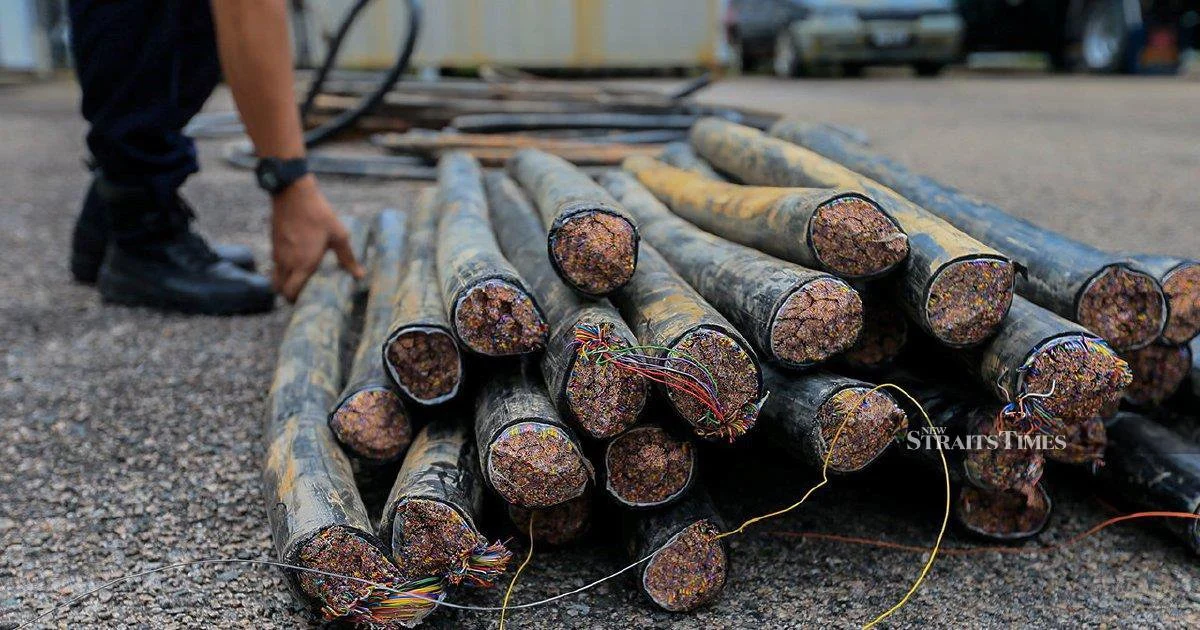
The Royal Malaysia Police has reported an encouraging decline in cable theft cases across Kuala Lumpur, marking what appears to be a successful outcome of stepped-up enforcement operations targeting one of the city's persistent infrastructure crimes. Official statistics reveal that police received 71 complaints related to cable theft during the five-month period spanning January through May, a substantial decrease from the 205 incidents documented throughout 2025, suggesting that coordinated law enforcement efforts are beginning to yield measurable results in combating this widespread criminal activity.
The reduction in reported incidents represents more than a third reduction from previous year totals, a significant achievement for a jurisdiction that has grappled with recurring problems involving the theft of electrical and telecommunications cables from public and private infrastructure. Such theft disrupts utility services, causes widespread power outages, and forces telecommunications companies and electricity suppliers to undertake expensive repair and replacement operations. The economic impact ripples through businesses, hospitals, residential areas, and public facilities that depend on uninterrupted power and communications supply.
During the same January to May period, law enforcement agencies have successfully apprehended 85 suspects allegedly involved in cable theft operations, indicating that police have not merely responded to incidents but have moved proactively to dismantle criminal networks engaged in this form of organised theft. These arrests suggest a shift toward intelligence-led policing rather than reactive responses, with authorities targeting individuals suspected of orchestrating larger-scale theft rings rather than addressing isolated incidents one at a time.
The decline in cable theft cases holds particular significance for Malaysia's urban infrastructure security and public service reliability. Cable theft typically requires organisation and planning, as thieves must identify vulnerable locations, coordinate timing to avoid detection, and establish channels to sell stolen materials for scrap value. The fact that such operations are becoming less frequent indicates that police strategies to interdict these networks—whether through increased patrols, surveillance operations, or community informant networks—are functioning as intended.
For Malaysian residents and businesses, fewer cable theft incidents translate directly to more dependable electrical supply and telecommunications services. Extended power outages caused by cable theft can halt commerce, disrupt medical treatments, compromise food storage, and create safety hazards in affected communities. Telecommunications disruptions similarly affect emergency services communications, banking operations, and digital infrastructure that increasingly underpins daily life across the Klang Valley metropolis.
The economic dimension of this crime reduction extends beyond immediate operational savings for utility companies. Cable theft imposes hidden costs throughout the economy—increased insurance premiums for businesses vulnerable to service disruption, investment in redundant or hardened infrastructure, security personnel deployed to monitor vulnerable locations, and lost productivity from service interruptions. When theft incidents decline, these costs decrease proportionally, freeing resources for productive investment and service improvements.
The 85 arrests recorded thus far this year represent a significant law enforcement achievement, though authorities will likely recognise that sustained progress requires continued vigilance. Cable theft networks often demonstrate adaptability, shifting their focus to new locations or developing increasingly sophisticated methods to avoid detection. The individuals arrested represent both direct offenders and suspected organisers within supply chains, as such theft typically involves coordination between those who commit the physical theft and others who purchase stolen cable for recycling or resale.
This success story also underscores the importance of cross-agency coordination and community engagement in crime prevention. Police departments across the region have increasingly found that effective crime reduction requires partnerships with utility companies, telecommunications providers, private security organisations, and residential communities. Information sharing about vulnerable locations, suspicious activity patterns, and organised crime networks enhances enforcement effectiveness beyond what police working alone could achieve.
For neighbouring Southeast Asian jurisdictions experiencing similar infrastructure crime challenges, Kuala Lumpur's experience offers instructive lessons about the feasibility of reducing entrenched criminal activities through sustained, focused effort. Thailand, Indonesia, and the Philippines have all confronted serious cable theft problems, and the Malaysian case demonstrates that systematic police responses can produce measurable results within relatively short timeframes.
The police data also suggests that preventive measures—such as increased lighting at vulnerable sites, security fencing, surveillance cameras, and regular patrols—combined with investigative follow-up on arrests contribute to deterring potential offenders. When individuals understand that engaging in cable theft carries genuine risk of apprehension and prosecution, the calculation of risk versus reward shifts against criminal participation.
Moving forward, maintaining this downward trend will require police to sustain their enforcement intensity and operational focus on cable theft networks. The 71 cases recorded from January through May represent approximately 14 incidents monthly, still a significant number indicating that cable theft remains a problem requiring continued attention. Authorities will need to identify remaining hotspots, adapt to criminal adaptations, and maintain community cooperation to consolidate these gains.
The significance of this crime reduction extends beyond simple statistical achievement. It reflects law enforcement's ability to effectively target organised criminal activity, protects essential infrastructure serving millions of residents and businesses, and demonstrates that seemingly intractable urban crime problems can yield to sustained professional police work combined with modern investigative techniques and community partnership.