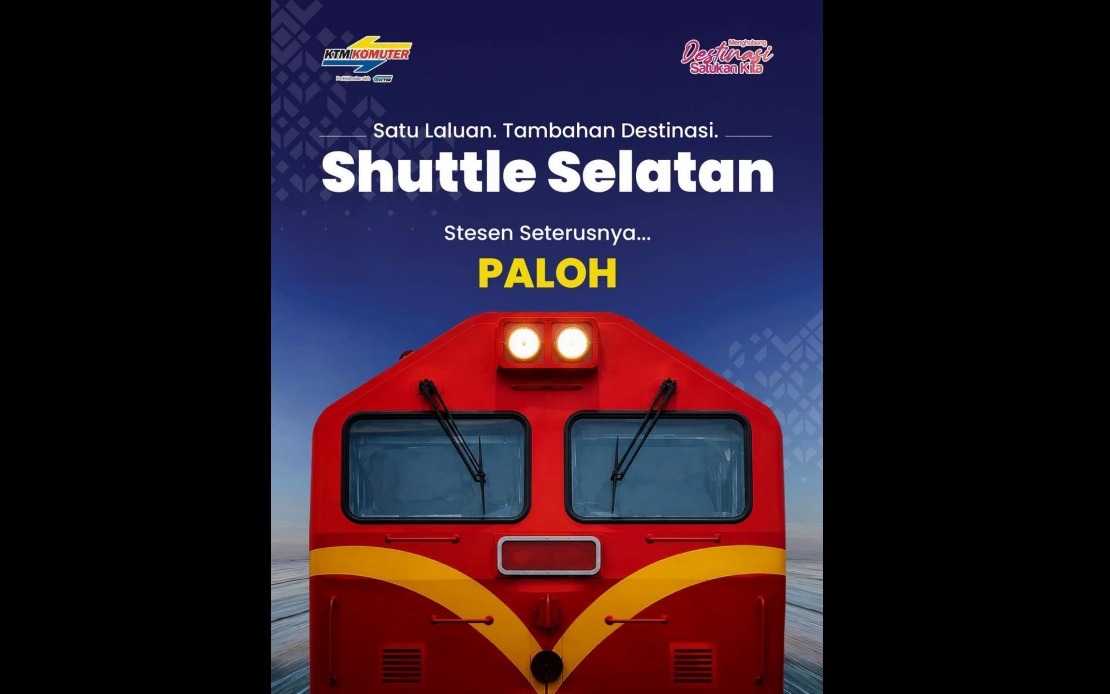
Keretapi Tanah Melayu Berhad (KTMB) is rolling out an expanded Southern Shuttle rail service beginning August 8, extending connectivity across central Johor and establishing a critical transport corridor for regional commuters and cross-border workers. The extension represents the second phase of the service rollout, arriving less than three months after the initial launch, and signals the government's accelerated push to modernise public rail infrastructure in one of Malaysia's most economically vibrant regions.
The augmented route will encompass seven stations spanning from Paloh through Kluang, Renggam, Layang-Layang, Kulai, and Kempas Baru, terminating at JB Sentral, Malaysia's principal rail hub in Johor Bahru. The journey covering this corridor requires approximately two hours, making it a practical alternative to road transport for daily travellers navigating the increasingly congested central Johor corridor. This geographic configuration positions the service as a bridge between suburban dormitory towns and the region's premier economic anchors, addressing a longstanding transport gap that has constrained labour mobility and commercial activity.
The Transport Ministry (MOT) conceptualised this expansion as a strategic measure to knit suburban populations directly into Johor's economic ecosystem, particularly the industrial and commercial clusters concentrated in Kulai and the greater JB Sentral precinct. By leveraging sections of the Gemas-Johor Bahru Electrified Double-Track Project (PLBEGJB) alignment, KTMB has capitalised on existing infrastructure investments to accelerate service deployment without requiring extensive new construction. This pragmatic approach reflects a broader government commitment to extracting maximum value from electrified rail infrastructure whilst simultaneously broadening citizen access to modern public transport.
Operational capacity will be substantial, with KTMB deploying ten daily departures—five journeys in each direction—utilising trains configured to accommodate up to 400 passengers per service. The timetable has been engineered specifically around commuter patterns, with the earliest Paloh departure at 3:55 am arriving in JB Sentral at 5:52 am, whilst the final JB Sentral service departs at 8:30 pm, reaching Paloh at 10:27 pm. These temporal parameters acknowledge the particular demographics the service must serve: workers whose employment patterns extend across jurisdictional boundaries, including the substantial population of cross-border commuters who traverse into Singapore via the Johor Bahru land crossing for employment and commerce.
Pricing remains a critical component of the expansion's commercial strategy. KTMB is maintaining promotional fares initially introduced with the service's debut, reducing the Paloh-JB Sentral single journey from RM15.30 to RM7.70 during this introductory period. This pricing approach persists until new electric rolling stock arrives, suggesting KTMB anticipates future fare adjustments concurrent with asset modernisation. The psychological and economic accessibility created by these discounted rates has proven instrumental in building passenger consciousness and ridership habits, essential preconditions for the service's long-term financial sustainability.
Concurrently, KTMB has expanded the MyRailLife Pass programme to encompass the Southern Shuttle service through December 31, granting complimentary travel for children aged four to six, primary and secondary students from Year One through Form Six, and persons with disabilities subject to applicable conditions. This inclusive pricing architecture extends the service's social utility beyond commercial considerations, explicitly incorporating equity objectives into the transport policy framework. Such targeted subsidisation addresses the specific transportation vulnerabilities of marginalised populations whilst simultaneously cultivating early adoption amongst youth cohorts, establishing foundational usage patterns that may persist into adulthood.
Intermodal connectivity enhances the service's systemic value within Johor's emerging transport network. Kempas Baru Station functions as a transfer point enabling passenger transitions to the Kempas Baru-Pasir Gudang circular route, thereby synthesising connectivity between the Paloh-Kluang-Kulai-Johor Bahru corridor and the strategically significant Pasir Gudang industrial zone. This integration represents precise urban planning, transforming the Southern Shuttle from a standalone service into a component of a hierarchical, interconnected rail ecosystem capable of moving passengers seamlessly across multiple economic zones with minimal interruption.
Early operational performance provides encouraging indicators regarding public reception and demand viability. Since commencing operations, the Southern Shuttle has transported 3,209 passengers across its initial two-route configuration, a metric indicating meaningful market penetration despite limited awareness and nascent service maturity. This passenger volume, modest in absolute terms, demonstrates demonstrable demand for rail alternatives in a region historically dominated by personal vehicle usage, suggesting the expansion may capture significantly higher ridership as service visibility increases and commuter networks disseminate information regarding accessibility and convenience.
The strategic calculus underlying this expansion extends beyond immediate transport provisioning to encompass broader regional development objectives. KTMB and the Transport Ministry frame the service as instrumental to facilitating workforce mobility supporting the Johor-Singapore Special Economic Zone (JS-SEZ), a bilateral economic integration project designed to harmonise and intensify cross-border commerce and labour flows. By reducing commuting friction and temporal costs, the Southern Shuttle removes a tangible constraint on labour market participation and commercial flexibility, theoretically enhancing productivity whilst reducing congestion-induced economic drag. Simultaneously, the service articulates government policy priorities regarding sustainable urban development and private vehicle reduction, aligning domestic transport infrastructure with climate and environmental commitments.
For Malaysian commuters and businesses, particularly those operating within Johor's dynamic economic corridors, the extension represents measurable improvement in transport accessibility and cost-effectiveness. The service democratises access to JB Sentral's intermodal connectivity, enabling provincial populations to access broader regional networks previously requiring significant time and financial investment. Cross-border workers, a population numbering in the hundreds of thousands, gain a formalised, scheduled alternative to the informal ride-sharing arrangements and private vehicle dependencies characterising current practice. Businesses dependent upon reliable workforce availability benefit from improved labour supply reliability and temporal predictability, potentially enhancing competitiveness within regional economic hierarchies.
Longer-term implications hinge upon KTMB's capacity to maintain service reliability, expand capacity as demand matures, and execute planned rolling stock modernisation without service disruptions. The promotional fare structure, whilst initially attractive to passengers and politically valuable to government, creates temporal constraints on revenue realisation and revenue model establishment. Passenger growth projections and frequency augmentation requirements will determine whether the current infrastructure and scheduling capacity remain adequate beyond the December 31 promotional period. Successful transition to commercial fare regimes whilst retaining ridership constitutes the critical juncture determining the service's structural sustainability and replicability across other Malaysian corridors requiring similar transport interventions.

