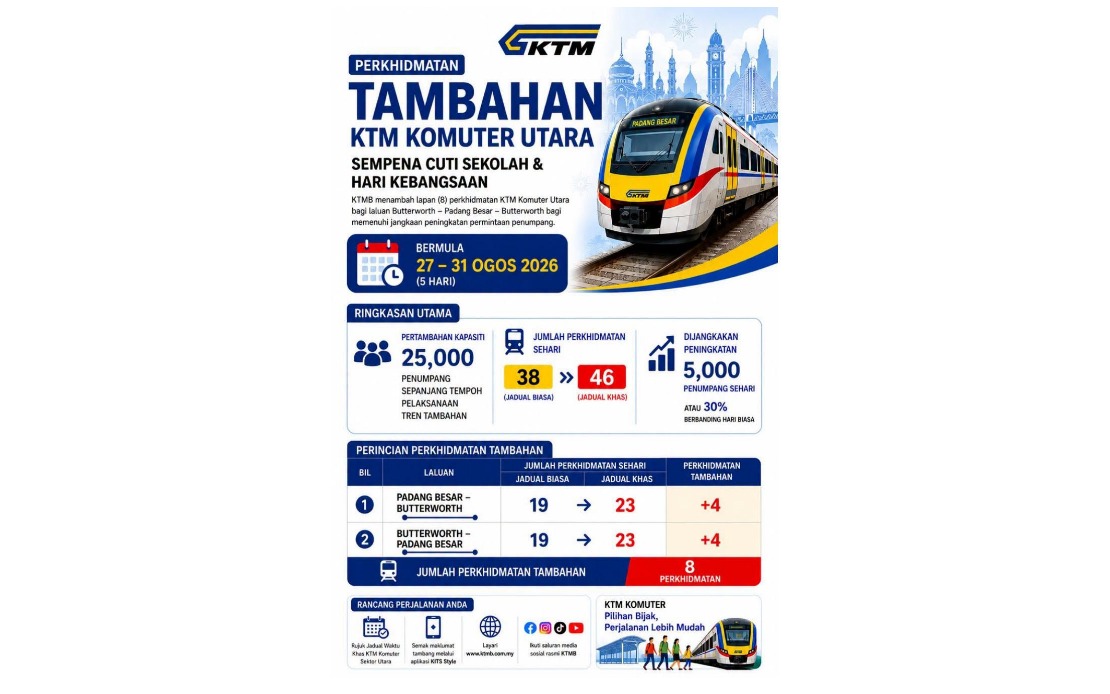
Keretapi Tanah Melayu Berhad (KTMB) is implementing an expanded timetable for its KTM Komuter Utara services to manage anticipated surge in travel demand across Peninsular Malaysia's northern states, with eight additional daily trains commencing operations from Thursday, August 27 through Monday, August 31. The temporary service enhancement responds directly to the overlapping school holidays and National Day celebrations, a period historically marked by significant population movement between population centres in Penang, Kedah, and Perlis.
Under the special arrangement, the daily service count on the Butterworth-Padang Besar corridor will expand from the standard 38 services to 46 services, representing a 21 percent increase in capacity along this commercially important route. The rail operator projects this capacity injection will enable the system to absorb approximately 5,000 additional passengers per day across the five-day implementation period, translating to roughly 25,000 incremental journeys. This expansion strategy reflects KTMB's ongoing efforts to position rail transport as a viable alternative to road networks, which typically experience severe congestion during holiday periods.
The service distribution across directional flows has been carefully calibrated to balance passenger movement patterns. The Padang Besar-Butterworth direction will receive four additional services, bringing that segment to 23 daily departures, while the Butterworth-Padang Besar direction similarly gains four supplementary trains, also reaching 23 services per day. This symmetrical allocation suggests KTMB's operational planners anticipate relatively balanced bidirectional traffic rather than pronounced directional skewing. The baseline timetable normally provides 19 services in each direction, indicating the additions represent a 21 percent boost to capacity in both directions simultaneously.
KTMB's projections suggest passenger volumes could climb by approximately 30 percent relative to typical weekday and weekend patterns during this period. Such a substantial increase underscores the significance of holiday travel in Malaysia's transport ecosystem, where extended school breaks trigger considerable movement, particularly among families with children returning to hometown states or undertaking domestic holidays. The northern corridor connecting Penang, Kedah, and Perlis represents a particularly important transportation artery during such periods, serving both intercity leisure travel and essential journeys.
The operational decision to implement a special timetable rather than attempt ad hoc service additions reflects professional transport management principles. By publishing advance schedules through multiple channels, KTMB enables passengers to plan journeys strategically rather than experiencing last-minute disruptions. This approach contrasts with reactive capacity management and demonstrates institutional commitment to service predictability. However, the move also highlights systemic capacity constraints during peak periods; permanent integration of these services might prove economically necessary if demand patterns persist.
Passenger communication appears central to KTMB's implementation strategy. The company has directed travellers to consult the KTM Komuter Northern Sector Special Timetable accessible via the KITS Style mobile application, KTMB's official website, and social media platforms. This multi-channel information dissemination recognises varying digital literacy levels among Malaysian commuters and ensures access for both smartphone-dependent younger passengers and others preferring traditional information sources. Early journey planning has been specifically recommended, a pragmatic acknowledgement that even expanded services can become saturated during peak travel windows.
From a broader transport policy perspective, KTMB's responsive capacity management during peak periods demonstrates public rail's potential contribution to managing holiday-season congestion. Enhanced rail services can reduce automobile volumes on expressways, theoretically improving safety and traffic flow during periods when Malaysian highways experience elevated accident rates. The northern corridor, serviced by the Butterworth-Padang Besar line, connects economically significant urban centres, making improved rail connectivity particularly valuable for regional economic integration.
The timing of this announcement—made in late August for immediate implementation—suggests KTMB had visibility of holiday patterns through historical data analysis. Malaysian school calendars are published well in advance, enabling predictive transport planning. The five-day window captures the tail end of school holidays through National Day on August 31, a national holiday itself that typically encourages domestic travel. The coordination between school holiday scheduling and National Day celebrations creates a compounded demand spike that necessitates exceptional capacity measures.
For Malaysian commuters in the northern corridor, this initiative offers practical benefit during a historically challenging travel period. The expanded service frequency reduces wait times and increases journey flexibility, particularly valuable for families managing complex itineraries involving multiple intermediate stops. The potential accommodation of 25,000 additional passenger journeys suggests KTMB's confidence in service reliability and rolling stock availability, though actual uptake depends on factors including fare competitiveness relative to road alternatives and service punctuality during implementation.
The special timetable represents a temporary measure rather than permanent service expansion, highlighting ongoing questions about optimal capacity investment in Malaysia's rail network. Whether demand patterns justify permanent service increases remains an analytical question that KTMB's operational data from this period will likely inform. For policymakers and transport planners monitoring public transport effectiveness, this initiative provides a natural experiment in whether enhanced rail frequency drives meaningful mode shift during peak travel periods or simply accommodates existing demand levels.

