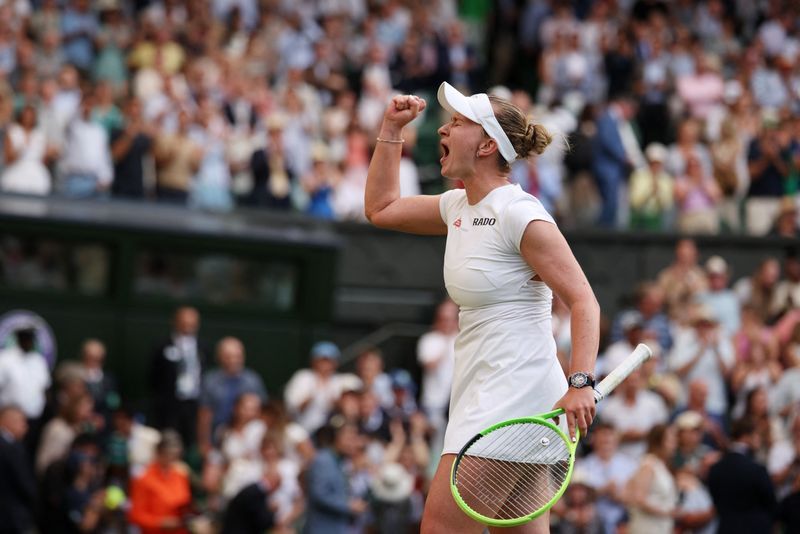
Barbora Krejcikova demonstrated the resilience that defines champions on Wednesday, fighting back from an opening set deficit to eliminate fifth seed Mirra Andreeva and secure her place in the third round at Wimbledon. The Czech veteran's 4-6 7-5 6-4 victory on Centre Court proved a masterclass in tournament tennis, showcasing the mental fortitude required to overturn an early setback against one of the sport's rising talents.
Krejcikova's path to victory began promisingly when she seized control against the 19-year-old Andreeva with an aggressive opening that saw her establish a commanding 3-0 lead in the first set. However, the defending champion's intensity waned unexpectedly, allowing the Russian teenager—fresh from capturing her maiden Grand Slam title at the French Open weeks earlier—to claw back into the contest. Andreeva's resurgence proved decisive in the opening set, as the young challenger's tactical adjustments and improving confidence saw her claim the frame 6-4 against the player who won Wimbledon in 2024 and already holds a French Open title.
The momentum appeared to favour Andreeva as the match transitioned into the second set, but Krejcikova's championship pedigree reasserted itself with characteristic authority. Rather than allowing frustration to undermine her game, the Czech player systematized her approach, targeting Andreeva's vulnerabilities with precision and mounting pressure. This tactical recalibration transformed the complexion of their contest, forcing the younger player to chase points rather than dictate them. Krejcikova's elevated serving and sharper groundstroke placement proved instrumental in levelling the match through a closely contested 7-5 second set that demanded both players extract their highest levels.
The decisive third set became a battle of mental resilience as much as technical prowess. Andreeva's frustrations mounted visibly as Krejcikova sustained her newly found rhythm, each rally seemingly extending the psychological distance between them. The Russian teenager's emotions surfaced through increasingly animated reactions, suggesting the weight of expectation following her French Open breakthrough began to weigh heavily. Despite salvaging six match points during the decider, Andreeva ultimately lacked the resources to deny her opponent's superior experience in championship moments. Krejcikova converted on her seventh opportunity, sealing a victory that extends her advantage in their head-to-head record to 2-1.
Post-match, Krejcikova reflected on the intensity of their encounter with genuine admiration for her opponent. The veteran acknowledged this represented their fifth meeting, each proving gruelling contests that tested her resolve. She recognized Andreeva's rare combination of youth and skill, noting the Russian possesses a complete weaponry that promises exceptional future achievements. Beyond individual compliments, Krejcikova emphasized the mutual commitment both players demonstrated in engaging spectators, describing their battle as a genuine exhibition worthy of Centre Court's prestige. Her acknowledgment of performing on what she termed the world's finest court revealed the pride Krejcikova derives from competing at Wimbledon's spiritual home.
The victory propels Krejcikova into the tournament's second week for further advancement opportunities. Her next challenge arrives in the form of fellow Czech Nikola Bartunkova, ensuring a domestic matchup between two established players with contrasting career trajectories. For Andreeva, the defeat represents a sobering reminder that early-season success, however impressive at Roland Garros, does not guarantee sustained dominance across different surfaces and competition styles. The teenager's reaction—throwing her racket toward her chair—captured the acute disappointment of squandering chances against a resilient opponent capable of raising her game when circumstances demand.
Andreeva's emergence as a serious contender at the sport's highest level carries significant implications for women's tennis development. Her rapid ascent from relative obscurity to major champion status within months suggests the next generation possesses exceptional talent capable of challenging established hierarchies. However, this encounter underscores the gap between sporadic brilliance and consistent championship performance. Krejcikova's comeback victory illustrates how experience, tactical intelligence, and emotional equilibrium remain decisive factors in elite tennis, particularly during Grand Slam tournaments where accumulated mental fatigue compounds the physical demands. For Southeast Asian enthusiasts following women's tennis, this contest exemplified the dynamic interplay between youthful exuberance and seasoned expertise that defines contemporary professional sport.
Krejcikova's triumph extends her Wimbledon legacy while simultaneously frustrating Andreeva's ambitions for consecutive major titles. The match reinforced that even prodigious talents require time adapting to varying tournament contexts and must develop resilience protocols for navigating setbacks. Looking forward, Krejcikova aims to maintain momentum through another championship run, having established the baseline form necessary for sustained advancement. Andreeva faces the psychological task of rebuilding confidence following a match where her opponent ultimately proved superior in critical moments. Their encounter provides instructive insights into professional tennis psychology and the separating factors between breakthrough performers and established champions.

