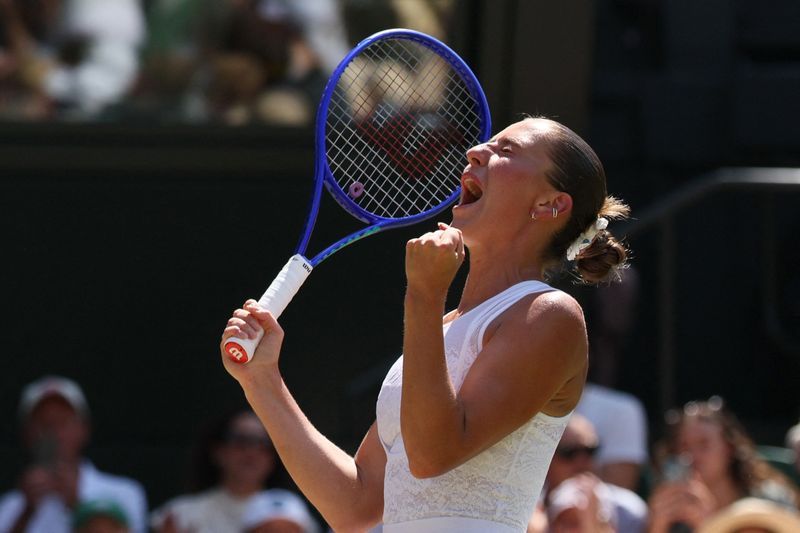
Ukraine's Marta Kostyuk delivered a masterclass in aggressive tennis on Wednesday, dispatching Italy's Jasmine Paolini with a scoreline of 6-3 6-2 to secure her place in the Wimbledon semi-finals. Playing on a hot and humid Centre Court, the 12th seed controlled proceedings throughout the encounter, which lasted just over an hour, demonstrating the kind of clinical tennis that leaves little room for her opponent to gain a foothold in the match.
The 24-year-old Ukrainian, making her debut appearance in the quarter-finals of the All England Championships and experiencing Centre Court for the first time, came into the match with clear tactical intent. Rather than allowing the contest to drift, Kostyuk seized the initiative from the opening service game, establishing her dominance early and refusing to relinquish it. The first set unfolded in her favour with remarkable efficiency, taking just 36 minutes to claim a commanding 6-3 victory. Her aggressive approach bore immediate fruit when she broke Paolini's serve at 3-2, then added another decisive break at 5-3 to seal the opening frame.
Paolini, the 13th seed who reached the final of the Australian Open earlier this year and was the runner-up at the 2024 French Open, arrived at the quarter-finals with considerable pedigree and momentum. However, the Italian could not translate her accumulated form into the performances required to trouble Kostyuk on this particular afternoon. The Ukrainian's powerful forehand proved particularly influential throughout the encounter, serving as the primary weapon through which she constructed points and put pressure on her opponent. This technical strength, deployed with precision and consistency, became the defining feature of a match that tilted decisively in Kostyuk's favour.
Further complicating matters for the Italian was her recent head-to-head record against Kostyuk. Prior to this quarter-final meeting, the Italian had won their last two encounters, which might have suggested some psychological advantage. Yet any expectations Paolini harboured of extending that winning streak were quickly dispelled as Kostyuk's superior movement, court positioning, and willingness to take risks proved too much to overcome. The Ukrainian had clearly prepared meticulously for this assignment and executed her gameplan without hesitation.
The second set proved an even more one-sided affair, with Kostyuk breaking her opponent's serve immediately to establish a 2-0 advantage. She secured another break at 3-1, effectively putting the contest beyond Paolini's reach. Throughout this segment, the Italian struggled to construct any genuine scoring opportunities, failing to engineer even a single break point against the Ukrainian's serving. Such a statistical imbalance typically indicates a significant gulf in performance levels, and the scoreboard bore stark testament to the disparity between the two competitors on the day.
With Queen Camilla observing proceedings from the Royal Box, the atmosphere on Centre Court was characterised by a traditional Wimbledon crowd that attempted to rally behind Paolini as the underdog in this particular contest. Yet Kostyuk's relentless approach and clinical finishing proved impervious to such external influences. She maintained her composure and intensity, methodically working through the second set without allowing momentum to shift in either direction. The match concluded after 69 minutes when Kostyuk converted her second match point on Paolini's serve, signalling a comprehensive and convincing victory.
The result marks a significant milestone for Ukrainian tennis, particularly given the broader geopolitical context affecting the nation. Kostyuk's progression through the Wimbledon draw represents another notable achievement for a player who has navigated considerable personal and professional challenges in recent years. Her performance against an opponent of Paolini's calibre underscores her credentials as a serious competitor in the major championships and suggests she possesses the resilience and technical skill set required to succeed on tennis's grandest stages.
For the Southeast Asian tennis community and Malaysian followers of the sport, Kostyuk's emergence as a semi-finalist at Wimbledon provides compelling viewing. Her style of play—aggressive, purposeful, and based on forcing opponents into passive positions—represents the modern tennis archetype that has become increasingly influential across professional women's tennis. The manner in which she dismantled a top-seed opponent offers valuable lessons for developing players throughout the region seeking to compete at the highest levels.
As Kostyuk advances to the semi-finals, her pathway to the title has naturally become clearer. The dominant nature of her victory over Paolini suggests she has entered a peak phase of her tournament performance, where the combination of physical capability, technical proficiency, and mental clarity align optimally. The question now turns to whether she can sustain this elevated standard of play through the semi-finals and potentially beyond, setting up an intriguing final week at SW19.

