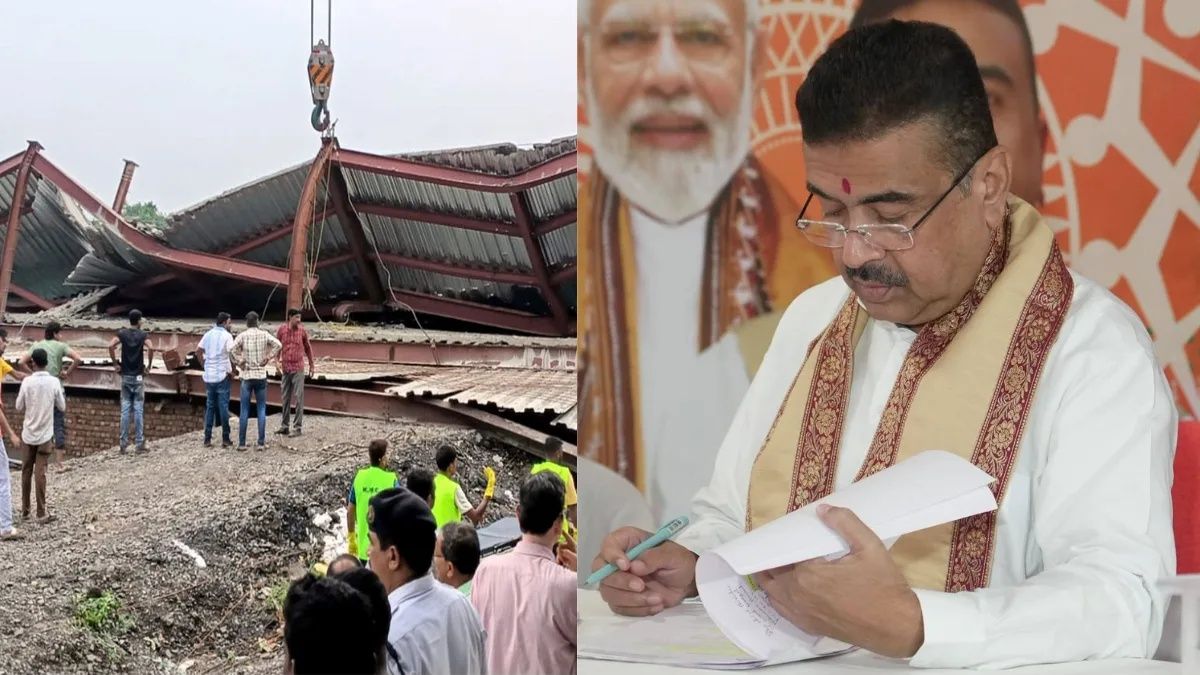
The death toll from the Taratala warehouse collapse in Kolkata climbed to 11 on Thursday as rescue teams continued their grim search through the rubble on the second day of operations. The latest body was recovered around 1:15pm and transported to SSKM Hospital's Trauma Care Centre, though officials have yet to confirm the victim's identity. The ongoing recovery effort represents a coordinated response across federal and state lines, with personnel from the Indian Army, the National Disaster Response Force, and other agencies working methodically through the debris field as concerns mount that additional workers may still be entombed beneath the collapsed structure.
West Bengal Chief Minister Suvendu Adhikari used Thursday's assembly session to launch a forceful political attack on the previous Kolkata Municipal Corporation administration, then controlled by the Trinamool Congress, alleging widespread irregularities in how the Taratala warehouse project received final approval. Armed with documentary evidence, Adhikari contended that the building plan had been sanctioned despite containing serious structural deficiencies in its design specifications. He produced documents bearing the signature of former Mayor Firhad Hakim while outlining findings from the government's preliminary investigation, and questioned the professional standards and integrity of the engineers and municipal officials responsible for authorizing the flawed construction plan.
The Chief Minister's public statement shifted beyond technical failures to broader accusations of systemic corruption, characterizing the previous TMC-controlled municipal regime as having presided over a governance structure poisoned by bribery and unofficial payments that had transformed Kolkata into what he termed a "city of death." This framing moves the disaster narrative from a single structural failure into a wider indictment of administrative capture and institutional rot. Adhikari pledged that the investigation would proceed without compromise or leniency, and announced that five individuals had already been taken into custody as part of the initial enforcement action.
The arrested parties include the construction supervisor, the steel structure contractor, the land lessee, the labour supply agent who also held a Trimex contract, and a broker implicated in securing the building plan's approval from the municipal corporation. However, Azgar, identified as the primary accused in the case, remains at large and is being actively pursued by authorities. The breadth of arrests suggests investigators are treating the collapse not as an isolated oversight but as a consequence of multiple failures across the construction chain, involving both private actors and government functionaries.
Adhikari publicly commended both the Indian Army and the NDRF for their professionalism and dedication during the rescue operation, providing a rare moment of cross-institutional appreciation during an otherwise politically charged statement. This recognition may serve to insulate the rescue effort from political contestation and underscore the government's commitment to humanitarian response even as it pursues accountability.
In perhaps the most consequential announcement, the Chief Minister declared a four-week moratorium on all construction activity throughout Kolkata Municipal Corporation territory and eight surrounding municipalities including Rajarhat-New Town, Maheshtala, Budge Budge, Pujali, Bishnupur, Sonarpur, and Baruipur. The only exceptions carved out are for essential services projects. During this suspension period, all previously approved building plans across these jurisdictions will undergo comprehensive technical and administrative review. This sweeping pause represents an extraordinary intervention in the development sector and will inevitably impact the real estate market, construction companies, and workers across the greater Kolkata metropolitan region.
To oversee this mammoth audit exercise, a high-level supervisory committee has been constituted under Additional Chief Secretary Rajesh Pandey. The committee's composition reflects an attempt to bring technical expertise, independence, and cross-sectoral credibility to the review process. Beyond senior government administrators, the panel includes senior academics and engineers from IIT Kharagpur, representatives from Rail India Technical and Economic Service and Indian Railway Construction Limited—organizations with established reputations for technical rigour—alongside officials from the Fire Services and Public Works departments and municipal representatives. This heterogeneous structure suggests an effort to overcome departmental silos and inject external scrutiny into what has clearly been viewed as a compromised municipal approval system.
Adhikari's hardline stance on culpability extends beyond criminal prosecution to property confiscation. He warned that individuals found responsible for the disaster would face not only imprisonment but also asset seizure, with confiscated property potentially liquidated to compensate victims and their families. This threat of expanded civil consequences is notable in the Indian context and signals political determination to impose meaningful deterrents beyond standard sentencing. The announcement also implicitly acknowledges the inadequacy of criminal penalties alone in addressing what officials characterize as deep institutional failures.
The Taratala collapse and the political response it has triggered carry significant implications for urban governance across India and Southeast Asia more broadly. Rapid industrialization and construction across the region has often proceeded with insufficient regulatory oversight, particularly in smaller cities and secondary markets where municipal capacity lags behind development pressures. The Kolkata incident and the subsequent audit initiative underscore how warehouse and industrial structures—often less visible to public scrutiny than residential buildings—can pose catastrophic risks when approval processes are compromised. For Malaysian policymakers and developers operating in India or managing Indian investments, the heightened regulatory environment now taking shape in West Bengal will require renewed attention to structural compliance and documentation standards.
The four-week construction suspension, while administratively disruptive in the short term, represents an attempt to prevent future tragedies through systematic review rather than reactive enforcement following disasters. Whether the audit committee can meaningfully reform approval practices within this constrained timeframe remains uncertain, particularly given the political dimensions of the previous corruption allegations. Successful implementation will require not only technical competence but also political will to enforce recommendations against connected individuals and interests, a challenge that has historically plagued governance reforms across Indian cities.
For construction workers and labourers—the population most immediately at risk from structural failures—the incident and subsequent response offer mixed signals. While heightened enforcement may eventually improve safety standards, the four-week moratorium on non-essential construction will displace thousands of workers from daily employment, placing immediate economic hardship on vulnerable populations. Whether compensation mechanisms or alternative employment schemes will be made available to affected workers remains unclear from the Chief Minister's announcement.
The investigation into the Taratala collapse will continue evolving as rescue operations conclude and forensic assessments determine precise failure causes. The political battle over municipal governance reforms has already begun, with clear lines drawn between the current government and its predecessors. How effectively the new audit regime translates pledges into institutional change will establish whether this tragedy catalyzes genuine reform or becomes another cycle in India's familiar pattern of crisis-driven accountability followed by gradual institutional erosion.

