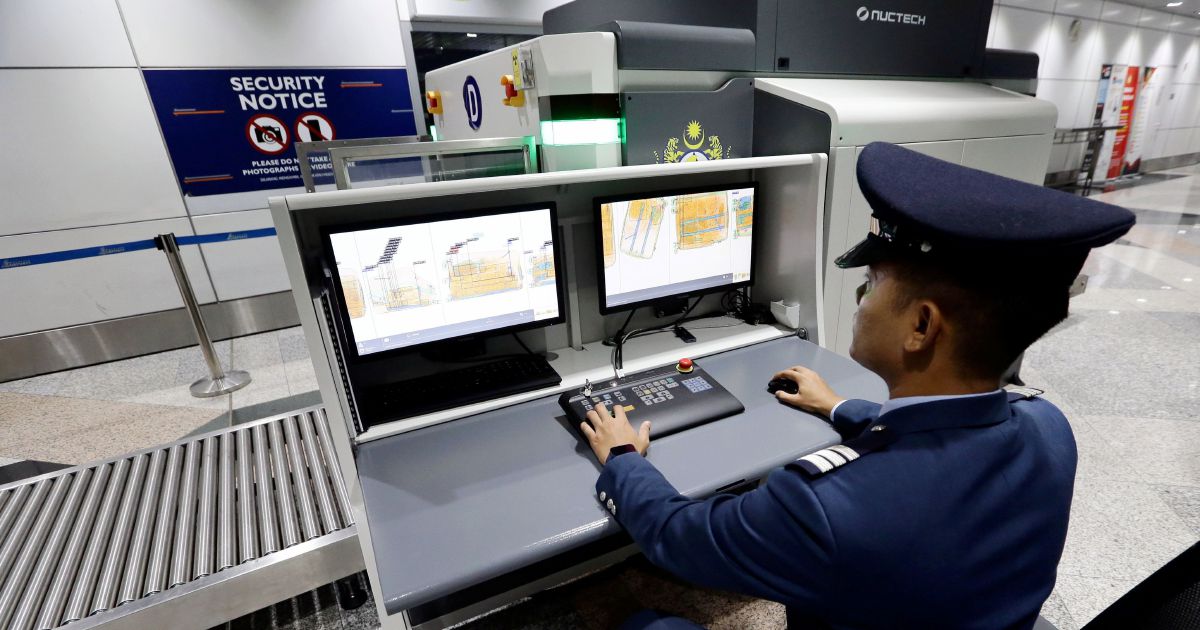
Malaysia's security arrangements at its premier international gateway have come under scrutiny following recent drug smuggling incidents, with Home Minister Datuk Seri Saifuddin Nasution Ismail providing clarification on the capabilities of airport screening infrastructure. Speaking in Putrajaya, Saifuddin acknowledged that the modern scanning technology deployed throughout Kuala Lumpur International Airport possesses the technical capacity to identify prohibited substances, including narcotics and other contraband items, but indicated that institutional procedures have oriented security operations toward identifying weapons and explosives rather than drug interdiction.
The minister's statement carries significant implications for understanding how Malaysia's busiest airport manages its dual mandate of facilitating legitimate passenger and cargo flows while preventing the movement of dangerous goods. The distinction Saifuddin drew between equipment capability and operational protocol suggests that solving Malaysia's drug interception challenges at KLIA may require administrative and procedural adjustments rather than capital investment in new technology. This observation aligns with broader security management principles, where institutional priorities frequently shape how even advanced systems are deployed in practice, sometimes creating unintended gaps in coverage across different threat categories.
Since its opening in 1998, KLIA has undergone multiple technological upgrades to its baggage handling and passenger screening systems, with particular emphasis on detecting weapons and explosives following the post-9/11 evolution of global aviation security standards. These international requirements, codified through various International Civil Aviation Organization protocols and bilateral security agreements, established benchmarks that naturally channeled investment and training toward counter-terrorism capabilities. The result is a screening environment optimized for identifying metallic objects, prohibited electronic detonation devices, and explosive residues, potentially at the expense of maintaining equally rigorous procedures for detecting chemical and pharmaceutical contraband.
The screening protocols Saifuddin referenced appear to reflect a hierarchical risk assessment that has historically treated weapons and explosives as posing more immediate threats to aviation security than drug trafficking. However, this calculus has become increasingly complicated in recent years, as transnational drug trafficking organizations have demonstrated sophisticated methods for concealing narcotics within legitimate cargo and passenger baggage. Malaysia's geographic position on major trafficking routes connecting the Golden Triangle and Golden Crescent opium-producing regions with lucrative markets in East Asia and Oceania has made KLIA an attractive transit point for smuggling operations, creating tension between its current procedural orientation and emerging operational realities.
The home minister's acknowledgment that procedures rather than equipment represent the constraint introduces a practical pathway for policy adjustment. Standard operating procedures at KLIA may require recalibration to mandate more thorough examination protocols for drug-detection screened items, retraining of screeners to prioritize identifying pharmaceutical and chemical contraband profiles, and possibly adjusting staffing allocations to increase the proportion of personnel engaged specifically in drug interdiction activities. These institutional changes typically require less capital expenditure than equipment procurement and can often be implemented more rapidly, though they may demand difficult resource allocation decisions given the constrained budgets typically facing airport security operations throughout Southeast Asia.
Malaysia's efforts to strengthen drug interdiction at KLIA also operate within the context of the country's broader criminal justice approach to narcotics trafficking. With drug-related offences carrying severe penalties under Malaysian law, including potential capital punishment for trafficking in quantities exceeding statutory thresholds, the government has consistently signaled that combating the drug trade represents a national priority. Yet enforcement effectiveness depends not only on legal consequences but also on the practical capacity of screening and intelligence apparatus to identify contraband before it enters the country. The procedural gaps Saifuddin identified suggest that institutional capacity exists but requires more effective coordination and prioritization.
The issue also reflects common implementation challenges across Southeast Asian airports, where competing security priorities and resource constraints frequently result in uneven enforcement intensity across different categories of prohibited materials. Neighboring regional hubs have confronted similar difficulties in maintaining equivalent screening rigor for all threat types, particularly as the volume of passengers and cargo has expanded without corresponding increases in screening personnel and infrastructure. KLIA's situation therefore likely represents not an isolated organizational failure but rather a systemic problem affecting airport security operations throughout the region, making the minister's statement potentially instructive for policymakers in adjacent jurisdictions.
Moving forward, the home ministry's analysis suggests that addressing drug interception performance at KLIA requires systematic review of current standard operating procedures to identify where protocols can be modified to increase detection likelihood without creating operational bottlenecks. This might involve implementing supplementary random screening regimens specifically designed for drug detection characteristics, establishing separate processing lanes for high-risk passenger and cargo categories based on origin-destination patterns and historical seizure data, and potentially deploying additional screening resources during peak traffic periods when volume pressures most severely constrain the ability to conduct thorough examinations. Each of these approaches relies on procedural and organizational adjustments rather than technological enhancement.
The transparency Saifuddin provided regarding screening limitations represents an important acknowledgment of genuine operational challenges rather than equipment failures. This distinction matters because it establishes that Malaysia possesses the technical foundation for more effective drug interdiction and requires primarily enhanced procedural implementation and organizational prioritization. For Malaysian travellers and the business community relying on KLIA for international connectivity, the statement offers modest reassurance that capacity for improvement exists within current infrastructure, while also signalling the government's recognition that systematic adjustments remain necessary to fully leverage existing screening capabilities and close remaining enforcement gaps.

