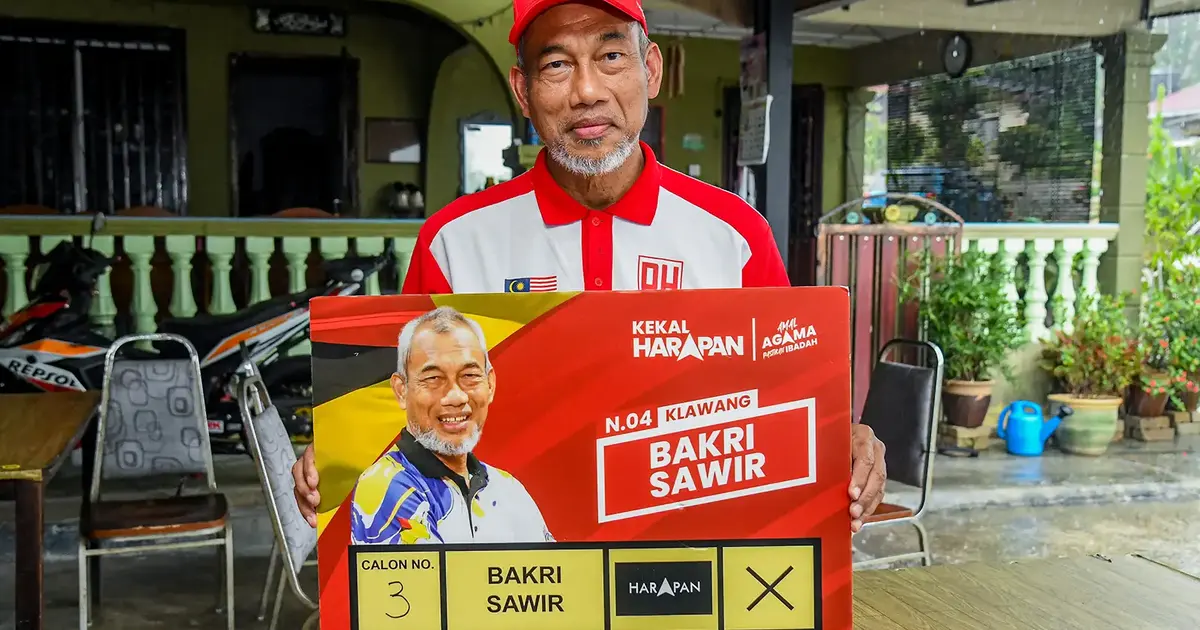
Bakri Sawir, the incumbent two-term assemblyman representing Klawang, has dismissed concerns about the newly formed coalition between Barisan Nasional and Perikatan Nasional, insisting that his previous electoral success provides a solid foundation for another victory. Speaking with confidence about his prospects in the upcoming contest, the Pakatan Harapan candidate pointed to his ability to secure support independently of Umno—a party he feels abandoned him during the 2023 state elections in Selangor.
The Klawang constituency has been a crucial battleground in Selangor politics, and Sawir's tenure as assemblyman has shaped local governance over the past several years. His assertion that he has won before without relying on Umno represents a departure from the traditional power structures that have long dominated Malaysian electoral politics, where major parties like Umno have wielded considerable influence over candidate selection and campaign machinery. The 2023 state elections appear to have been a turning point in his political calculations, as he reassesses his relationship with the larger Malay-Muslim political establishment.
The formation of the BN-PN alliance signals a significant realignment in Malaysia's political landscape, particularly at the state level where coalitions can dramatically shift the competitive dynamics. For Sawir, however, this development does not appear to fundamentally alter his strategic outlook. His confidence stems partly from his ability to mobilize grassroots support and build direct relationships with constituents in Klawang, a factor that can sometimes transcend the reach of institutional party machinery. This approach suggests an evolution in how local politicians are approaching state-level contests, placing greater emphasis on constituency-level work rather than relying solely on party institutional strength.
The context of the 2023 state elections reveals important nuances about Sawir's political positioning. Being what he characterizes as 'betrayed' by Umno during that contest indicates that party decisions about candidate support or campaign allocation did not favor him as he might have hoped. Such experiences have become increasingly common in Malaysian politics as coalitions shift and recalibrate, with politicians finding themselves reassigned or deprioritized based on larger strategic considerations that may not reflect their personal electoral strength. For Sawir, this experience appears to have reinforced his belief that his appeal transcends party labels and bureaucratic decisions made at higher echelons.
Klawang's electoral profile deserves scrutiny when evaluating Sawir's confidence. The constituency comprises a mix of urban and semi-rural areas typical of Selangor's development patterns, with diverse voter demographics that include Malay, Chinese, and Indian communities. This heterogeneous composition means that success often depends on a candidate's ability to communicate across communal lines and address concerns that resonate beyond a single ethnic or religious group. Sawir's previous victories suggest he has cultivated this cross-community appeal, which could indeed prove resilient even against a unified BN-PN challenge.
The broader implications of such positioning extend beyond a single state seat. As Malaysian politics continues to fragment and realign, local candidates increasingly finding their footing outside traditional party structures represents a meaningful shift in how electoral contests may be contested. If Sawir succeeds again despite facing a stronger opposing coalition, it would validate a model of politics centered on personal credibility, local service delivery, and constituency engagement rather than institutional party machinery and top-down campaign coordination.
For Pakatan Harapan, Sawir's confidence may offer some reassurance in constituencies where traditional party structures have weakened or where candidates possess strong personal followings. The coalition has faced considerable challenges in maintaining control of the Selangor state government, and holding Klawang would be strategically important. Sawir's expressed willingness to contest without expressing anxiety about the BN-PN combination suggests that not all PH candidates view the new opposition alignment as equally threatening, a differentiation that may reflect constituency-specific circumstances.
The political dynamics in Selangor remain fluid, with the state serving as a laboratory for Malaysia's evolving political configurations. Sawir's narrative—of winning without Umno before and remaining capable of doing so again—taps into a distinctly Malaysian political sensibility that emphasizes personal merit and direct constituent connection as alternatives to institutional patronage networks. Whether this approach can sustain him through a contest against a more consolidated opposition coalition will provide significant lessons for how Malaysian electoral politics may continue to transform in coming contests.
Sawir's public statements also reflect a degree of defiance toward larger party apparatus structures that have historically dominated candidate selection and campaign resources. By articulating confidence in his independent appeal, he implicitly challenges the assumption that electoral success depends primarily on party machinery, campaign financing, and institutional endorsement. This positioning carries risks, particularly if voters ultimately do punish him through their ballots, but it also signals a willingness to stake his political future on the foundation he has built at constituency level rather than seeking validation from higher party ranks.
The coming electoral contest will ultimately determine whether Sawir's assessment of his political standing proves accurate. His refusal to be intimidated by the BN-PN alliance and his invocation of previous success represent a conscious choice to frame the competition on grounds favorable to him—local performance, constituent relationships, and individual credibility—rather than accepting the narrative that superior party organization and coalition strength necessarily determine outcomes.

