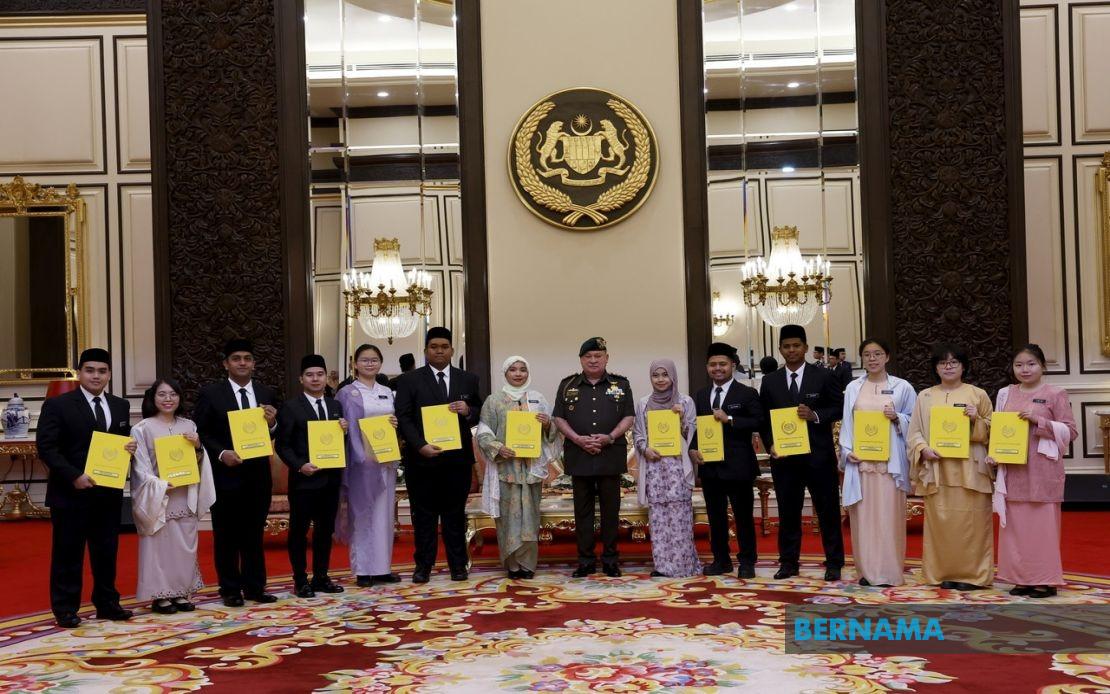
His Majesty Sultan Ibrahim, King of Malaysia, conferred the 2026 Yang di-Pertuan Agong Scholarships upon 14 carefully selected recipients during a formal investiture ceremony at Istana Negara in Kuala Lumpur on June 24. The occasion highlighted the Crown's ongoing commitment to nurturing the nation's intellectual capital and supporting advanced research across critical academic disciplines.
The scholarship awards reflected a balanced distribution of support across postgraduate levels. Seven recipients were selected to undertake doctoral research programmes, while an equal number secured funding for Master's level research studies. This composition underscores a deliberate strategy to build research capacity at multiple levels of academic progression, ensuring a pipeline of skilled researchers equipped to address complex national and regional challenges.
Geographic distribution of the awards reveals the scholarship's dual focus on domestic and international academic excellence. Ten scholars will pursue their advanced studies at premier research-focused universities within Malaysia, tapping into the nation's growing institutional capabilities in postgraduate research. Simultaneously, four recipients will conduct their research at leading academic institutions beyond Malaysia's borders, exposing them to world-class research methodologies and international intellectual networks while maintaining ties to the Malaysian academic ecosystem.
The BYDPA represents one of Malaysia's most coveted scholarship opportunities, reflecting the high calibre expected of recipients and the competitive nature of the selection process. Among government-sponsored scholarship schemes, the Yang di-Pertuan Agong scholarship stands apart in terms of financial generosity and prestige. Tan Sri Wan Ahmad Dahlan Abdul Aziz, the Director-General of the Public Service, confirmed after the ceremony that this scholarship programme offers the most substantial funding quantum across all official government scholarship initiatives, positioning it as the premier avenue for supporting Malaysia's most promising research scholars.
The ceremony's formal nature, presided over by His Majesty with attendance from senior government officials including Tan Sri Dr Azmi Rohani, the Comptroller of the Royal Household, underscored the significance accorded to these scholarships within the Malaysian establishment. Such high-level involvement signals the government's recognition that advanced research and postgraduate education are not peripheral concerns but central to national development aspirations.
For Malaysian scholars, particularly those from modest backgrounds, the BYDPA opens pathways to research careers that might otherwise remain inaccessible. The financial burden of pursuing PhDs and research-intensive Master's programmes has historically limited opportunities to individuals with family resources. By removing financial barriers, the scholarship democratises access to elite research training, enabling talent to rise based on merit rather than economic circumstance.
The international component of the scholarship programme carries particular strategic weight. By enabling four recipients to study abroad while maintaining their Malaysian identity and obligations, the initiative cultivates globally-minded researchers who can bring international best practices back to Malaysian institutions. This brain circulation model, in contrast to the traditional brain drain concern, aims to create a network of internationally-experienced scholars committed to advancing Malaysia's research agenda.
For the broader Southeast Asian region, Malaysia's investment in postgraduate scholarships reflects wider trends across ASEAN nations to strengthen research capabilities. As the region seeks to move beyond manufacturing and lower-value services toward knowledge-intensive sectors, scholarship programmes targeting advanced researchers become increasingly crucial. Malaysia's approach offers a model that other regional economies might emulate or benchmark against.
The concentration on research-focused postgraduate programmes aligns with Malaysia's positioning as a regional research hub. By supporting both PhD and Master's research initiatives, the scholarship framework builds comprehensive research capacity. PhDs produce novel knowledge and prepare individuals for academic and advanced research careers, while research-intensive Master's programmes create practitioners capable of applying advanced methodologies within industry, government, and institutional settings.
The selection of recipients across diverse fields of study, though not detailed in the official announcement, typically reflects government priorities in areas such as engineering, biotechnology, environmental science, and social sciences. This strategic alignment ensures that scholarship investment generates returns in sectors critical to national competitiveness and social progress.
For the 14 recipients, the BYDPA represents more than financial support; it constitutes an investment in their potential to contribute meaningfully to Malaysian knowledge creation. The prestige of receiving a royal scholarship carries expectations and opportunities for leadership roles in their respective fields upon completion of their studies. Many recipients of such prestigious awards go on to anchor research programmes at universities, lead innovation initiatives in industry, or shape policy in government.
Looking forward, as Malaysia navigates an increasingly knowledge-driven global economy, scholarship programmes like the BYDPA function as strategic infrastructure for national competitiveness. The 14 scholars selected this year represent an investment in Malaysia's intellectual future, with implications extending well beyond their individual careers to influence institutional capacity, research output, and ultimately, the nation's capacity for innovation and problem-solving across generations.