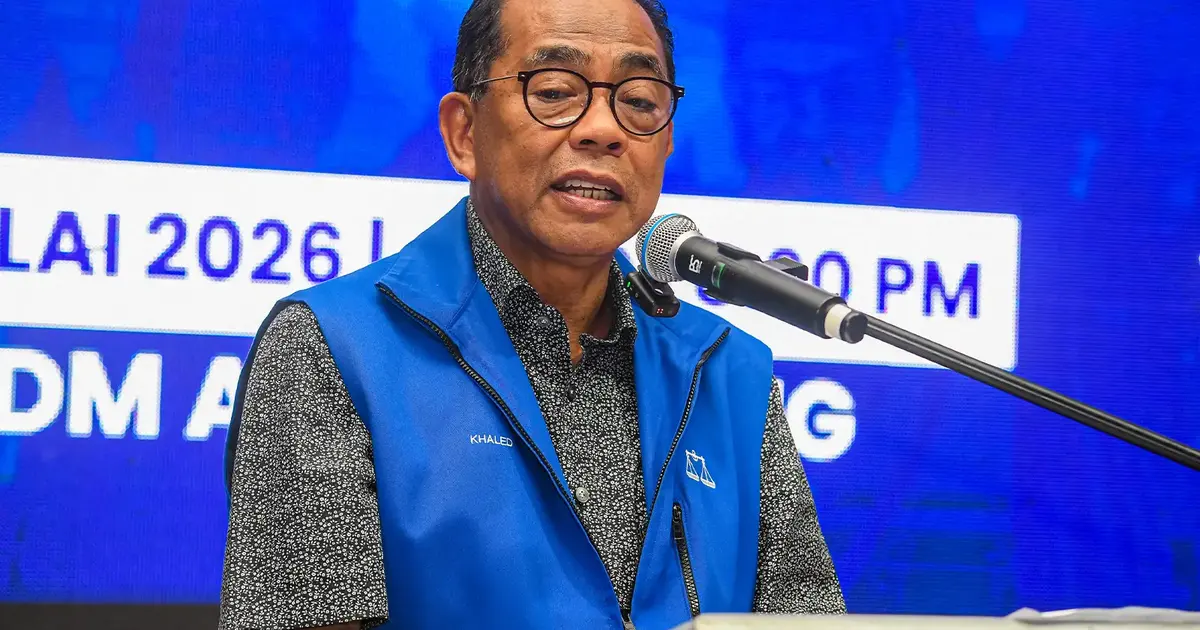
UMNO Vice-President Khaled has called upon Negeri Sembilan voters to engineer a comprehensive electoral defeat of Bersatu in the state, drawing comparison to the party's total elimination from Johor in the most recent electoral cycle. His appeal underscores growing determination within the UMNO leadership to prevent Bersatu from establishing any meaningful political foothold ahead of the 16th General Election, signalling intensified intra-coalition tensions and competition for dominance within Malaysia's political landscape.
The appeal reflects a strategic calculation that Bersatu, despite its historical roots in UMNO and connections to former Prime Minister Mahathir Mohamad, represents a competitive threat to UMNO's established dominance in the Malay-Muslim heartland. By explicitly invoking Johor's outcome—where Bersatu secured no seats—Khaled appears to be framing a complete electoral wipeout as both achievable and desirable, suggesting that voters possess the power to determine the political future of parties vying for their support.
Negeri Sembilan holds particular significance in Malaysian politics as a state where kingship traditions remain ceremonially important, and where UMNO has traditionally maintained strong organisational presence. The state's electoral dynamics have shifted considerably in recent years, influenced by broader national political polarisation and changing demographic patterns. Khaled's intervention signals that UMNO views the state as terrain where its dominance must be reasserted and protected against incursions by rival parties, particularly former allies-turned-competitors.
Bersatu's political trajectory has proven volatile since its establishment in 2016. The party has experienced significant fluctuations in electoral fortunes and parliamentary representation, reflecting broader instability in Malaysian coalition politics. Its presence in certain state assemblies and parliament has provided it with relevance in coalition negotiations, yet such influence remains contingent upon maintaining electoral viability. A complete shutdown in Negeri Sembilan would reduce its claim to territorial significance and constrain its bargaining power in future political arrangements.
The timing of Khaled's statement carries weight as Malaysia approaches the five-year mark since the 15th General Election held in November 2022. Political cycles are beginning to crystallise, with parties positioning themselves for the anticipated 16th General Election. For UMNO, reasserting control over traditional strongholds and preventing rival parties from fragmenting support bases has become increasingly crucial, particularly given the broader fragmentation of Malaysia's political landscape into competing coalitions and blocs.
Khaled's rhetoric reflects a hardline approach within UMNO toward managing internal coalition dynamics. Rather than seeking accommodation or power-sharing arrangements with Bersatu, his language suggests a preference for decisive electoral competition that would render Bersatu electorally insignificant. This approach contrasts with efforts at consensus-building and reflects the genuine friction that exists between parties formally aligned within the Barisan Nasional or broader government coalitions.
For Negeri Sembilan voters, Khaled's call represents an invitation to participate in a deliberate political strategy aimed at reshaping the state's party landscape. The framing positions voting decisions not merely as personal preferences but as contributions to a broader national political project. This mobilisational approach seeks to activate emotional and ideological motivations among supporters who view Bersatu as illegitimate or threatening to UMNO's interests.
Bersatu's response to such challenges will likely determine its political viability going forward. The party faces a fundamental choice between attempting to rebuild and differentiate itself politically, or accepting a diminished role in Malaysian politics. Previous statements from Bersatu leadership have emphasised its distinct ideological positioning and commitment to Islamic-oriented governance, yet such messaging has not consistently translated into sustained electoral support or voter loyalty.
The broader context involves continuing evolution of Malaysia's coalition architecture. The Pakatan Harapan coalition, Barisan Nasional, and various other groupings have not achieved stable configuration, with parties regularly shifting alignments and electoral pacts. Bersatu's movement between coalitions—including its periods in government and opposition—has contributed to voter confusion regarding its fundamental political identity and commitments.
For Malaysian politics more broadly, Khaled's intervention highlights the reality that coalition politics in the country remains considerably personalised and driven by factional competition rather than stable institutional arrangements. The willingness of senior UMNO figures to openly campaign for rival parties' electoral elimination suggests limited consensus regarding acceptable roles for different political actors within the system. Such fragmentation creates both uncertainty and opportunity for parties capable of mobilising voters effectively.
The stated objective of completely eliminating Bersatu from Negeri Sembilan reflects confidence within UMNO regarding its organisational capacity and voter appeal in the state. Whether such confidence proves justified will depend on execution during campaign periods and the actual voting behaviour of Negeri Sembilan residents. Political outcomes in Malaysia frequently confound expectations, and the gap between elite aspirations and electoral reality often proves substantial.

