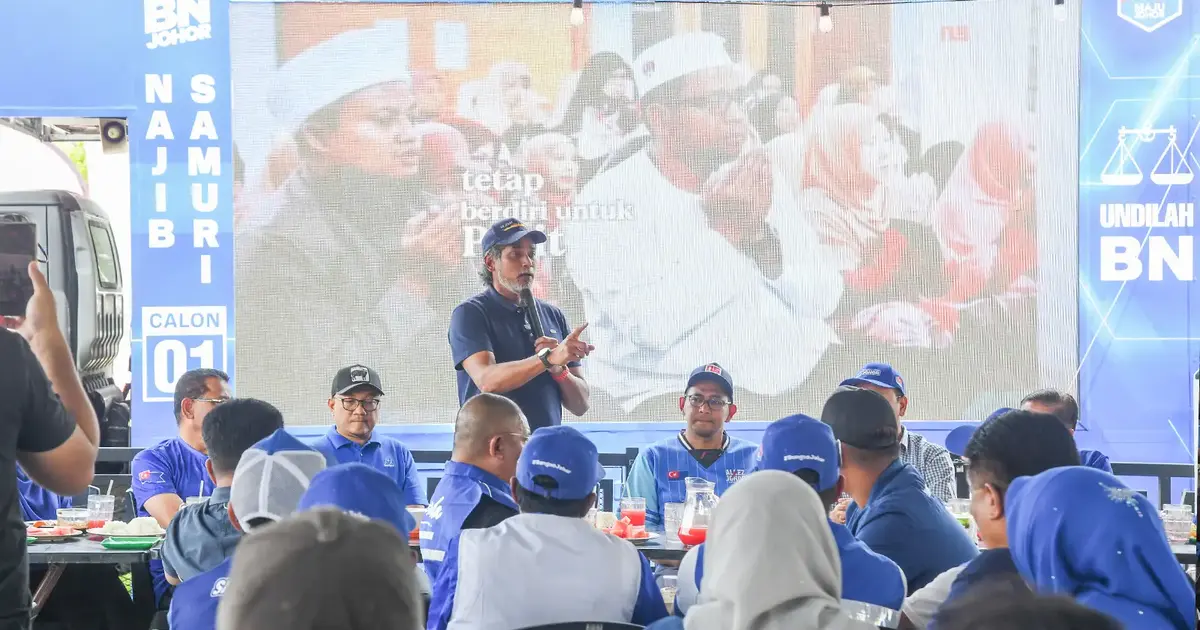
Khairy Jamaluddin, the former Umno Youth chief, has set a clear condition for any debate between the opposition coalition Pakatan Harapan and Johor's Barisan Nasional leadership. If PH intends to challenge Onn Hafiz Ghazi, the current Johor Barisan Nasional chairman, to a public debate, it must put forward its own prospective menteri besar candidate rather than fielding lower-ranking representatives. The statement reflects the hierarchy of political engagement expected in Malaysia's state-level contests and underscores the symbolic weight placed on matching representatives of equivalent standing.
Onn Hafiz Ghazi holds significant political authority in Johor as both the Barisan Nasional chairman for the state and a pivotal figure within the Umno machinery. His position makes him a frontline spokesperson for the ruling coalition's agenda in the southern state, which has remained a traditional stronghold of Barisan Nasional politics for decades. By insisting that PH match his seniority, Khairy's remarks suggest that debates at this level carry substantial weight in shaping public perception and electoral momentum ahead of state-level polling.
The former youth movement leader's condition highlights a fundamental aspect of Malaysian electoral politics: the importance of visible leadership parity in public forums. Debates between mismatched opponents—where one side represents an official party position while the other represents a secondary faction—can undermine credibility and allow the more senior representative to dismiss engagement as beneath their station. Khairy appears to be establishing this principle proactively to prevent what might otherwise be construed as one-sided political theatre.
Packatan Harapan's strategy in Johor remains a central question as the coalition repositions itself in a state where its electoral performance has been less than stellar compared to other regions. PH's prospects depend partly on whether it can articulate a coherent alternative vision through high-profile representatives. The absence of a clearly announced menteri besar candidate from PH, or reluctance to field such a figure in debates, could suggest either internal disagreement about Johor strategy or a tactical decision to avoid premature exposure of key figures to public scrutiny.
Khairy's statement also reflects the competitive dynamics between Umno's traditional power base and the challenges it faces from both internal Barisan Nasional partners and opposition forces. By setting conditions for debates, senior Umno figures maintain control over the narrative environment and determine the terms under which their policies and leadership are questioned. This gatekeeping function serves multiple purposes: it reinforces hierarchical party discipline, protects senior figures from potentially uncomfortable confrontations, and signals confidence in their electoral position.
For Malaysian political observers, such conditions about debate participants reveal deeper truths about how power is exercised and legitimacy is contested. When senior figures demand equivalently-ranked opponents, they implicitly acknowledge that debates matter as public performances that influence voter perceptions. Yet this same requirement can also function as a delaying tactic, allowing time for party preparation or preventing opposition figures from gaining visibility they might otherwise achieve through debate appearances.
The Johor political landscape has undergone considerable shifts in recent years, with various alliances and realignments reshaping traditional configurations. PH's presence in the state, while not commanding majority support, represents a meaningful challenge to assumptions about Johor as an uncontested Barisan Nasional domain. Any serious debate between high-level representatives from both coalitions would therefore carry significant implications for the state's electoral trajectory and broader regional politics in Southeast Asia's southern corridor.
From a regional perspective, the conditions Khairy places on debate participation reflect how Malaysian political culture emphasizes formal protocols and hierarchical recognition. This contrasts with some other democracies where debates occur more fluidly across different levels of candidate seniority. The Malaysian approach, epitomized by Khairy's remarks, suggests a political system where symbols of equivalence and respect remain central to public legitimacy, and where refusing to debate someone is itself a political message.
PH's response to this condition will likely reveal its confidence level regarding Johor and its strategic intentions for the state. If the coalition fields its menteri besar candidate promptly and accepts Khairy's implicit challenge, it signals serious commitment to contesting Johor at the highest level. Conversely, if PH declines to name such a candidate or avoids debate altogether, it may indicate either strategic conservatism or internal uncertainty about leadership and policy direction in the state.

