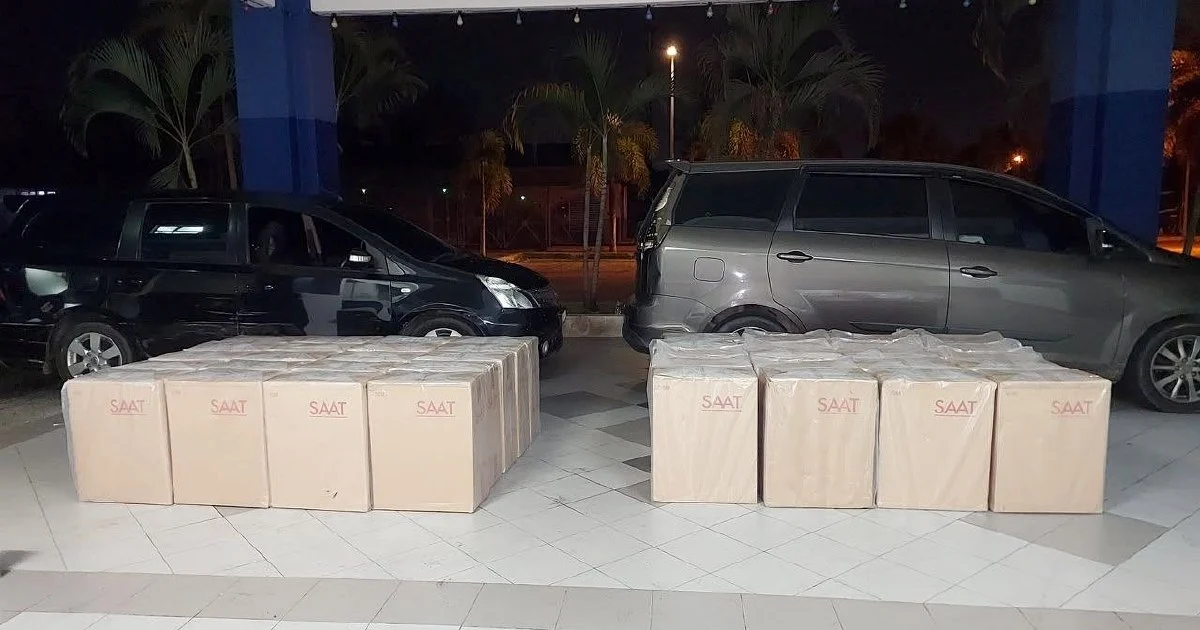
A significant cigarette smuggling operation was disrupted in Kelantan yesterday evening when law enforcement officers intercepted a vehicle and apprehended its occupant, a 29-year-old male suspect, in Kampung Pulau Panjang near Kota Baru. The dramatic pursuit culminated in the discovery of approximately 400,000 contraband cigarette sticks, with an estimated street value reaching RM813,000. The seizure underscores the ongoing challenge authorities face in combating the illicit tobacco trade across Malaysia's borders and within domestic distribution networks.
The pursuit itself began when officers detected suspicious activity during routine patrols, leading to a high-speed chase through residential areas before the suspect was finally cornered and taken into custody. The apprehension marks another successful interception in a continuing crackdown on smuggling operations that have become increasingly sophisticated in their methods and routes. Such operations typically exploit border vulnerabilities and supply chain gaps to move untaxed tobacco products into the Malaysian market, where they undercut legitimate retailers and deprive the government of substantial tax revenue.
The quantity seized in this single operation—400,000 cigarette sticks—represents the equivalent of approximately 20,000 cartons, a volume consistent with organized smuggling rather than petty trafficking. This scale of operation suggests the suspect may have been part of a larger distribution network, though investigators have not yet disclosed details about potential coordination with other individuals or organized crime syndicates. The sophistication required to move such quantities into the country points to established supply chains, likely originating from countries with significant tobacco production capacities and lower excise duties.
Smugglers typically target cigarette brands that command premium prices in Malaysia, where excise taxes have pushed retail costs substantially higher than in neighbouring nations. The economic incentive for smuggling is substantial—the difference in taxation between Malaysia and countries such as Thailand or Vietnam can mean profit margins exceeding 100 percent for illicit operators. This price differential continuously motivates organized networks to develop new routes, concealment methods, and distribution partnerships despite enhanced enforcement efforts.
Kelantan's strategic location as both a production hub and transit point makes it particularly vulnerable to smuggling activities. The state's proximity to Thailand and its role as a major cigarette manufacturing center create both opportunities and challenges for authorities. While legitimate tobacco production generates significant economic activity and employment, the existence of these manufacturing facilities also complicates enforcement efforts, as criminals exploit the regulatory environment and distribution infrastructure.
The financial impact of cigarette smuggling extends beyond the immediate loss of excise revenue. Uncontrolled smuggling distorts market competition, enabling illicit operators to undercut legitimate retailers and manufacturers who comply with taxation and regulatory requirements. This undermines the viability of authorized businesses and reduces overall tax compliance. Additionally, counterfeit and smuggled cigarettes often escape quality control standards, potentially posing health risks to consumers who may be unaware of the product's provenance or contents.
Government agencies, including the Royal Malaysia Police and the Customs Department, have intensified joint operations targeting smuggling networks in recent months. These coordinated efforts combine intelligence gathering, surveillance, and checkpoint operations with community reporting mechanisms. The arrest in Kampung Pulau Panjang reflects the fruits of these enhanced enforcement strategies, though authorities acknowledge that addressing the root causes of smuggling requires sustained pressure across multiple fronts.
The suspect's detention and the ongoing investigation may yield additional intelligence about supplier networks, financing arrangements, and downstream distribution channels. Authorities typically seek to trace seized contraband back through the supply chain to identify higher-level organizers and financiers. Such investigations can take considerable time but ultimately prove more valuable than single-point seizures in terms of disrupting organized operations and preventing future smuggling attempts.
For Malaysian consumers and businesses, the seizure carries mixed implications. While it demonstrates law enforcement's commitment to combating illegal trade, the sheer volume recovered also illustrates the continued viability and scale of smuggling networks. Legitimate cigarette retailers continue facing pressure from underpriced contraband products, while government revenues—which fund public services and infrastructure—remain compromised by the trade's persistence. Consumer awareness campaigns about the risks associated with purchasing uncontrolled tobacco products remain limited despite potential public health benefits.
The case also reflects broader regional smuggling patterns affecting Southeast Asia. Countries throughout the region face similar challenges as criminal organizations exploit tariff differentials and regulatory gaps. Addressing these issues effectively requires not only robust domestic enforcement but also international cooperation, harmonized regulatory standards, and targeted development assistance to countries serving as source or transit nations. Without such comprehensive approaches, individual seizures, while noteworthy, represent only temporary disruptions to networks capable of quickly adapting operations.
Looking ahead, the arrested individual's cooperation with investigators and the progress of his prosecution will provide insights into smuggling methodologies and organizational structures operating in the region. Law enforcement agencies will likely use information obtained during interrogations to refine intelligence-gathering capabilities and identify associated criminal actors. Such tactical adjustments, combined with strategic partnerships between maritime authorities, land border agencies, and intelligence units, may gradually increase the operational costs and risks faced by smugglers, potentially deterring future attempts or redirecting contraband flows.

