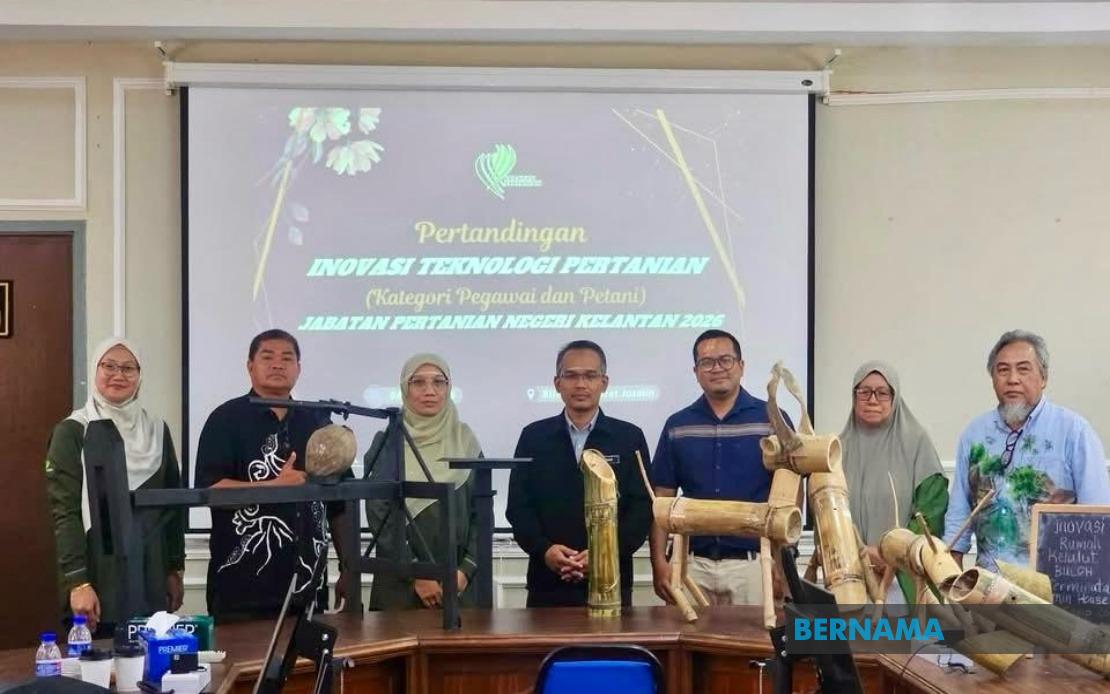
Plantation entrepreneur Che Adnan Che Kadir has caught the attention of Malaysia's agricultural establishment with a deceptively simple invention. The four-star rated coconut dehusking device, developed on his six-hectare farm in Kampung Chetok, Pasir Mas, represents the kind of grassroots innovation that could reshape how farmers across Southeast Asia handle labour-intensive harvesting tasks. What began as a solution to his own operational challenges has evolved into something far more consequential: a platform technology with potential applications across multiple tropical crops, most notably durians.
Che Adnan, 56, recently received the farmer category award at the Kelantan Department of Agriculture's 2026 Agricultural Technology Innovation Competition. The recognition comes two years after he first built the device in 2024, driven by a pragmatic need to accelerate coconut processing while reducing injury risks inherent to traditional hand dehusking methods. The device's core achievement is straightforward but valuable: it cuts processing time from two to three minutes per coconut down to a single minute, with experienced operators achieving results in 40 to 45 seconds. At just 3.5 kilograms, the portable machine demonstrates that effective farm technology need not be massive or complex.
What distinguishes this innovation is the judging panel's recommendation to adapt the technology for durian processing. The panel, drawn from the Kelantan Department of Agriculture, the Malaysian Agricultural Research and Development Institute (MARDI), and polytechnic institutions, identified durians as the primary development target. This suggestion reflects a genuine gap in agricultural practice across the region. Opening durians remains fundamentally unchanged from traditional methods—a labour-intensive process requiring considerable skill and careful handling to avoid injury or product damage. For a commodity that commands premium prices and is increasingly important to Malaysia's agricultural export economy, mechanisation could yield significant returns.
Durians present a distinct challenge compared to coconuts. The fruit's thick, spiky exterior and delicate interior flesh demand precision and expertise. Skilled workers can spend considerable time per fruit, and the risk of hand injuries is substantial. A successfully adapted device could address both safety and efficiency concerns simultaneously, making commercial durian farming more scalable and economically viable. For smallholder farmers across Malaysia, Thailand, and Indonesia who depend on durian cultivation, such technology could materially improve their competitive position against larger operations.
Che Adnan expressed genuine surprise at the device's trajectory. What he initially conceived as a farm-specific problem solver has attracted institutional attention and potential for significantly broader application. His comments reveal the modest origins of many agricultural innovations: solutions born from direct operational necessity rather than laboratory research. This bottom-up approach to innovation holds particular relevance for Malaysian and Southeast Asian agricultural sectors, where farmers often possess intimate knowledge of processing bottlenecks and operational inefficiencies that formal research institutions might overlook.
The path forward requires navigating Malaysia's innovation support infrastructure. Advancement to the national stage during National Innovation Week in Putrajaya at the end of September would represent validation at a higher institutional level. However, scaling production and adapting the technology for durians demands investment and refinement. The national innovation grant of RM10,000, while modest, could fund preliminary design improvements and feasibility studies. Che Adnan explicitly identified securing additional innovation funding as critical to translating the award into commercially viable products.
The judges' recommendations point toward specific enhancements needed for market readiness. Production capacity considerations, industry standards compliance, and adaptation to durian-specific processing requirements all require engineering work and testing. This intermediary phase between innovation and commercialisation represents the critical juncture where many promising agricultural technologies stall. Support from MARDI and polytechnic partners becomes essential during this phase, as does potentially engaging agricultural equipment manufacturers interested in licensing or producing the device at scale.
Regionally, the implications extend beyond Malaysia's borders. Durian production across Southeast Asia has grown substantially, with Thailand, Indonesia, and Vietnam becoming major suppliers. A universally applicable processing device could benefit farming communities across the region, particularly as mechanisation increasingly becomes a competitive necessity. The underlying technology principle—using mechanical leverage and focused force to separate protective husks from valuable fruit—might eventually apply to other agricultural products, from coconut variants to specialty fruits.
Che Adnan's experience also illuminates the broader innovation ecosystem in Malaysian agriculture. The structured competition format, involving state-level preliminary rounds with input from government agencies and research institutions, provides accessible pathways for farmer-inventors to gain recognition and resources. Unlike industrial manufacturing or technology sectors where innovation often concentrates in urban centres and large companies, agricultural innovation frequently emerges from rural practitioners solving real operational problems. Creating institutional mechanisms to identify, develop, and commercialise such innovations directly benefits the sector's competitiveness and sustainability.
The device's portability and efficiency metrics already demonstrate practical value. The speed improvements alone reduce labour requirements and associated costs per unit of product. For a labour-intensive industry facing persistent challenges in attracting consistent workforce availability, particularly for seasonal harvesting, mechanised alternatives offer strategic advantages. The injury reduction aspect carries both humanitarian and economic significance—workplace injuries impose direct costs through lost productivity and healthcare, plus indirect costs through workforce morale and retention.
Looking forward, successful commercialisation would require clear differentiation in the marketplace. Equipment suppliers, agricultural cooperatives, and individual farmers would need compelling evidence of durability, ease of maintenance, and return on investment calculations. Demonstration trials at multiple farm scales, independent performance verification, and user testimonials could build confidence among potential adopters. The fact that this innovation emerged from actual farm use rather than theoretical design provides inherent credibility.
The intersection of Che Adnan's practical achievement and institutional support structures reveals how Malaysian agriculture might address modernisation challenges. Farmer-driven innovation, when properly supported and connected to research institutions and potential manufacturers, could generate solutions particularly well-suited to local conditions and practices. As durian cultivation becomes increasingly important to Malaysia's agricultural export economy and regional food security, practical technologies that improve efficiency without replacing essential human judgment represent valuable competitive advantages.
Che Adnan's stated hope—that his innovation could become a practical, safe home-grown solution benefiting farmers and reaching wider markets—reflects realistic ambitions grounded in demonstrated performance. From a six-hectare farm in Pasir Mas to potential national competition and possible commercial deployment across multiple countries, this coconut dehusking device exemplifies how persistent problem-solving by agricultural practitioners, combined with institutional support and market opportunity, can generate innovations with transformative potential for Southeast Asia's farming communities.

