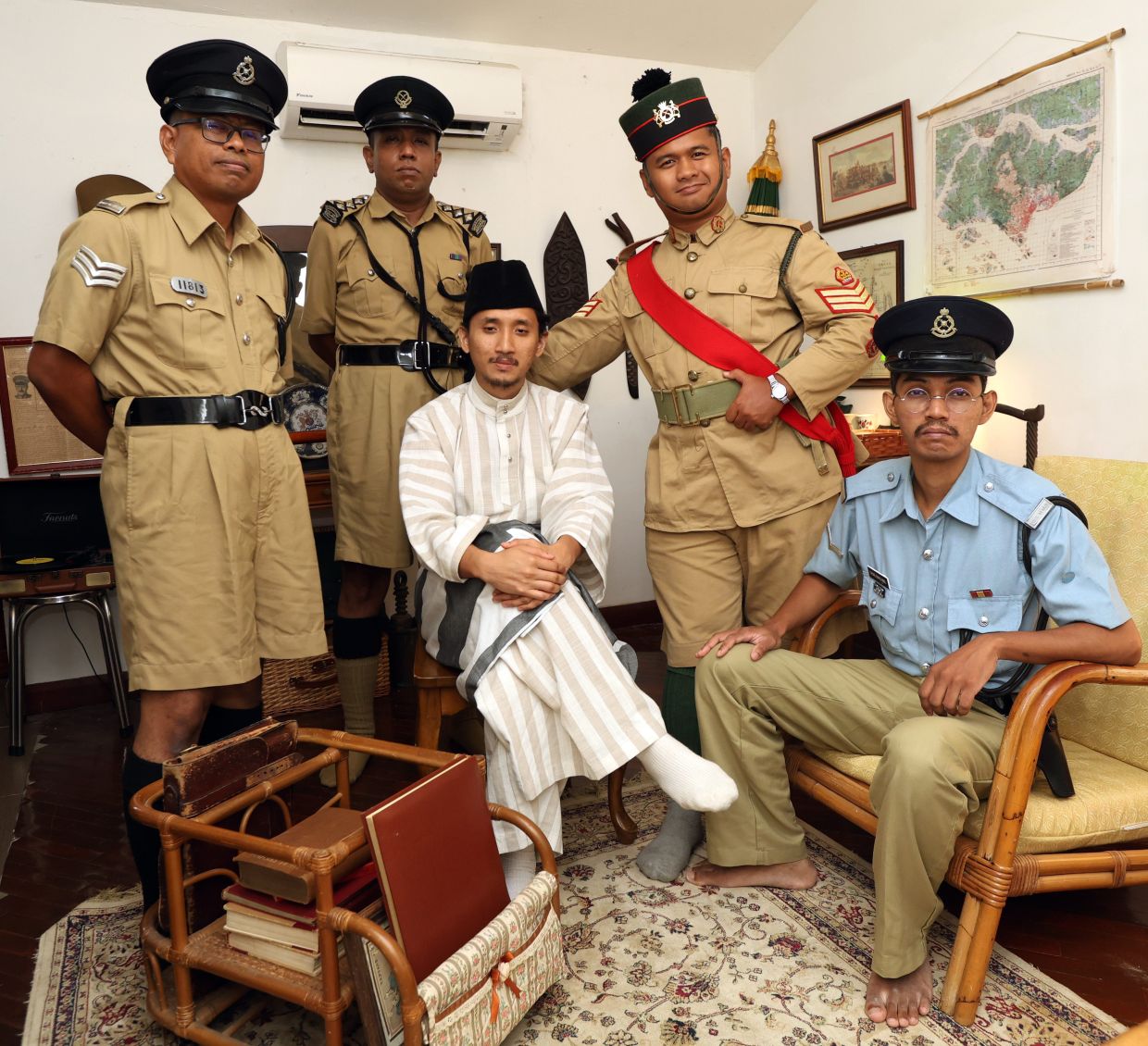
On weekends, members of Persatuan Reka Ulang Sejarah (PRUS) gather in period military uniforms to discuss, demonstrate, and bring Malaysian history to life in ways that static museum displays and classroom lectures cannot replicate. What began as informal meetings among vintage uniform collectors has evolved into a registered educational initiative with a specific mission: making the nation's military past tangible and comprehensible for younger Malaysians who might otherwise encounter history only through textbooks.
The organisation traces its origins to the early 2010s, when enthusiasts first assembled at an event hosted by the Port Dickson Army Museum at the then-operational Royal Malaysian Air Force Base in Sungai Besi, Kuala Lumpur. Operating initially under the informal designation "We Are Re-enactors," the group formalised its structure by registering as PRUS in 2023, expanding beyond simple uniform collection to embrace a broader mandate for historical awareness and cultural preservation. This transition from hobby to registered society represents a significant shift in how the group approaches its work, enabling members to collaborate with educational institutions, museums, and cultural organisations on structured programming.
Chairman Abdul Hakim Abdul Rani identified a critical knowledge gap that motivated PRUS's formal establishment. During the era of black-and-white photography, visual confusion frequently arose regarding military uniforms across different branches and periods, with casual observers unable to distinguish between forces that appeared to wear similar colours. Abdul Hakim recognised that shared expertise among collectors could address this historical literacy problem. His professional background as a tour guide reinforced his conviction that accurate historical presentation carries educational weight beyond entertainment value. By pooling knowledge and pursuing official recognition, PRUS members gained legitimacy to conduct workshops in schools and museums, transforming anecdotal uniform knowledge into systematic historical education.
What distinguishes PRUS from casual costume appreciation is the meticulous attention to contextual authenticity. Members understand that each historical period embedded specific protocols regarding bearing, movement, speech patterns, and ceremonial procedure. Marching techniques, posture conventions, and even conversational formality varied significantly across different military eras and between the armed forces. This commitment to granular accuracy stems from an educational philosophy that historical re-enactment must prioritise fidelity rather than entertainment. When PRUS members don a uniform, they are not merely adopting costumes but embodying the occupational culture, physical discipline, and social conventions of a particular historical moment.
The organisation's commitment to authenticity extended dramatically during a two-day training jamboree conducted in July, where members underwent instruction in period-appropriate marching, map reading, navigation, and basic combat manoeuvres. Abdul Hakim, drawing on his previous service with the Territorial Army (Askar Wataniah), led these sessions using original pre-Independence military manuals as reference material. Significantly, PRUS members substituted sticks for actual weapons during combat demonstrations, adhering to Malaysian regulations while still conveying the tactical principles and physical exertion soldiers historically experienced. This approach distinguished the exercise from pure role-playing, instead functioning as a historical laboratory for understanding how military personnel of the period actually operated within their professional environment.
Beyond internal training sessions, PRUS has expanded into advising film and television productions on historical accuracy. Vice chairman Mohd Fadzreeq Mokti emphasises that this consultancy work transcends simple costume validation; members ensure that visual presentation, movement patterns, and interpersonal dynamics remain faithful to the historical period. By serving as extras in productions while maintaining rigorous standards, PRUS members effectively become animated historical references, translating archival knowledge into visual media that reaches audiences beyond traditional heritage venues. This film industry engagement represents a secondary educational channel, influencing popular cultural representations of Malaysian military history.
The organisation deliberately concentrates its public engagement activities during August and September, capitalising on heightened national consciousness during National Month and Malaysia Day celebrations. Members transport their uniform collections to exhibitions and community events, recognising that many young Malaysians lack exposure to historical artefacts outside formal museum settings. This timing strategy acknowledges that temporal proximity to national observances amplifies receptiveness to historical narratives and encourages broader societal reflection on national development.
Mohd Fadzreeq, who works as a school teacher, has witnessed directly how physical presence and tactile engagement transform student engagement with history. When he appears at his own school in historical uniform—an arrangement approved by school leadership—student enthusiasm visibly escalates, with pupils repeatedly inquiring when he will wear the uniform again. This response pattern reveals a fundamental pedagogical principle: young learners gravitate toward embodied, multisensory historical experiences rather than abstract textbook presentations. Many students lack convenient access to museums or opportunities to handle historical artefacts directly, creating an educational vacuum that PRUS members partially fill through direct community appearances. The concept of members functioning as "walking museums" captures this educational function precisely; they provide mobile historical accessibility in communities where institutional museum visits may prove logistically difficult or financially prohibitive.
The knowledge burden undertaken by PRUS members deserves recognition. Preparation for authentic re-enactment requires extensive independent research through primary source materials, military manuals, historical photographs, and archival documentation. Members invest considerable personal time studying period-specific protocols, equipment specifications, and social conventions to ensure their presentations withstand scrutiny from knowledgeable observers. This scholarship-adjacent commitment distinguishes PRUS from superficial historical entertainment, positioning members as amateur historians who prioritise accuracy over convenience.
The broader context of Malaysian historical consciousness provides important framing for PRUS's significance. National identity formation depends substantially on citizens' awareness and appreciation of shared military experiences, independence struggles, and institutional development. When segments of the younger generation demonstrate unfamiliarity with important historical figures and pivotal national events, educational trajectories require intervention. Abdul Hakim's expressed concern regarding this knowledge gap reflects legitimate anxiety about historical amnesia affecting national cohesion and civic understanding. Schools represent crucial intervention points, yet curriculum constraints frequently limit historical instruction to compressed coverage. PRUS effectively functions as supplementary educational infrastructure, extending historical learning beyond textbook constraints through experiential engagement.
The societal implications of PRUS's work extend beyond individual student enrichment. As Malaysia develops economically and urbanises rapidly, traditional knowledge transmission mechanisms weaken. Fewer young people encounter military service or family narratives rooted in pre-Independence experiences. Without deliberate preservation and presentation efforts, embodied historical knowledge—the practical understanding of how soldiers moved, equipped themselves, and conducted operations—risks disappearing entirely. PRUS essentially maintains living memory of military procedures and social conventions that might otherwise survive only in archival documents inaccessible to general publics.
Looking forward, PRUS's model offers instructive lessons for other Southeast Asian nations confronting similar challenges regarding historical literacy among youth populations. The approach combines authentic material culture, educational methodology, community engagement, and entertainment value in proportions that maintain intellectual integrity while building accessible entry points for public learning. By validating history as experiential rather than exclusively academic, PRUS demonstrates how passionate amateur scholarship can complement institutional heritage preservation efforts, ultimately strengthening national historical consciousness through grassroots cultural engagement.

