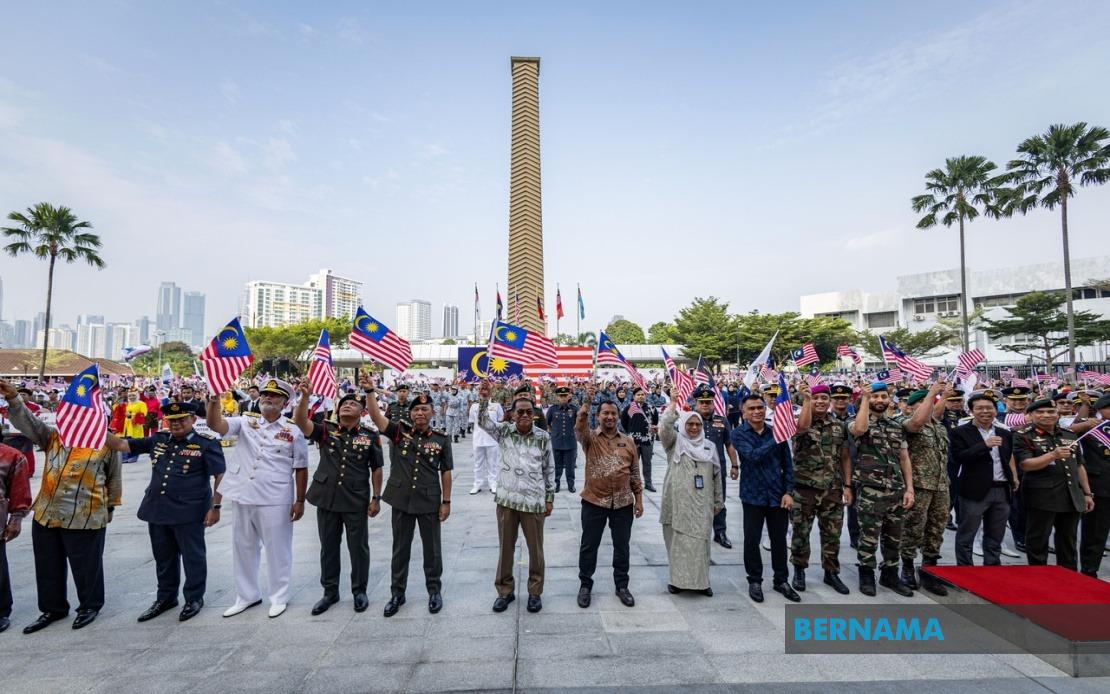
Defence Minister Datuk Seri Mohamed Khaled Nordin has cautioned against transforming the nation's most significant civic occasions into stages for airing grievances and settling political scores, insisting instead that National Day and Malaysia Day should serve as moments for Malaysians to reaffirm their collective commitment to the country.
Speaking at the launch of the Defence Ministry's National Month and Fly the Jalur Gemilang celebration in Kuala Lumpur on Wednesday, Mohamed Khaled drew a clear distinction between legitimate democratic expression and what he characterized as the weaponization of patriotic occasions. He emphasized that while Malaysians are entitled to hold differing views on specific policy matters, the national celebrations represent a unique space where such divisions should be temporarily set aside in favour of demonstrating solidarity and national pride.
The Defence Minister specifically addressed calls for boycotts of the celebrations, stating that withdrawing participation based on dissatisfaction with particular government decisions undermines the unifying purpose of these observances. His remarks appeared to reference concerns raised by various groups regarding Malaysia's handling of the Rohingya refugee crisis, which has emerged as a contentious domestic issue. Rather than allowing such disputes to overshadow the festivities, Mohamed Khaled suggested that displaying patriotic sentiment would send a powerful signal to both domestic and international audiences that Malaysians remain united despite their disagreements.
Central to Mohamed Khaled's message is the assertion that Malaysia's foundational strength rests upon the delicate equilibrium between its diverse communities. He characterized the nation as an independent, peaceful, and sovereign state fundamentally built on principles of mutual respect and harmony across racial and religious lines. These values, he contended, are not abstract ideals relegated to history books but living practices that require active nurturing and commitment from every segment of society. The Defence Minister argued that allowing National Day to become a forum for political contestation risks eroding this carefully maintained social fabric.
The timing of Mohamed Khaled's intervention is significant within Malaysia's political context, where competing visions of patriotism and national identity frequently intersect with policy disagreements. By framing the question as one of preserving national cohesion rather than dismissing legitimate concerns, the Defence Minister positioned his argument as a matter of national security and stability. The emphasis on sovereignty and the reference to security personnel serving at the nation's borders underscores an implicit connection between internal unity and external security resilience.
Malaysia Day, celebrated on September 16th, marks the formation of the Malaysian federation in 1963, while National Day commemorates independence from British colonial rule in 1957. These occasions carry profound historical weight and are deeply embedded in the national consciousness. By invoking these celebrations, Mohamed Khaled appealed to a shared historical narrative that transcends contemporary political divisions. The suggestion that flying the Jalur Gemilang—Malaysia's national flag—should be accompanied by gratitude and prayers for national well-being reflects a vision of patriotism rooted in positive sentiment rather than reactive positioning.
The Defence Minister's exhortation for Malaysians to remember the sacrifices of security personnel and border guards adds another layer to his argument. This rhetorical move connects national celebration to national security considerations, suggesting that internal discord potentially undermines the morale and effectiveness of those entrusted with protecting the nation. For many Malaysian readers, particularly those with family members in the armed services or security forces, this framing carries particular resonance.
However, Mohamed Khaled's position also raises complex questions about the relationship between patriotism and dissent in democratic societies. While his call for unity during national celebrations is straightforward, the implicit suggestion that boycotts or using these occasions to highlight policy concerns represents a failure of patriotism may sit uneasily with those who view democratic engagement—even during significant national moments—as itself a form of patriotic expression. The distinction between allowing political discourse during National Day celebrations and allowing such occasions to become primarily political forums remains inherently contested terrain.
For Malaysian citizens grappling with multiple concerns—whether related to humanitarian issues, governance questions, or economic anxieties—the Defence Minister's message presents a choice between compartmentalizing their political views during national celebrations or potentially appearing unpatriotic. This dynamic reflects broader tensions in many democracies between the desire for social cohesion and the legitimacy of dissent. The effectiveness of Mohamed Khaled's appeal will likely depend on whether Malaysians perceive the invitation to strengthen patriotic sentiment as an inclusive call to unity or as a request to temporarily suppress legitimate concerns.
Looking forward, the Defence Ministry's National Month campaign will test whether emphasizing shared national identity can successfully transcend the specific policy disputes currently dividing public opinion. The initiative reflects an understanding that national celebrations, properly framed, can serve important social functions in reinforcing collective identity and purpose. Yet it also suggests that Malaysian leadership recognizes fragmentation risks if contemporary grievances are seen as entirely separate from patriotic expression. How citizens respond to this invitation to separate sentiment from patriotism will reveal much about the current state of national cohesion and the degree to which Malaysians view their various roles—as patriots, as democratic participants, and as individuals with policy concerns—as fundamentally compatible or necessarily in tension.

