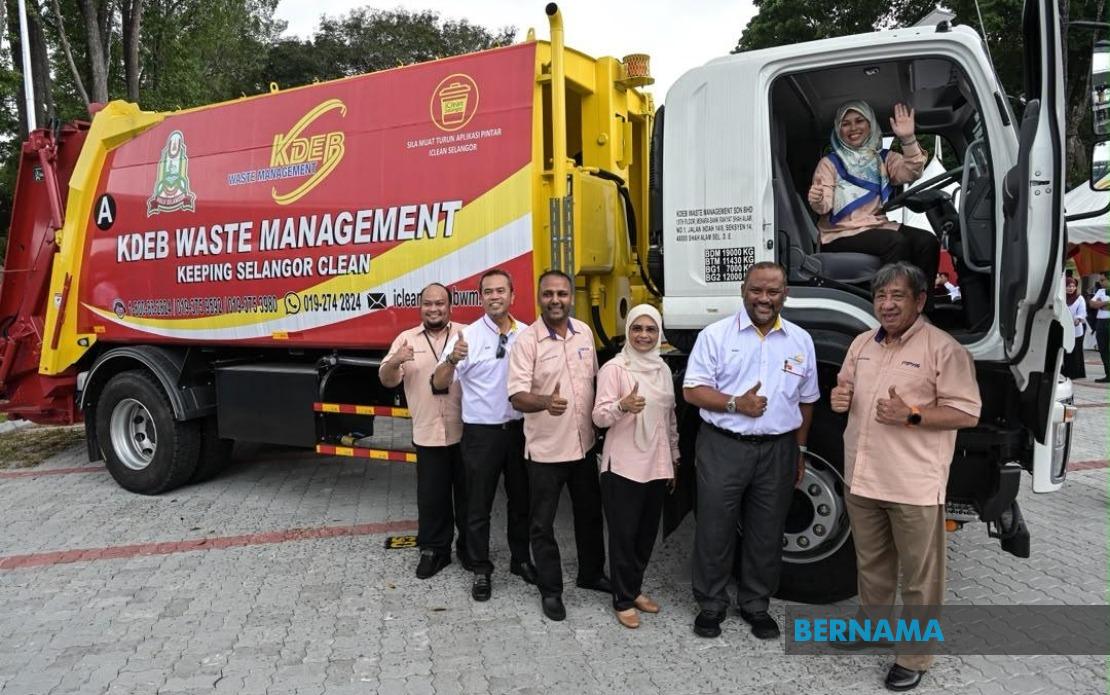
KDEB Waste Management (KDEBWM) has bolstered its waste collection capabilities in Hulu Selangor with the delivery of 33 new compactor lorries, marking the formal launch of its latest seven-year operational contract with the Hulu Selangor Municipal Council (MPHS) that commenced on July 1. The fleet comprises 18 Isuzu lorries, five Mitsubishi Fuso units, and 10 UD Trucks, each outfitted with modern technology designed to streamline collection operations and uphold stringent environmental and safety standards throughout the contract period extending to June 30, 2033.
Managing director Datuk Ramli Mohd Tahir emphasised that KDEBWM's reappointment represents a continuation of the partnership that began in 2018, following the successful completion of its inaugural seven-year tenure. The company's track record in Hulu Selangor demonstrates its capacity to manage escalating waste volumes, with collection rates rising substantially from the historical 100 to 150 tonnes per day to current figures ranging between 150 and 250 tonnes, with projections suggesting daily volumes could surpass 300 tonnes. This expansion reflects both population growth within the district and improved waste management infrastructure that encourages broader participation from residents and businesses.
The financial commitment underpinning this arrangement reflects the municipality's investment in service quality, with the seven-year contract valued at RM117.2 million, translating to approximately RM16.7 million in annual expenditure. This substantial allocation underscores MPHS's recognition that effective waste management requires continuous capital investment and operational excellence. For Malaysian municipalities, such figures serve as benchmarks for evaluating municipal service agreements, particularly as urban centres nationwide grapple with rising waste generation rates driven by economic activity and population density.
Central to the renewed partnership is the implementation of a door-to-door collection system commencing July 1, fundamentally altering how residents interact with waste disposal protocols. Rather than relying on communal collection points, scheduled collection directly from residential premises aims to minimise littering, reduce public nuisance, and create accountability among residents regarding waste segregation and disposal practices. This approach, increasingly adopted across Malaysian municipalities, reflects international best practices in residential waste management and represents a shift toward personalised service delivery.
The transition to the new system necessitates standardised household infrastructure, with MPHS requiring residents to obtain covered waste bins of at least 120-litre capacity, clearly labelled with house or lot numbers to prevent confusion during collections. Waste must be placed in plastic garbage bags, securely tied, and deposited in the bins with lids kept closed to prevent animal interference and water infiltration. These specifications, though seemingly administrative, address practical challenges that plague many Malaysian waste collection systems, where open bins and scattered rubbish attract vermin and compromise sanitation in residential areas.
Simultaneously, the partnership dismantles the leach bin system previously utilised in Hulu Selangor, signalling a modernisation of waste infrastructure that many municipalities have undertaken. Leach bins, commonly used in semi-urban and developing areas, typically lack proper containment and contribute to environmental contamination through leachate seepage. Their elimination represents progress toward municipal standards that prioritise environmental protection and public health alongside operational convenience.
Beyond residential services, KDEBWM and MPHS are collaborating to address industrial waste streams from small and medium enterprises throughout Hulu Selangor. Rather than directly managing SME waste, the municipality engages concession panel companies to handle industrial refuse, a model that distributes responsibility and leverages specialised operators. This tiered approach acknowledges that industrial and commercial waste requires distinct handling protocols compared to domestic refuse, and encourages entrepreneurship within the waste management sector through concession opportunities.
The escalation in waste volumes collected by KDEBWM—from 100-150 tonnes daily to potentially 300 tonnes—raises questions about disposal infrastructure downstream. While compactor lorries improve collection efficiency, the destination facilities must expand correspondingly to process, sort, or dispose of this material sustainably. Malaysian municipalities have historically faced bottlenecks at landfills and treatment facilities, suggesting that MPHS must ensure adequate receiving capacity and waste-to-energy or recycling infrastructure to prevent overflow scenarios that undermine service delivery.
For residents and businesses in Hulu Selangor, the new system introduces both benefits and obligations. Improved collection frequency and reliability reduce public health hazards associated with accumulated refuse, while the standardised bin system and labelling mechanism theoretically streamline operations and reduce cross-contamination between residential and neighbouring properties. Conversely, residents must invest in compliant bins and adhere to collection schedules, requiring behavioural adjustment and awareness campaigns to ensure smooth implementation.
The contract's extension through 2033 provides KDEBWM with operational stability and investment certainty, enabling the company to plan capital expenditures and workforce development over a defined timeframe. For MPHS, the seven-year term balances competitive procurement processes with the practical reality that waste management services benefit from operational continuity, allowing contractors to amortise equipment investments and refine service delivery without frequent transitions.
Regionally, Hulu Selangor's approach reflects broader trends in Malaysian municipal governance toward privatised, performance-based waste management contracts. As Selangor faces mounting waste volumes from industrialisation and urbanisation, models like KDEBWM's demonstrate how public-private partnerships can scale infrastructure to meet demand. Yet success hinges on enforcement of service standards, transparent performance monitoring, and genuine resident engagement—dimensions that remain inconsistent across Malaysian municipalities.

