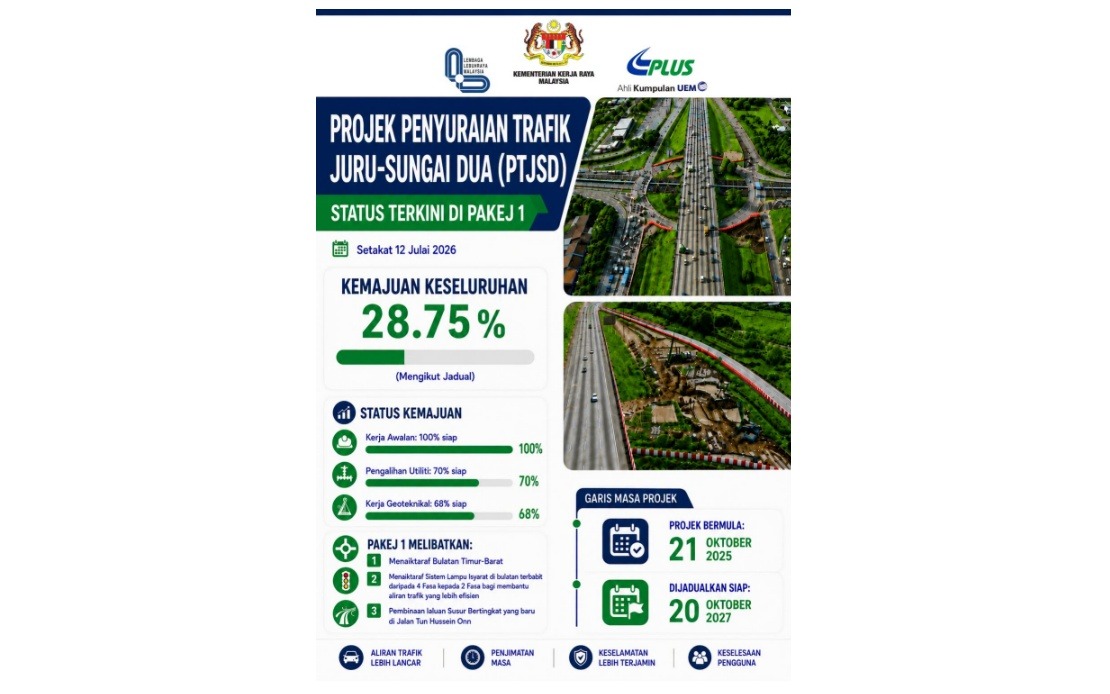
The Juru-Sungai Dua Traffic Dispersal Project (PTJSD) is maintaining its construction timeline, with Package 1 achieving 28.75 per cent progress as of mid-July, according to an update from PLUS Malaysia Berhad. The announcement signals that the multi-billion ringgit infrastructure initiative continues to move forward despite the complexities inherent in large-scale highway development across the Seberang Perai region.
Among the tangible milestones achieved thus far, preliminary works have been completed in their entirety, a critical foundation for subsequent construction phases. Utility relocation—the intricate process of moving water pipes, electrical lines, telecommunications cables, and other services—has progressed to the 70 per cent mark. Concurrently, geotechnical investigations and preparation work have reached 68 per cent completion, setting the stage for major structural elements to begin.
The first package of the project concentrates on three primary improvements to the existing transportation corridor. The East-West Roundabout will undergo comprehensive upgrading to accommodate increased traffic volumes and improve safety. Simultaneously, the traffic light system governing the roundabout's operations will be enhanced with modern technology designed to optimise vehicle flow during congested periods. Additionally, a new elevated slip road will be constructed along Jalan Tun Hussein Onn, providing alternative routing and reducing conflicts between different traffic streams.
The full PTJSD undertaking represents an ambitious attempt to resolve chronic congestion plaguing the Juru-Sungai Dua corridor, which functions as the primary artery connecting Penang Island to states throughout the northern peninsula. The project's scope spans 17.3 kilometres and touches three distinct administrative districts—South, Central, and North Seberang Perai—making coordination and implementation inherently challenging across multiple local governance boundaries.
When the initiative reaches completion in October 2027, it is projected to deliver substantial benefits to the estimated 200,000 people who traverse this route daily. Traffic modelling suggests that approximately 30 per cent of vehicles will be diverted to the new direct Juru-Sungai Dua route, fundamentally altering how commuters and freight operators navigate the region. More dramatically, journey times during peak hours are expected to contract from the current hour-long average to merely 20 minutes, a transformation that would generate enormous economic savings for time-sensitive commercial operations and dramatically improve quality of life for daily commuters.
The RM3 billion investment reflects the scale of intervention deemed necessary to address what has become an intractable bottleneck in the northern corridor. This funding level underscores how congestion has translated into measurable economic costs—delayed goods, lost productivity, increased fuel consumption, and vehicle wear—that justify substantial public expenditure in infrastructure relief. For Malaysia's economy, particularly given Penang's importance as a manufacturing and tourism hub, such connectivity improvements directly influence competitiveness and investment attractiveness.
Implementation involves collaboration between the Ministry of Works and the Malaysian Highways Authority, reflecting the project's status as a critical national priority requiring coordination across multiple government agencies. Such partnerships are essential given the technical complexity and the need to maintain coordination between federal highway management and state-level infrastructure planning. The involvement of these institutions suggests that resolving the Juru-Sungai Dua congestion has been elevated from a regional concern to a matter of national transportation strategy.
For Malaysian commuters and businesses relying on this corridor, the project represents a concrete response to years of deteriorating conditions. The northern route's chronic congestion has effectively constrained economic activity in surrounding districts, deterred investment, and imposed hidden costs on individuals through wasted time and fuel. The current timeline targeting October 2027 completion provides a defined endpoint, though infrastructure projects of this magnitude frequently experience delays due to unforeseen complications, adverse weather, or supply chain disruptions.
From a broader Southeast Asian perspective, the PTJSD exemplifies the infrastructure investment challenges confronting regional economies. As populations grow and urbanisation intensifies, existing transportation networks rapidly become inadequate, necessitating expensive retrofitting and expansion projects. Malaysia's experience here offers lessons for neighbouring nations grappling with similar congestion problems in key economic corridors.
The project's emphasis on safety enhancement and user comfort reflects evolving standards in transportation planning that go beyond merely increasing capacity. Modern highway development increasingly incorporates safety considerations, environmental mitigation, and livability factors alongside throughput improvements. The PTJSD's focus on these dimensions suggests a more holistic approach to transportation infrastructure than simple capacity expansion.
Monitoring subsequent progress reports will be essential for stakeholders and commuters who depend on this corridor. The project's halfway point, anticipated for late 2025 or early 2026, will provide a crucial benchmark for assessing whether the current trajectory toward October 2027 completion remains realistic. Any deviations from the stated schedule could have ripple effects on regional commerce and commuting patterns that extend well beyond the immediate construction zone.
For transport planners across Malaysia and the region, the PTJSD stands as a significant test case of whether coordinated, well-funded infrastructure initiatives can effectively address congestion in critical economic corridors. Success would validate investment in similar projects elsewhere, while delays or cost overruns could dampen enthusiasm for comparable infrastructure spending in other regions requiring relief from transportation bottlenecks.

