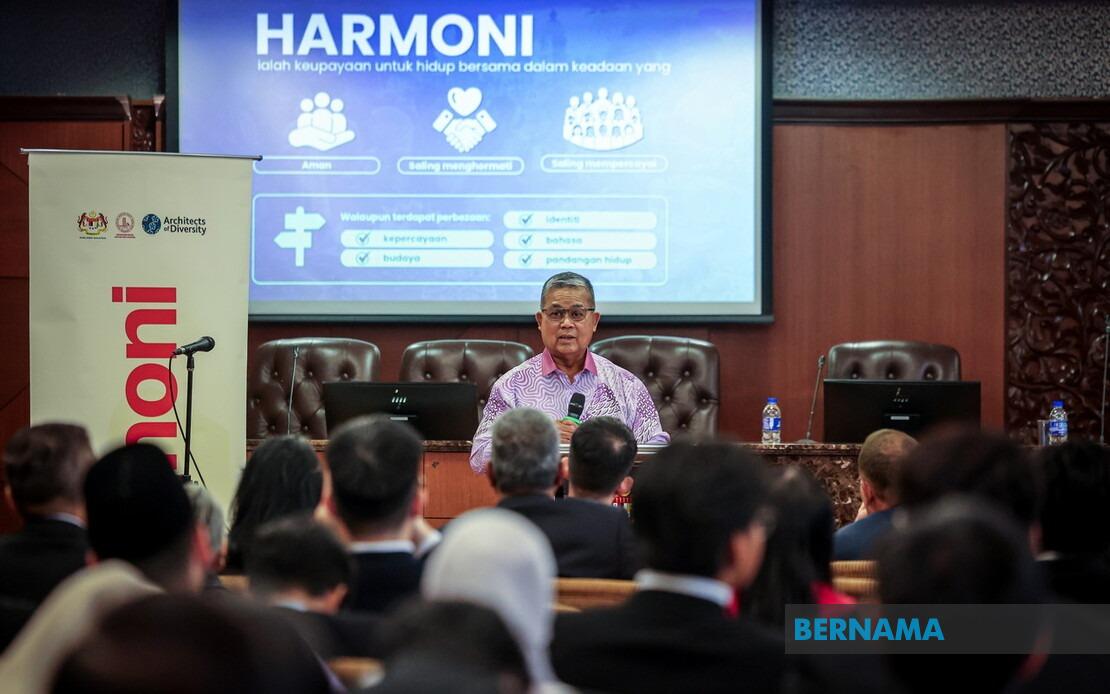
The Department of National Unity and National Integration (JPNIN) has begun work on a Community Tension Index designed to systematically track social cohesion across Malaysia and identify emerging flashpoints around sensitive communal issues. Minister of National Unity Datuk Aaron Ago Dagang announced the initiative at the 2026 Harmony Symposium hosted by the Malaysian Parliamentary Cross-Party Group on Racial and Religious Harmony at Parliament Building in Kuala Lumpur on June 26, positioning it as a critical tool for government policymaking in an increasingly fractured media landscape.
The index represents a shift towards data-driven governance in managing Malaysia's complex multicultural society. By quantifying tension across communities, the government aims to move beyond reactive responses to incidents and instead establish baseline measurements that reveal emerging discord before it escalates into public confrontation. This proactive approach acknowledges that many tensions simmer beneath public view until they suddenly erupt, often triggered by isolated incidents amplified through social channels that have weaponised public sentiment in recent years.
Aaron emphasised that the timing of this effort reflects mounting challenges in the digital sphere, where threats to national unity have become increasingly sophisticated and geographically dispersed. Between January 1, 2025 and January 31, 2026, the Malaysian Communications and Multimedia Commission (MCMC) removed 1,493 pieces of online content specifically related to religion, royalty and race issues—what officials abbreviate as 3R concerns. This volume underscores how extensively problematic material circulates even under regulatory oversight, suggesting that much additional content evades detection entirely.
The phenomenon of algorithmic polarisation presents a particular challenge that the government is now grappling with publicly. Social media platforms employ algorithms designed primarily to maximise user engagement, which inadvertently creates "filter bubbles" and "echo chambers" where individuals encounter predominantly content reinforcing their existing beliefs. This algorithmic curation fundamentally differs from traditional media gatekeeping; rather than editors making selective choices, algorithms learn user preferences and serve increasingly extreme versions of preferred viewpoints. The result is that Malaysians increasingly inhabit separate informational universes based on their initial political leanings, religious affiliations or ethnic identities, making productive dialogue across communities progressively more difficult.
Aaron articulated how this fragmentation directly undermines the social fabric. When communities retreat into algorithmically-curated information bubbles, opportunities for healthy discourse and mutual understanding shrink considerably. Individuals encounter fewer perspectives challenging their assumptions and more content validating grievances or stoking suspicions about other groups. Over time, this environment produces increasingly polarised populations with widening perception gaps—where different communities develop fundamentally incompatible understandings of basic facts about their shared nation. Malaysia's particular vulnerability to such trends reflects its religious and ethnic diversity; divisive content can rapidly weaponise identity markers that carry historical weight and contemporary political salience.
Beyond the diagnostic index, JPNIN is simultaneously advancing plans for institutional reform. The ministry has engaged various stakeholders in preliminary consultations regarding establishment of a National Harmony Commission (SKN). Unlike the tension index, which monitors and measures discord, the proposed commission would function as an interventionist body focused on early prevention, mediation and conflict resolution. The commission would operate through constructive engagement with disputing parties rather than punitive enforcement, and would also investigate issues potentially threatening national cohesion before they crystallise into major incidents.
This dual approach—measurement through the tension index combined with institutional intervention through the proposed commission—suggests recognition that Malaysia's unity challenges require both sophisticated surveillance systems and dedicated conflict-resolution mechanisms. The measurement component provides the data foundation necessary for targeted intervention, while the commission provides the institutional capacity to act on such intelligence. Neither component alone would prove sufficient; data without action capacity remains merely academic, while intervention without systematic monitoring risks inconsistency and reactive firefighting.
For Malaysian readers and policymakers, the implications are substantial. The tension index could potentially reveal which communities face genuine grievances requiring policy attention versus which tensions result primarily from algorithmic amplification of fringe voices. This distinction matters enormously for resource allocation and intervention strategy. If discord between specific communities stems largely from algorithmic curation rather than material conflict, targeted media literacy initiatives or platform policy changes might prove more effective than traditional communal dialogue programs.
The proposed commission also raises important questions about institutional design and oversight. How independent would it remain from political influence? What enforcement mechanisms would ensure recommendations translate into actual policy changes? Would the commission investigate government actions that might threaten harmony, or focus exclusively on civil society and online behaviour? These operational questions will largely determine whether the institution becomes a genuine conflict-prevention mechanism or merely another bureaucratic structure serving symbolic rather than substantive functions.
Singapore's model of harmony management through dedicated institutions offers potential templates for Malaysia, though differing constitutional structures and historical contexts mean direct adoption would prove inappropriate. Singapore's central agency approach has succeeded partly through comprehensive government resources and limited political contestation over national identity, advantages Malaysia cannot replicate given its federal system and more vibrant democratic discourse.
For Southeast Asian observers, Malaysia's initiative signals broader recognition across the region that digital polarisation represents a qualitatively different challenge than traditional communal tensions. Previous unity efforts focused on managing offline relationships between communities, employing dialogue forums and cultural exchange programs. The digital age demands parallel strategies targeting algorithmic amplification, misinformation ecosystems and the deliberate instrumentalisation of identity markers by actors seeking to destabilise societies. Malaysia's methodical approach—combining measurement with institutional capacity—may offer lessons for other regional nations confronting similar pressures.
The success of these initiatives ultimately depends on implementation quality and political will. Developing the tension index requires sophisticated data collection, rigorous methodology and genuine commitment to following evidence even when findings prove uncomfortable. The proposed National Harmony Commission requires genuine independence and adequate resources. Most challengingly, these mechanisms require sustained governmental commitment across multiple election cycles, a standard difficult to maintain in the face of competing policy priorities and shifting political alignments. The coming months will reveal whether JPNIN can translate these conceptually sound approaches into operational reality capable of actually strengthening Malaysia's fraying social fabric.

