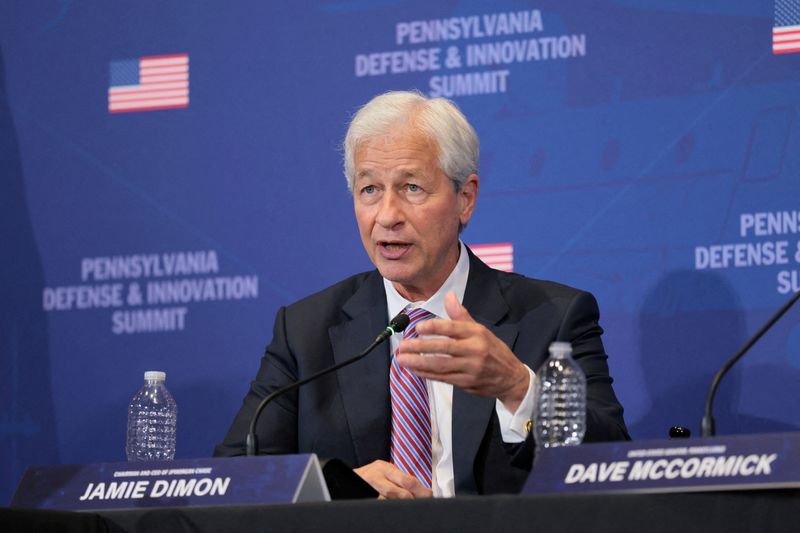
Jamie Dimon, chief executive of JPMorgan Chase, is building momentum among America's largest corporations to confront the strategic challenges posed by artificial intelligence adoption. The initiative, launched through the Alliance for Critical Infrastructure, represents one of the most ambitious private-sector attempts to manage the intersection of critical systems and rapidly evolving AI technology. Dimon has personally appealed to chief executives across banking, technology, energy, water utilities, airlines and railroads to participate in collaborative risk management frameworks designed to protect essential infrastructure from emerging AI-related vulnerabilities.
The scope of this corporate mobilisation is substantial. Over 40 companies have already been engaged in early discussions since the outreach began in July, with the Alliance targeting a fully operational structure by year-end. This breadth reflects the reality that artificial intelligence capabilities now touch nearly every sector of advanced economies. The participating industries—financial services, energy generation and distribution, water systems, telecommunications networks, and transportation—represent the backbone of modern economic life. Any disruption in these sectors cascades rapidly through interconnected economies, making coordinated governance of AI risks a legitimate concern for board-level executives.
For Malaysian readers, the implications of this American initiative warrant close attention. Singapore and Malaysia are increasingly embedded within regional technology ecosystems and supply chains that depend on American financial and technology standards. As international capital flows through Singapore's financial hubs and as Malaysian utilities modernise their infrastructure, the governance frameworks adopted by American corporations often set benchmarks that eventually influence regional practices. If JPMorgan's peer companies establish substantive protocols for managing AI risks in critical infrastructure, these standards may eventually ripple across Southeast Asia through multinational operations, subsidiaries, and technology partnerships.
Dimon's personal involvement signals that this is not a routine compliance exercise but a strategic priority for institutional leaders concerned about systemic risk. He has become one of the most prominent American executives warning publicly about artificial intelligence dangers. His comparison of advanced AI capabilities to distributing ballistic missiles to individuals illustrates the severity with which he views the governance challenge. JPMorgan's position as the largest American bank gives his pronouncements outsized influence on how financial institutions and regulators conceptualise AI's potential harms. By translating his concerns into a concrete cross-industry initiative, Dimon is attempting to shift from abstract warnings to operational collaboration.
The Alliance for Critical Infrastructure itself provides institutional scaffolding for this effort. Founded by JPMorgan Chase, Mastercard, Berkshire Hathaway Energy and others, the ACI was originally established to coordinate responses to cyber threats, physical security risks, and geopolitical disruptions affecting essential services. Pivoting toward AI governance represents a logical extension of this mandate, though it significantly broadens the scope from defensive cybersecurity to understanding how artificial intelligence itself might become a source of vulnerability or weaponisation across interconnected systems.
The specific trigger for accelerated action appears to be recent cyberattacks on water systems in Minnesota and other American states. These incidents underscore that critical infrastructure remains accessible to malicious actors, and that artificial intelligence could amplify such threats by enabling more sophisticated attack methods, automating vulnerability discovery, or facilitating coordination of multi-vector assaults. Water systems are particularly sensitive targets because contamination can cause immediate public health consequences. The Minnesota attacks therefore served as a concrete reminder that abstract discussions about AI risks have immediate real-world relevance.
The coordination effort also reflects shifting dynamics in technology governance at the federal level. The Trump administration's approach to AI regulation remains unclear, but the private sector appears to be acting preemptively to establish frameworks before government mandates crystallise. This represents a familiar dynamic where corporations, anticipating regulatory pressure, attempt to shape governance through self-regulatory mechanisms that preserve operational flexibility while demonstrating responsibility. Whether such approaches prove sufficient remains contested, but they create a baseline understanding among competitors about acceptable risk management practices.
The parallel Gold Eagle initiative launched by the U.S. government in July indicates that public-sector concerns about AI and critical infrastructure are driving formal interagency coordination. Gold Eagle brings together artificial intelligence developers, infrastructure operators, and federal agencies to share information about vulnerabilities discovered through advanced AI systems. The existence of both a private initiative through the ACI and a public initiative through Gold Eagle suggests recognition that managing AI risks requires unprecedented collaboration across sectors that traditionally operate with minimal transparency between them.
One tension embedded in these efforts concerns the fundamental asymmetry between rapid AI capability advancement and the slower pace of governance institution-building. Artificial intelligence systems are evolving at an accelerating pace, with new model releases and capability demonstrations occurring at shorter intervals. Establishing shared understanding about risks, negotiating information-sharing protocols, and developing coordinated responses takes months or years. This temporal mismatch means that formal coordination mechanisms often address yesterday's risks rather than emerging challenges. Dimon's initiative, even if fully implemented by year-end, will still operate within this fundamental constraint.
For financial systems specifically, the stakes are particularly high because banks function as nodal points through which capital flows across the entire economy. If AI-driven attacks compromised banking infrastructure, the consequences would extend far beyond the financial sector itself. JPMorgan's motivation to lead on this issue thus reflects enlightened self-interest aligned with broader systemic stability. The bank's involvement lends credibility and resources that a purely government-led initiative might lack, while positioning JPMorgan as a responsible corporate citizen managing risks proactively.
The information-sharing dimension of this initiative deserves particular emphasis. Historically, competing corporations in the same sector share information reluctantly, fearing that disclosure of vulnerabilities or attack details might disadvantage them competitively or expose them to liability. The ACI's framework must therefore develop trust protocols and legal structures that allow genuine information exchange without creating unintended consequences. This represents one of the substantive governance innovations required by AI risk management at scale.
As this initiative develops over the coming months, its effectiveness will depend on whether participating companies move beyond rhetorical commitments to establishing tangible shared standards, testing protocols, and response procedures. The appointment of specific executive leads, the allocation of dedicated resources, and the establishment of working groups focused on particular sectors or risk vectors will indicate whether corporate America is serious about AI governance or merely performing responsibility for regulators and stakeholders. Malaysian observers watching American corporate governance trends would be wise to monitor this effort closely, as its outcomes may establish precedents that eventually influence how Southeast Asian corporations and governments approach similar challenges.

