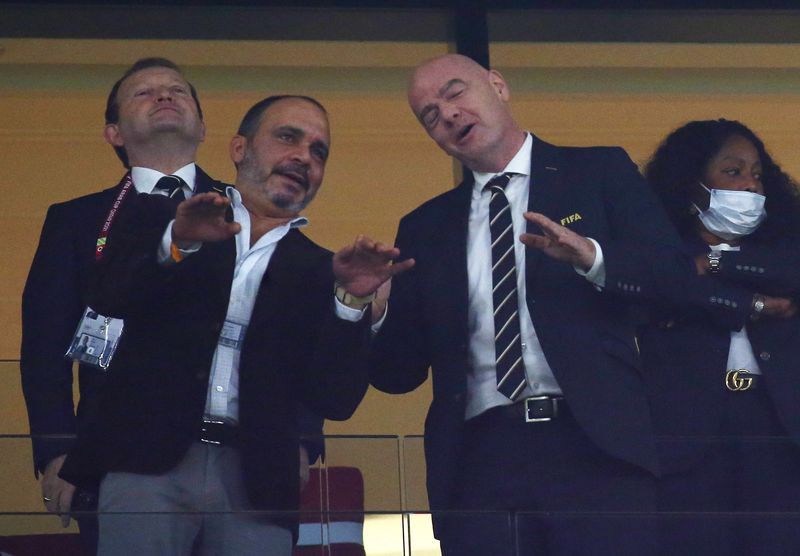
Jordan's players and coaching staff have finally collected outstanding payments for their participation in December's Arab Cup tournament, eight months after the competition concluded. The long-delayed transfer came just two days after Prince Ali bin Hussein, president of the Jordan Football Association, made pointed accusations that FIFA had weaponised financial assistance, effectively holding the kingdom's football development hostage in exchange for political support ahead of the world body's leadership elections.
Prince Ali's decision to speak publicly about the payment freeze marks a significant escalation in the simmering discontent among confederation leaders towards FIFA President Gianni Infantino. The timing is strategically important: Infantino has faced mounting internal pressure following his controversial proposal to partially privatise World Cup commercial rights, a scheme that sparked such widespread opposition from national associations and continental bodies that he quietly abandoned it before a crisis meeting in Morocco. By highlighting the eight-month payment delay immediately after FIFA's apparent capitulation on the World Cup sale, Prince Ali has effectively framed the organization's leadership as both incompetent and ethically compromised.
The broader context reveals a troubling pattern within FIFA's institutional culture. According to Prince Ali's account, FIFA officials verbally proposed during the World Cup tournament that his endorsement of Infantino "would go a long way to helping our FA out." This alleged quid pro quo arrangement—linking concrete financial support to political backing—undermines FIFA's foundational governance principles and raises uncomfortable questions about how many other national associations may have experienced similar pressure. For a Malaysian readership familiar with regional governance challenges, the parallel to conditional aid and political horse-trading will resonate sharply as a recognisable dysfunction in international institutional management.
Jordan's specific grievance centres on prize money that should have been distributed in December but remained unpaid through the following eight months. This was not discretionary funding or sponsorship revenue that could reasonably be delayed; it represented contractual obligation to players and staff whose participation in an official FIFA tournament generated income that the global body committed to distribute. The extended delay inevitably creates hardship for individual athletes and their families while simultaneously serving as a pressure point against the national association leadership. From a Southeast Asian perspective, this illustrates how FIFA's operational challenges directly affect individual athletes across member nations, not merely institutional relationships.
Prince Ali's public statement accepting the money while simultaneously renouncing any shift in his position demonstrates a calculated diplomatic move. By emphasizing that the payment does not alter his assessment of FIFA's leadership or his refusal to endorse Infantino, he neutralises any suggestion that FIFA has successfully applied leverage through finally releasing the funds. This rhetorical stance also signals to other confederation leaders that accepting long-overdue payments should not be construed as forgiveness for governance failures or implicit consent to FIFA's strategic direction. The message is clear: Jordan accepts what was contractually owed, but refuses to become complicit in validating FIFA's institutional problems.
The crisis meeting in Morocco represented a turning point in FIFA's internal politics. After the World Cup commercialisation proposal collapsed under confederation pressure, the organization's leadership held damage-control discussions with member associations. FIFA formally apologised for "mistakes made" regarding the abandoned commercial scheme, though notably stopped short of addressing the governance questions raised by its conception and sudden reversal. The fact that FIFA simultaneously reaffirmed support for Infantino despite these acknowledged mistakes suggests the organization's power structure remains largely intact despite external criticism. This pattern—apologising for specific tactical errors while maintaining strategic direction and leadership—offers only symbolic rather than substantive reform.
For Malaysian football administrators and observers, Prince Ali's willingness to publicly challenge FIFA's leadership carries particular significance. Malaysia participates in AFC competitions and World Cup qualifying tournaments under FIFA's regulatory framework, making the health of FIFA's governance structures directly relevant to Malaysian football's development and investment opportunities. If FIFA's leadership continues operating through pressure tactics and conditional resource allocation, it undermines the meritocratic competition and transparent governance that should characterise international sports administration. The precedent established through this dispute will influence how national associations throughout Asia and Africa interact with FIFA during future disputes over payments, tournament allocation, and competitive structures.
Prince Ali's reference to FIFA's leadership problems being "usually linked to the FIFA presidential elections" points to a structural dysfunction within the organization. The apparent correlation between financial pressure and electoral strategy suggests that FIFA's institutional priorities become distorted during competitive races for the presidency. This pattern has emerged across multiple Infantino election cycles, creating an environment where operational excellence and transparent governance take secondary priority to coalition-building and internal political positioning. For regional stakeholders, this institutional instability creates uncertainty about FIFA's reliability as a neutral arbiter of international football governance.
The Jordan episode also illuminates FIFA's inconsistent application of its own governance standards. While the organization has invested considerable resources in anti-corruption initiatives, integrity commissions, and governance reforms, it simultaneously appears capable of deploying financial leverage against member associations for political purposes. This contradiction between FIFA's stated governance commitments and its apparent operational practices suggests that institutional reform remains superficial rather than transformative. True governance improvement would require mechanisms preventing leadership from instrumentalising tournament payments as political tools, yet no such protections appear evident in FIFA's current operational framework.
Looking ahead, the presidential election dynamics will likely intensify these tensions. Member associations throughout Asia, Africa, and other regions will increasingly scrutinise FIFA's commitment to transparent resource distribution and operational fairness. The Jordan situation has essentially provided a public roadmap for other associations experiencing similar leverage: documentation and public articulation of governance failures can generate sufficient reputational pressure to force compliance with contractual obligations. This emerging dynamic could fundamentally alter FIFA's internal politics, as associations become less susceptible to quiet pressure and more willing to publicly challenge institutional problems.
Fundamentally, the resolution of Jordan's payment dispute should not obscure the deeper institutional questions it raised. FIFA's apparent willingness to withhold contractual payments in exchange for political support represents a governance failure that transcends any single nation's interests. For Malaysian football stakeholders, the broader lesson is clear: FIFA's institutional health directly affects opportunities and resources available to member associations throughout Southeast Asia. Sustained pressure for genuine governance reform—not merely tactical apologies or delayed payment resolution—will remain essential as FIFA navigates increasingly contentious leadership elections and faces growing skepticism from regional confederations.

