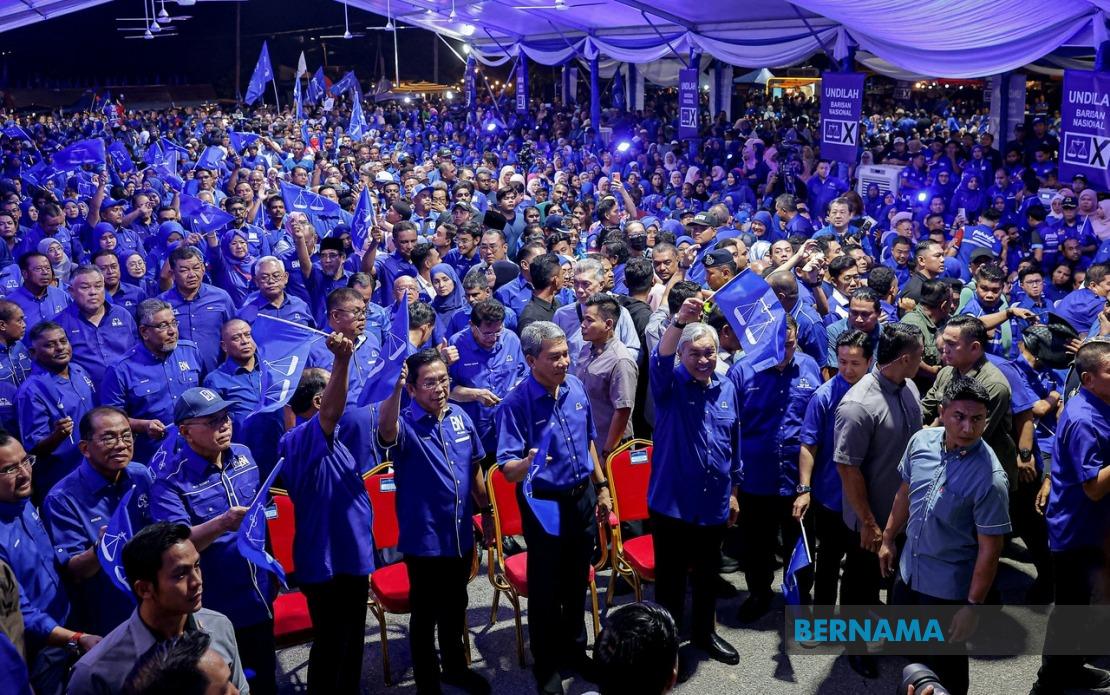
Barisan Nasional's commanding performance in the recent Johor state election should energize the coalition's efforts to capture the Negeri Sembilan state assembly, according to BN chairman Datuk Seri Dr Ahmad Zahid Hamidi. Speaking at the launch of BN's campaign machinery and candidate announcement ceremony in Paroi on July 15, Ahmad Zahid presented the Johor results as a template for electoral success and a demonstration of public appetite for stable, growth-oriented governance. The Deputy Prime Minister stressed that reclaiming Negeri Sembilan depends on translating this momentum into sustained ground-level activity, with party members conducting systematic voter outreach and building broader support networks across constituencies.
The Johor victory delivered remarkable numbers that underscore BN's renewed electoral appeal in the state. The coalition secured 48 of the 56 state seats and garnered nearly 60 per cent of the popular vote—figures the BN leadership has characterized as the coalition's largest triumph in Johor's electoral history. For Malaysian political observers, this result marks a significant recovery for BN following setbacks in previous general elections, suggesting that strategic repositioning and messaging around economic competence and administrative capacity can restore voter confidence. The scale of the Johor win provides empirical evidence that BN, despite its complex history and internal divisions, remains a formidable electoral force when organizational discipline and messaging alignment are achieved.
Ahmad Zahid attributed Johor's success to internal cohesion within the BN family, highlighting how coalition members operated as a unified force built on mutual trust and complementary contributions. He presented this formula as directly applicable to the Negeri Sembilan contest, arguing that the same principles of unity, subordination of individual interests to collective goals, and synchronized campaign efforts would yield comparable results. This framing carries particular significance in Malaysian politics, where coalition stability and internal coordination often prove decisive in determining electoral outcomes. The emphasis on moving beyond factional tensions and candidacy disputes to focus on broader institutional objectives reflects lessons BN leadership has absorbed from previous campaigns where internal wrangling undermined campaign effectiveness.
The party chairman issued explicit guidance to BN members regarding the balance between candidacy considerations and electoral obligations. He cautioned against allowing the competitive dynamics of candidate selection to divert attention or energy from the core mission of securing voter support and winning seats. This directive addresses a recurring challenge within BN—the tendency for internal power struggles over selection processes to fragment campaign momentum and alienate party members who feel sidelined. By framing candidacy as subordinate to the collective interest in victory, Ahmad Zahid attempted to reorient internal party culture toward prioritizing electoral success over personal advancement. For constituencies across Negeri Sembilan, this message sought to ensure that campaign machinery remained engaged and motivated regardless of which faction's preferred candidate ultimately received nomination.
Negeri Sembilan's electoral significance extends beyond its 36 state assembly seats. The state represents a critical testing ground for BN's ability to rebuild support in regions where it faced deterioration following 2018 and maintained only moderate strength during the 2023 state election, when the coalition won 14 seats. A substantial gains in Negeri Sembilan would reinforce BN's narrative of recovery and position the coalition favorably ahead of future national-level contests. Conversely, stagnation or losses would suggest that the Johor breakthrough represents a localized phenomenon rather than broader realignment. The state's political composition—with significant Malay-Muslim populations alongside Indian and Chinese communities—makes it representative of Malaysia's broader electoral demographics and thus an instructive measure of BN's appeal across different demographic segments.
The Election Commission's timeline for the Negeri Sembilan election compresses the campaign schedule substantially. With nomination day scheduled for July 22, early voting on July 28, and polling on August 1, candidates and party machinery have roughly two weeks to conduct intensive campaign activities. This compressed schedule favors well-organized parties with established grassroots infrastructure and rapid decision-making capacity—advantages BN traditionally possesses. The tight timeframe also means that any internal coordination failures or messaging confusion could disproportionately damage campaign effectiveness. Ahmad Zahid's emphasis on immediate ground-level action reflects awareness that delayed campaign launches or lingering candidate selection controversies could consume precious campaign time without translating into voter contact.
The presence of BN deputy chairman Datuk Seri Mohamad Hasan and other coalition leaders at the Paroi ceremony underscored organizational commitment to the Negeri Sembilan campaign. Mohamad Hasan, who holds significant influence within UMNO and has demonstrated electoral acumen, signals BN's intent to deploy senior leadership capacity toward the campaign. The gathering at Tuanku Abdul Rahman Stadium, a venue chosen to convey organizational scale and momentum, served as public demonstration of coalition readiness. For stakeholders observing BN's operational capacity, such displays of leadership coordination and turnout provide reassurance regarding institutional coherence—a factor that influences voter perceptions of party viability and governance capability.
The messaging strategy Ahmad Zahid articulated emphasizes BN's capacity to deliver political stability, facilitate economic development, and administer government responsibly. This framing appeals to voters prioritizing tangible outcomes—employment, infrastructure, public services—over ideological positioning or reform agendas. In Malaysian political discourse, emphasis on administrative competence and economic performance typically resonates strongly with middle-class and business-oriented constituencies, as well as voters in regions dependent on state government contracts and development spending. By anchoring the BN appeal to these instrumental concerns rather than broader political themes, the party targets voters motivated by material interest in continued coalition governance rather than partisan loyalty.
For regional observers, Negeri Sembilan's election outcome carries implications extending beyond state-level politics. Malaysia's federal structure creates interdependencies between state governments and national policy implementation, particularly regarding economic development incentives, infrastructure investment, and revenue-sharing arrangements. A BN victory in Negeri Sembilan would strengthen the coalition's control over state governments and reinforce its position in national political dynamics. Conversely, opposition gains would reduce BN's territorial dominance and potentially shift momentum toward competing coalitions. In this context, Ahmad Zahid's mobilization of BN resources and leadership attention toward Negeri Sembilan reflects strategic calculations about the state's significance within broader political competition and coalition building.
The campaign's success ultimately depends on whether BN's organizational machinery can sustain the intensity and coordination Ahmad Zahid advocated during the compressed two-week campaign period. Voter engagement at the door-to-door level requires sustained volunteer effort, clear messaging discipline across candidates and party representatives, and rapid response capabilities to opposition campaigns and emerging political developments. BN's historical strength in organizational capacity provides grounds for confidence, yet the party's previous electoral disappointments demonstrate that superior organization alone cannot guarantee outcomes if voters perceive governance failures, corruption concerns, or loss of public confidence in leadership competence. The Johor victory suggests that voters remain responsive to BN's appeal, but whether this sentiment extends to Negeri Sembilan's specific political circumstances and local voter priorities remains uncertain until ballots are cast on August 1.

