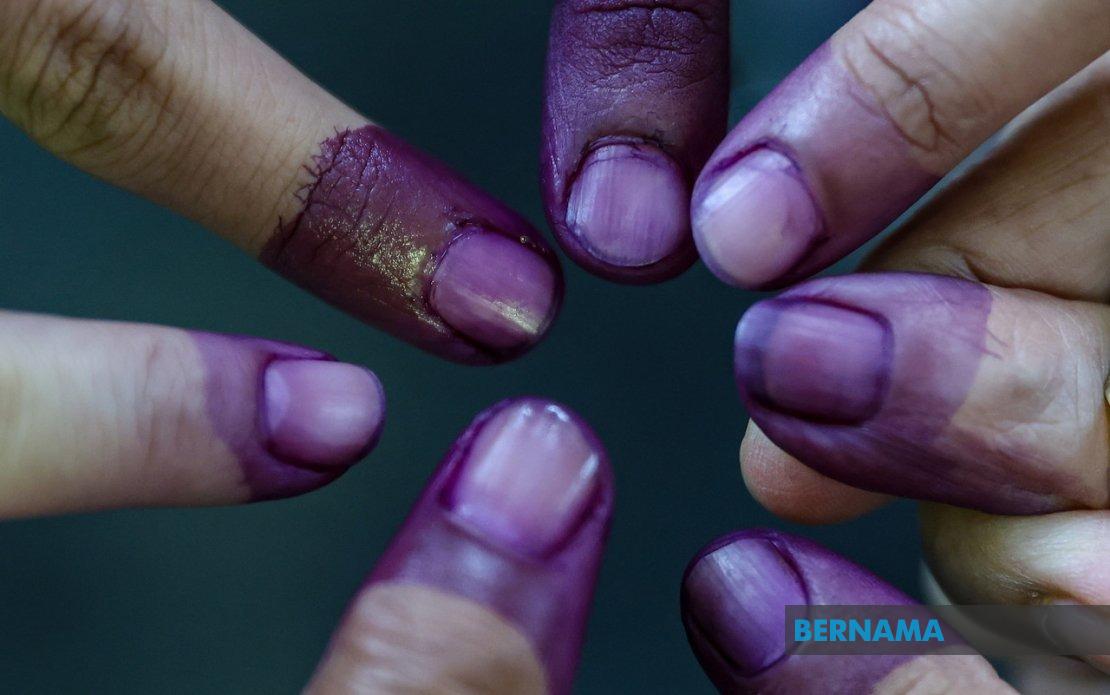
As Johor residents lined up at polling stations for the 16th state election on July 11, the purple indelible ink marking their participation in the democratic process became an unexpected passport to culinary rewards across the state. What began as a safeguarding measure against electoral fraud has evolved into a symbol of civic virtue worthy of commercial recognition, with major food and beverage operators joining in to celebrate voter turnout.
The practice of using indelible ink to prevent multiple voting was introduced by the Election Commission in 2013 during the Kuala Besut by-election, a mechanism that has since become standard procedure. Over the past decade, the distinctive purple stain on voters' index fingers has transformed from a purely functional security feature into an emblem of democratic participation that merchants are now eager to acknowledge.
The Coffee Bean & Tea Leaf opened the promotional floodgates with a 20 per cent discount on selected items for customers willing to display their inked finger, though the offer was limited to polling day itself. The strategy reflects broader recognition among retail businesses that election days create opportunities to engage with engaged citizens and build goodwill through reciprocal gestures of appreciation.
Krispy Kreme capitalized on the moment by offering an Original Glazed doughnut for just RM2 to voters showing their ballot mark at participating Johor outlets, with availability dependent on stock levels. The modest price point suggests the promotion was designed as a symbolic gesture rather than a profit-maximizing exercise, positioning the brand as supportive of electoral participation.
Burger King extended its recognition period by one day, providing complimentary Soft Serve Cone ice cream with any set meal purchase through July 12, acknowledging that not all voters would visit establishments on the actual polling day. This temporal flexibility demonstrates how chains adapted promotional mechanics to accommodate real-world voting patterns and shopping behaviours.
Marrybrown similarly contributed to the festivities by bundling one free piece of fried chicken with any MB Combo when customers presented their indelible mark, adding tangible value to the promotional offering. The participation of these diverse franchises—spanning coffee culture, doughnuts, burgers, and chicken—suggests coordination or at least a shared understanding that election day presented a unique marketing opportunity.
The phenomenon gained traction through social media channels as voters documented their post-ballot reward visits throughout the morning and afternoon. Images of inked fingers alongside promotional items circulated widely, creating organic amplification of the campaign messaging and effectively crowdsourcing brand visibility among politically engaged demographics. This user-generated content proved more authentic and compelling than traditional advertising would have been.
Beyond their commercial dimensions, these promotions served a more subtle social function. The modest value of each offer—ranging from RM2 doughnuts to free ice cream cones—suggests the intent was recognition rather than incentivization. They provided tangible acknowledgment that voting constitutes participation worthy of appreciation, fostering a positive emotional association between civic duty and community recognition during an occasion that, while important, can sometimes feel burdensome or tedious to voters.
The 16th Johor state election drew more than 2.6 million eligible voters to the polls to select representatives for 56 seats in the State Legislative Assembly. A competitive field of 172 candidates fielded by eight different political groupings—Pakatan Harapan and Barisan Nasional each fielding 56, Perikatan Nasional with 33, Parti Bersama Malaysia with 15, and smaller contenders including MUDA with four candidates—ensured a diverse range of political perspectives and constituencies were represented on the ballot.
For Malaysian readers, the Johor election represents a significant bellwether for national political sentiment, with the state's strategic importance as a commercial hub and population centre making its electoral outcome particularly consequential for federal calculations. The alignment of food industry players with voter recognition efforts may also reflect business community interest in demonstrating civic support for orderly, high-turnout elections that signal economic stability and social cohesion.
The creative use of election-day promotions illustrates how commercial interests and democratic processes can intersect constructively, transforming a civic obligation into a community celebration. Rather than the transactional framing that sometimes dominates discussions of voter engagement—where incentives are deployed to boost turnout—Johor's food sector framed its offers as appreciation for those who had already chosen to participate. This distinction, subtle yet meaningful, reframes voting as an act deserving recognition rather than bribery.
The precedent established by these promotions may influence how future elections in Malaysia and the region are experienced by voters. If other states and federal elections adopt similar models, the indelible ink could become more closely associated with tangible community appreciation than with security measures alone. This cultural shift would reflect growing sophistication in how democracies can celebrate participation while maintaining electoral integrity.

