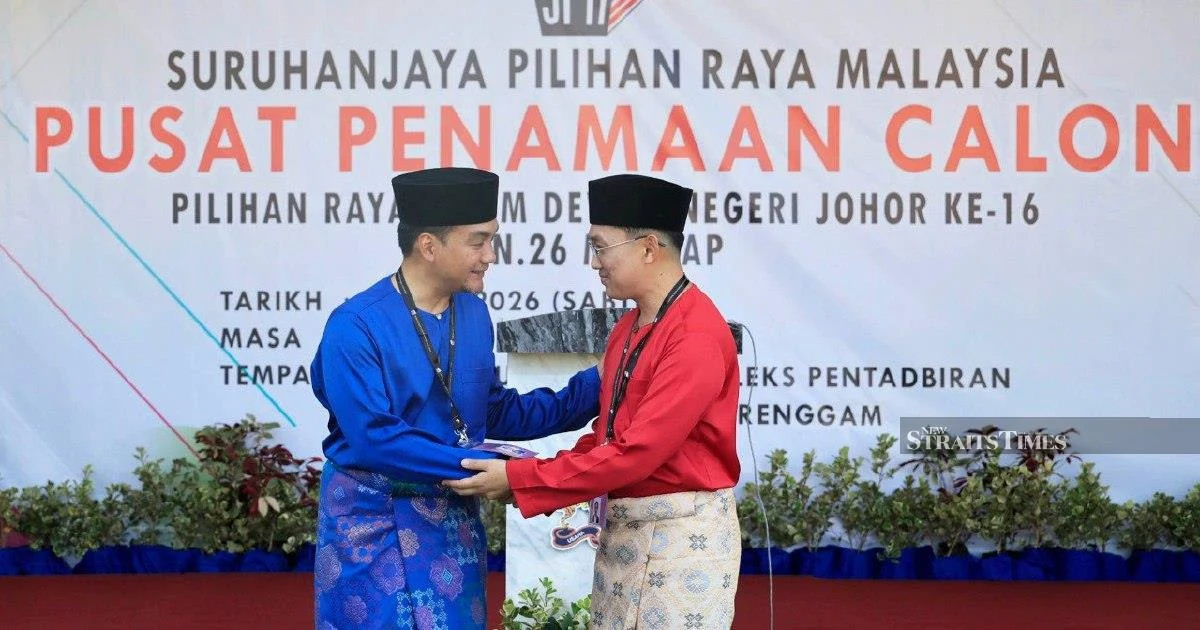
Datuk Onn Hafiz Ghazi, who currently holds the position of Menteri Besar in a caretaker capacity, has signalled that he views the forthcoming Johor state election scheduled for July 11 as wide open despite his ambitions to secure another term in office. Speaking in Simpang Renggam, the Barisan Nasional-aligned political figure acknowledged that predicting electoral outcomes remains a precarious exercise, emphasising that conventional wisdom frequently proves unreliable when voters cast their ballots.
The Machap constituency has emerged as a focal point of attention during this election cycle, representing one of several competitive battlegrounds that will determine the composition of the state assembly. Rather than displaying the confidence often associated with incumbent administrations seeking renewal, Onn Hafiz adopted a more measured tone, reflecting the underlying tensions and uncertainties that characterise contemporary Malaysian electoral politics. This posture suggests an awareness that regional dynamics have shifted considerably since the last general election, with voters demonstrating a willingness to punish perceived underperformance or mismanagement.
Johor's political landscape has undergone substantial transformation over the past several years, with multiple changes in leadership and shifting coalitions creating an environment where traditional voting patterns have become less predictable. The state's electorate has shown an increasing propensity to evaluate governance records critically, and candidates cannot rely solely on party machinery or historical voting blocs to secure victory. This reality has prompted political leaders across the spectrum to intensify grassroots engagement and address specific constituency concerns with greater urgency.
The caretaker Menteri Besar's willingness to publicly acknowledge electoral uncertainty carries strategic implications for Barisan Nasional's broader campaign messaging in the state. By tempering expectations and avoiding overconfident declarations, Onn Hafiz may be attempting to galvanise party supporters into more active campaigning rather than assuming victory is assured. This approach recognises that complacency has historically disadvantaged ruling parties in Malaysian elections, particularly when opposition movements successfully mobilise their voter bases.
Machap's specific context adds another layer of complexity to the electoral equation. The constituency encompasses diverse demographic segments with varying policy priorities, ranging from urban commercial interests to rural agricultural concerns. Candidates seeking representation must demonstrate understanding of these multifaceted needs while articulating credible proposals for addressing longstanding infrastructure and economic development gaps. The level of engagement demonstrated by competing parties in this area will significantly influence the final outcome.
Johor's importance within Malaysia's broader political ecosystem extends beyond the state itself. The state's electoral outcome carries implications for national coalition dynamics, particularly regarding the relative strength of different components within the Barisan Nasional umbrella. A strong performance enhances the coalition's claim to effective governance and stable administration, while a diminished result would require introspection regarding campaign strategy, candidate selection, and policy responsiveness to public demands.
The July 11 election date itself reflects careful planning, as the timing avoids major religious and cultural observances while allowing campaigning during a period when political activity typically intensifies statewide. Voters will have had adequate opportunity to assess the outgoing administration's performance across multiple policy domains, including education, healthcare, agriculture, and industrial development. These evaluations will undoubtedly influence electoral calculations alongside partisan considerations and individual candidate credibility.
Onn Hafiz's background as both administrator and political operator should inform his strategic approach during the campaigning period. Previous experience navigating Johor's competitive political environment has equipped him with insights into voter behaviour patterns and the specific grievances that mobilise electoral coalitions. Nevertheless, as he himself appears to acknowledge, historical precedent provides limited guarantee of future outcomes, particularly in an era of rapid information dissemination and shifting public priorities.
The broader context of Malaysian federalism also intersects with this state election. Johor's governance record contributes to national perceptions regarding BN's administrative competence and commitment to development priorities. Economic performance, fiscal management, and service delivery standards directly influence how voters assess their elected representatives. An administration perceived as responsive, transparent, and genuinely focused on constituent welfare maintains stronger electoral appeal regardless of partisan affiliation.
For opposition parties competing in Johor, the electoral opportunity presents both advantages and challenges. Public dissatisfaction with specific policy outcomes can be leveraged into electoral support, but sustained organisational weakness continues to hamper the effectiveness of alternative coalitions. The fragmentation that characterises Malaysian opposition politics generally affects Johor specifically, potentially benefiting an incumbent administration facing a divided challenge from multiple political quarters.
As the campaign intensifies, individual candidates will increasingly take centre stage alongside broader party narratives. Machap voters, like those across Johor, will evaluate not merely partisan arguments but the personal qualities, local engagement records, and future commitment demonstrated by those seeking representation. The electorate's demonstrated capacity to evaluate such factors independently of party endorsements underscores why Onn Hafiz's caution regarding electoral unpredictability reflects realistic political assessment rather than mere rhetorical modesty.

