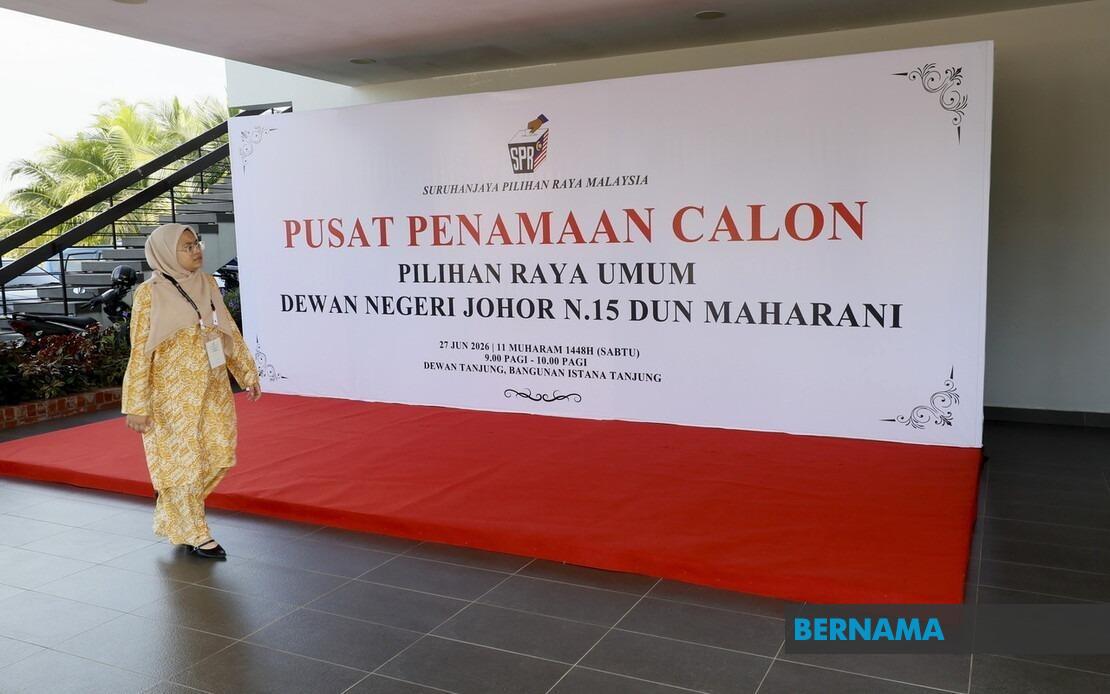
The 16th Johor State Election formally commenced today, marking the beginning of what is expected to be a competitive and closely watched contest in one of Malaysia's most important electoral battlegrounds. Across the state, 56 nomination centres opened their doors from 9 am to receive nomination papers from prospective candidates, with a strict one-hour window extending until 10 am for submission to Returning Officers. This compressed timeframe, a standard feature of Malaysian elections, ensures that the process moves swiftly while maintaining order and clarity about which candidates will ultimately be eligible to contest.
The nomination process represents far more than mere administrative formality in the Malaysian electoral calendar. It serves as the formal gateway through which political parties transform their internal selections into official candidacy, and it traditionally draws vibrant scenes of party activism and public engagement. Supporters of various political movements gather early at nomination centres to demonstrate enthusiasm for their chosen representatives, creating visible displays of political commitment that often generate significant public interest and media coverage. For voters, nomination day offers a preview of the political landscape they will navigate during the campaign period and ultimately on polling day.
As candidates submitted their nomination forms, the Election Commission revealed that substantial groundwork had already occurred in the lead-up to today. By yesterday morning, a total of 593 nomination forms had been distributed to prospective candidates, while 133 candidates had already paid their required election deposits, signalling their firm intention to contest. These figures provide an early indicator of the level of competition expected across the 56 state seats, with multiple parties preparing to field candidates in nearly all constituencies. The readiness displayed by candidates reflects weeks of internal party deliberations, candidate selection processes, and strategic positioning ahead of the formal nomination period.
Following today's nomination close and official announcement of eligible candidates, a intensive 14-day campaign period will commence, running until 11.59 pm on July 10. This fortnight represents the critical window during which political parties mobilise supporters, articulate their visions for Johor's future, and attempt to persuade voters of their suitability to govern. The campaign landscape in Johor carries particular significance for Malaysia's broader political trajectory, given the state's status as an economic powerhouse and its historical importance as a political bellwether. The stakes for the major coalitions—Pakatan Harapan, Barisan Nasional, and Perikatan Nasional—are substantial, as control of the state assembly holds implications extending beyond Johor's borders.
The contest will unfold across a voter base of considerable size and diversity. According to the Election Commission, 2,727,926 registered voters are eligible to participate, comprising 2,703,175 ordinary voters alongside 12,041 military personnel and their spouses and 12,710 police personnel and their spouses. This electorate encompasses urban professionals in Johor Bahru and Iskandar Puteri, industrial workers across the state's manufacturing corridors, rural communities in the interior, as well as significant populations from Indian and Chinese ethnic backgrounds. Understanding and appealing to this diverse coalition remains central to each political coalition's strategy for securing victory.
The electoral battlefield will feature an unusually wide array of competing political forces. Pakatan Harapan is mounting a comprehensive challenge by contesting all 56 seats through a tripartite arrangement comprising PKR (fielding 20 candidates), Amanah (19 candidates), and DAP (17 candidates). Barisan Nasional, the incumbent coalition holding 40 seats before the assembly's dissolution on June 1, is likewise contesting comprehensively through UMNO (36 seats), MCA (16 seats), and MIC (four seats). This represents a traditional confrontation between two established coalitions with deep organisational roots and substantial resources. However, the electoral configuration has become substantially more complicated by the emergence of additional political forces, fundamentally altering the competitive dynamics.
Perikatan Nasional adds considerable complexity to the contest by contesting through multiple vehicles: PAS will field candidates in 11 seats, Bersatu in 16 seats, the Malaysian Indian People's Party in five seats, and Pejuang in a single seat. Beyond these established coalitions, several other parties are contesting seats, including MUDA (four seats), the Parti Sosialis Malaysia (one candidate), and notably, Parti Bersama Malaysia, which is making its electoral debut by contesting 15 seats. This fragmentation of the political landscape means that in many constituencies, voters will encounter contests involving five or more candidates from different parties, potentially reshaping traditional voting patterns and creating unpredictable outcomes in previously safe seats.
To maintain order and security throughout the nomination process, substantial state resources have been mobilised. The Election Commission has issued detailed reminders to all candidates and their supporters regarding compliance with the Election Offences Act 1954 and relevant local authority regulations, with particular emphasis on restrictions governing the use of musical instruments and vehicle-mounted loudspeakers during campaign activities. Meanwhile, the police force has deployed 4,832 personnel throughout Johor to ensure security and manage traffic flow, with particular attention to 19 major roads near nomination centres that will experience temporary closures and diversions. This security presence reflects authorities' commitment to maintaining electoral integrity while facilitating the democratic process.
Weather conditions are expected to influence the logistics of nomination day, with the Malaysian Meteorological Department forecasting rain in several parts of Johor during morning hours, followed by thunderstorms in the afternoon. These conditions, while potentially affecting turnout and the comfort of supporters gathering at nomination centres, are unlikely to disrupt the formal nomination process itself. Election officials have adapted their operations to accommodate such contingencies, and the nomination period's fixed timing ensures that weather-related delays do not extend beyond the allocated one-hour window.
The official electoral calendar now stretches clearly before voters and political participants. Early voting is scheduled for July 7, accommodating those unable to vote on the main polling day, while the decisive moment arrives on July 11, when Johor voters will determine the composition of their state assembly for the next term. The dissolution of the previous assembly on June 1 initiated this electoral process, and the subsequent weeks have witnessed intensive behind-the-scenes preparation by political parties across the spectrum. Today's nomination process represents the public commencement of a democratic exercise that will shape governance in one of Malaysia's most significant states for years to come. The results will ripple through Johor's economy, development priorities, and social policies, while simultaneously providing important indicators for Malaysia's broader political landscape and the balance of power between competing national coalitions.

